
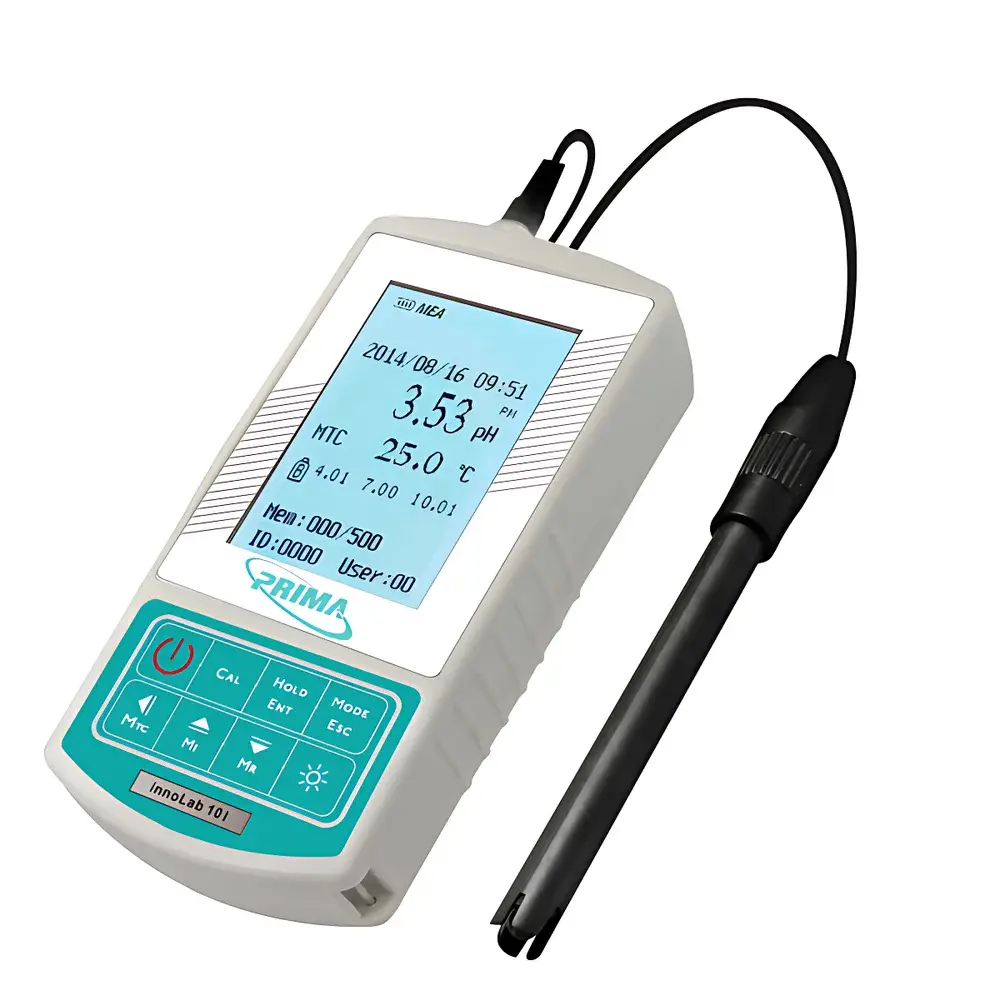
PRIMA innoLab 10I Portable Ion Concentration Meter (Fluoride, Sodium, Chloride, Bromide, Potassium)
| Brand | PRIMA (UK) |
|---|---|
| Origin | Taiwan |
| Model | innoLab 10I |
| Instrument Type | Portable/Handheld Water Quality Analyzer |
| Measurable Ions | F⁻, Na⁺, Cl⁻, Br⁻, K⁺ |
| pH Range | −2.000–20.000 |
| mV Range | −2000.0–2000.0 mV |
| Ion Concentration Range | 0.000–9999 mg/L |
| Resolution (ION) | 0.001 mg/L (dependent on concentration) |
| Accuracy (ION) | ±0.5% F.S. ±3 LSD |
| Temperature Range | −10.0–120.0 °C |
| Temp. Accuracy | ±0.3 °C |
| Calibration | Up to 7-point ISE calibration |
| Memory Capacity | 1000 data sets (pH: 500, mV: 250, ION: 250) |
| Interface | USB |
| Power | 100–240 VAC adapter |
| Dimensions | 150 × 194 × 56 mm |
| Weight | 1.0 kg |
| Electrode Interface | BNC |
| Compatible ISEs | Epoxy/PVC/Teflon-body gel-filled or glass electrodes (e.g., IS-FLS, IS-NaLS, IS-ClLS, IS-BrLS, IS-KLS) |
Overview
The PRIMA innoLab 10I is a field-deployable, multi-parameter ion concentration meter engineered for reliable, trace-level quantification of key anions and cations—including fluoride (F⁻), sodium (Na⁺), chloride (Cl⁻), bromide (Br⁻), and potassium (K⁺)—in aqueous environmental and process water samples. Based on potentiometric measurement principles using ion-selective electrodes (ISEs), the instrument operates via the Nernst equation, converting electrode potential (mV) into concentration values (mg/L or ppm) with high reproducibility and minimal drift. Its design adheres to fundamental electrochemical metrology standards, supporting both direct concentration readout and slope-based calibration verification. Unlike benchtop-only systems, the innoLab 10I integrates ruggedized hardware with laboratory-grade analytical functionality—making it suitable for routine field surveys, wastewater compliance checks, drinking water safety verification, and educational fieldwork where portability and regulatory traceability are essential.
Key Features
- Multi-ion capability with dedicated calibration protocols for up to seven standard points per ion species—enabling robust calibration curves and improved low-concentration accuracy.
- High-resolution display (dot-matrix LCD with adjustable backlight) supports simultaneous parameter viewing and intuitive navigation via tactile, scratch-resistant membrane keys.
- User-configurable stability criteria: three-tier response time settings allow operators to define acceptable signal convergence thresholds before auto-logging.
- Comprehensive calibration management: stores date-stamped calibration records—including slope (mV/decade), offset, and R² values—for each ion mode, facilitating GLP-compliant audit trails.
- Programmable calibration reminders (0–60 days) and password-protected configuration menus ensure procedural consistency across multiple users and shifts.
- USB interface enables secure data export to Windows-based software for post-acquisition analysis, report generation, and long-term trend evaluation.
- Temperature compensation support (automatic or manual) with ±0.3 °C accuracy ensures thermally corrected readings across −10.0 to 120.0 °C—critical for field measurements subject to ambient fluctuations.
Sample Compatibility & Compliance
The innoLab 10I is compatible with a wide range of commercially available ISEs—including PRIMA’s IS-FLS (fluoride), IS-NaLS (sodium glass), IS-ClLS (chloride), IS-BrLS (bromide), and IS-KLS (potassium) electrodes—each certified for specified pH and temperature windows per ISO 7870-2 and ASTM D6919 guidelines. Sample matrices include raw surface water, treated effluent, groundwater, and potable distribution system taps. The instrument meets general requirements for field-portable analyzers under EPA Method 300.0 (for anions) and USP (for pharmaceutical water testing). While not intrinsically certified for hazardous locations, its IP-rated enclosure (IEC 60529 equivalent Class II) provides protection against dust and incidental moisture during outdoor deployment.
Software & Data Management
Data acquisition and archival are supported through PRIMA’s proprietary PC software, which facilitates bidirectional communication via USB. The software logs metadata—including operator ID, sample ID, timestamp (with user-selectable format), electrode serial number, and calibration history—ensuring full traceability per FDA 21 CFR Part 11 Annex 11 expectations for electronic records. Export options include CSV and PDF formats compatible with LIMS integration. Audit trail functionality records all configuration changes, calibration events, and memory deletions with timestamps and user identifiers—supporting ISO/IEC 17025 internal audits and third-party accreditation reviews.
Applications
- Environmental monitoring: Fluoride screening in groundwater (per WHO guideline value of 1.5 mg/L) and industrial discharge compliance.
- Drinking water utilities: Routine verification of sodium and chloride levels in desalinated or blended supplies.
- Wastewater treatment plants: Tracking bromide and potassium as indicators of upstream contamination or nutrient loading.
- Academic and vocational training: Hands-on instruction in electrochemical sensing, calibration theory, and ion activity versus concentration relationships.
- Food and beverage QA: Monitoring rinse water conductivity contributors (e.g., Na⁺, Cl⁻) in clean-in-place (CIP) validation protocols.
FAQ
What ion-selective electrodes are validated for use with the innoLab 10I?
The instrument is fully compatible with PRIMA’s IS-series ISEs (e.g., IS-FLS, IS-NaLS, IS-ClLS), as well as third-party BNC-interfaced electrodes meeting ISO 11500 specifications for output impedance and reference junction stability.
Does the device support automatic temperature compensation during ion measurements?
Yes—ATC is enabled by default when a compatible temperature probe (e.g., Pt1000 or NTC thermistor) is connected; manual entry is also supported for fixed-temperature applications.
Can calibration data be exported separately from measurement records?
Yes—the PC software allows selective export of calibration logs (including slopes, offsets, and dates) independent of sample datasets, supporting quality assurance documentation workflows.
Is the innoLab 10I compliant with GLP or GMP requirements?
While the hardware itself does not carry formal GLP/GMP certification, its audit-trail-enabled software, password-protected configuration, and timestamped calibration logging align with core GLP principles outlined in OECD Series on Principles of Good Laboratory Practice.
What is the recommended maintenance interval for ISEs used with this meter?
Electrode performance should be verified daily before use via two-point calibration check; gel-filled electrodes typically require replacement every 6–12 months depending on usage frequency and matrix fouling exposure.
Related Products







