
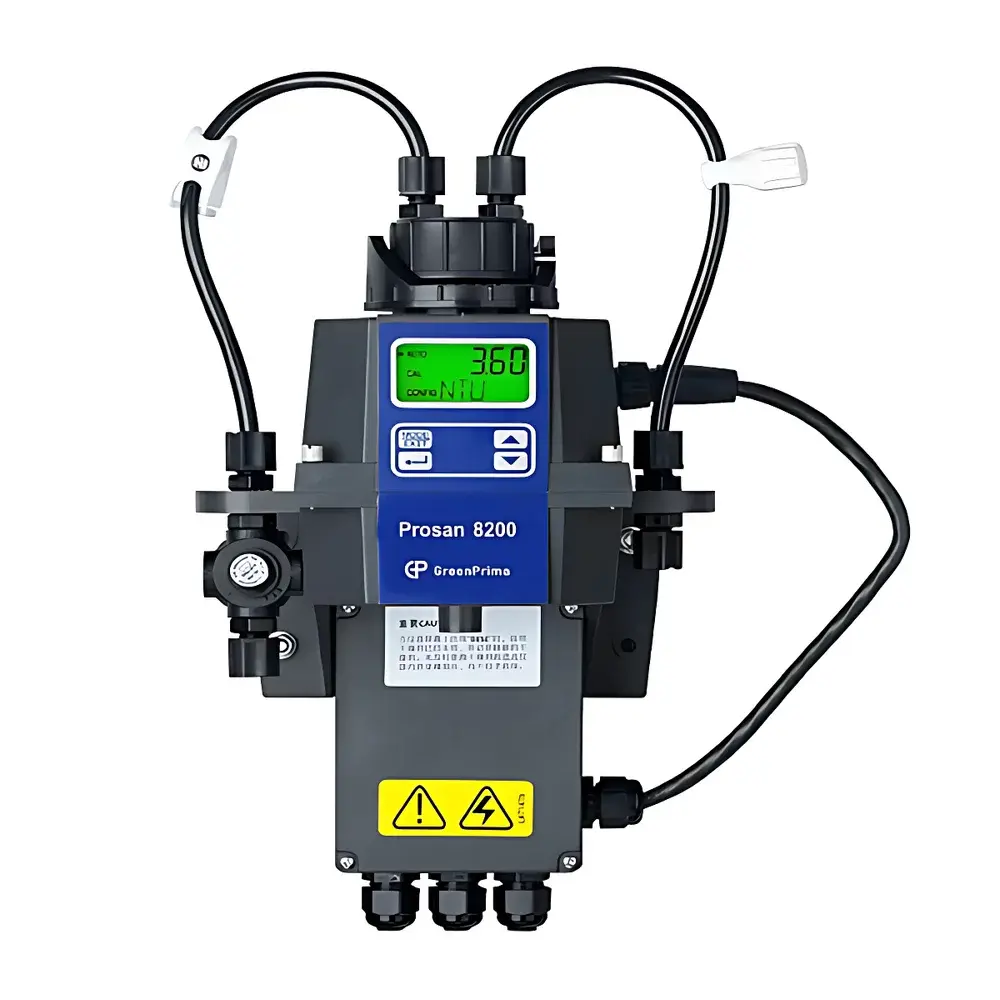
GreenPrima Prosan8200 Inline Turbidimeter
| Brand | GreenPrima |
|---|---|
| Origin | USA |
| Manufacturer Type | Manufacturer |
| Origin Category | Imported |
| Model | Prosan8200 |
| Product Type | Online |
| Measurement Range | 0–1000 NTU |
| Resolution | 0.0001 NTU (adjustable) |
| Operating Temperature | 1–50 °C |
| Accuracy | ±2% of reading or ±0.02 NTU (≤40 NTU) |
| Response Time | 5–500 s (adjustable) |
| Light Source | 850 nm LED (7-year lifetime) |
| Sample Pressure | 1–200 psi (integrated pressure regulator, factory-set to 15 psi) |
| Display | Backlit LCD, multi-line |
| Output Signals | Isolated 4–20 mA or RS-485 (MODBUS RTU protocol, optional) |
| Ingress Protection | IP66 |
| Dimensions | 35 × 30 × 30 cm |
| Weight | 2.5 kg |
| Power Supply | 100–240 VAC |
Overview
The GreenPrima Prosan8200 Inline Turbidimeter is a high-stability, process-integrated optical instrument engineered for continuous, real-time turbidity monitoring in demanding industrial and municipal water applications. Based on the nephelometric principle—measuring scattered light intensity at 90° relative to an 850 nm near-infrared LED source—the Prosan8200 complies with both U.S. EPA Method 180.1 and ISO 7027 standards for turbidity measurement. Its optical path design ensures minimal drift and high reproducibility, while the non-contact optical architecture prevents fouling and eliminates sample-induced degradation of sensor performance. Unlike immersion-type probes, the Prosan8200 employs a true flow-through cuvette configuration, enabling stable laminar flow conditions and consistent light-scattering geometry—critical for regulatory-grade compliance in drinking water distribution, filtration validation, and pharmaceutical water systems.
Key Features
- Integrated desiccant-based moisture removal system with user-replaceable drying cartridges—prevents condensation on optical windows without requiring external purge gas or heated housings.
- Self-contained air-bubble suppression mechanism that actively removes entrained microbubbles from the sample stream while maintaining sub-5-second response latency—no compromise between accuracy and dynamic responsiveness.
- Modular optical assembly with front-access service ports: all critical components—including LED source, photodetector array, and flow cell—are field-replaceable without system shutdown or recalibration.
- Factory-configured pressure regulation (15 psi setpoint) with built-in pressure relief and inlet/outlet isolation valves—ensures safe, stable operation across variable pipeline pressures (1–200 psi).
- Zero-drift calibration routine executed in under 5 minutes using reusable, NIST-traceable calibration standards; no consumable reagents or proprietary kits required.
- Robust IP66-rated enclosure with corrosion-resistant aluminum housing—rated for indoor and outdoor wall-mount installation in humid, chemically aggressive environments.
Sample Compatibility & Compliance
The Prosan8200 is validated for use with potable water, filtered surface water, reverse osmosis permeate, ultrapure water (UPW), and low-turbidity industrial process streams (e.g., boiler feedwater, pharmaceutical WFI, beverage rinse water). It meets the performance criteria specified in ASTM D6508 (Standard Practice for Turbidity Measurements in Water), USP (Turbidity and Clarity), and FDA 21 CFR Part 11 requirements when paired with compliant data logging software. Its 850 nm LED source minimizes interference from coloration and dissolved organics, making it suitable for applications where traditional 400–600 nm white-light turbidimeters exhibit spectral bias. All wetted materials conform to NSF/ANSI Standard 61 and EU Regulation (EC) No. 1935/2004 for food contact safety.
Software & Data Management
The Prosan8200 supports dual communication protocols: isolated 4–20 mA analog output (HART-enabled upon request) and optional MODBUS RTU over RS-485. When integrated into SCADA or DCS platforms, it delivers timestamped turbidity values with configurable averaging intervals (1–300 s), alarm thresholds (high/low/fail), and diagnostic status flags (e.g., low signal, window fouling, desiccant saturation). Optional GreenPrima DataBridge™ software provides audit-trail-enabled data acquisition, automated calibration logging, and electronic signature support per 21 CFR Part 11 Annex 11 guidelines. Raw data export is available in CSV and XML formats, with metadata including instrument ID, firmware version, calibration history, and environmental diagnostics.
Applications
- Municipal water treatment: continuous monitoring of raw intake, coagulation/flocculation effluent, sedimentation basin outflow, rapid sand filter influent/effluent, and finished water before distribution.
- Pharmaceutical manufacturing: real-time verification of purified water (PW) and water for injection (WFI) quality during storage and distribution loops—supporting risk-based validation per ISPE PW/WFI Baseline Guide.
- Food & beverage production: inline control of CIP rinse water clarity, syrup dilution consistency, and final product suspension stability (e.g., fruit pulps, dairy emulsions).
- Power generation: detection of particulate breakthrough in condensate polishing systems and turbine lube oil contamination monitoring (when adapted with appropriate sampling interface).
- Electronics manufacturing: UPW loop surveillance in semiconductor fab facilities—meeting SEMI F63 specifications for particle-related turbidity correlation.
FAQ
Does the Prosan8200 require periodic lamp replacement?
No—the 850 nm LED light source has a rated operational lifetime of ≥50,000 hours (≈7 years at continuous duty), with built-in intensity monitoring to flag luminance decay prior to performance impact.
Can the instrument be calibrated without removing it from the process line?
Yes—calibration is performed in-situ using the integrated flow cell and standard reference suspensions (e.g., Formazin or AMCO AEPA-1); no disassembly or bypass is required.
Is the Prosan8200 compatible with existing PLC-based control systems?
Yes—it natively supports MODBUS RTU over RS-485 and provides isolated 4–20 mA output with HART capability (optional firmware upgrade), enabling seamless integration with Allen-Bradley, Siemens, Schneider, and Yokogawa DCS platforms.
How often must the desiccant cartridge be replaced?
Under typical ambient humidity conditions (40–70% RH), replacement is recommended every 6–12 months; the instrument reports desiccant saturation status via diagnostic register and front-panel indicator.
What maintenance is required beyond desiccant replacement?
Annual inspection of O-rings, cleaning of optical windows with isopropyl alcohol, and verification of pressure regulator function—documented in the included GLP-compliant maintenance log template.





