
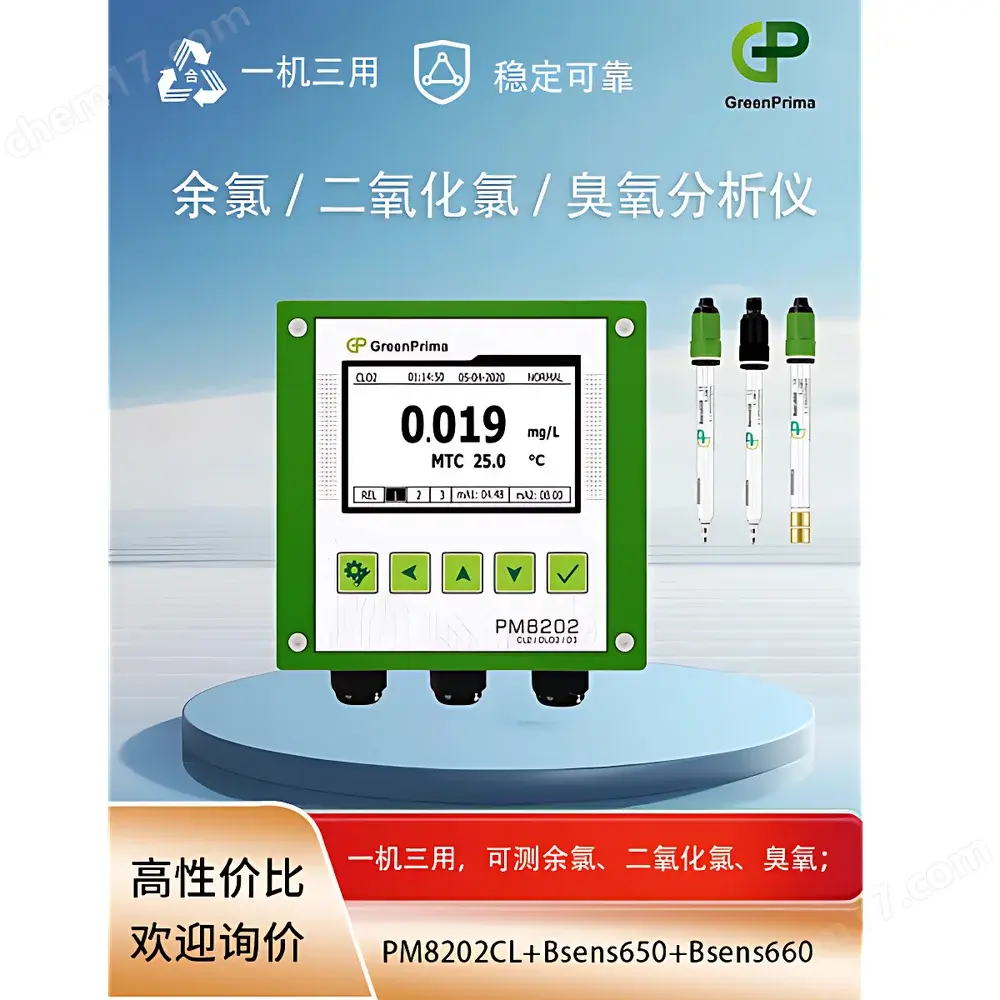
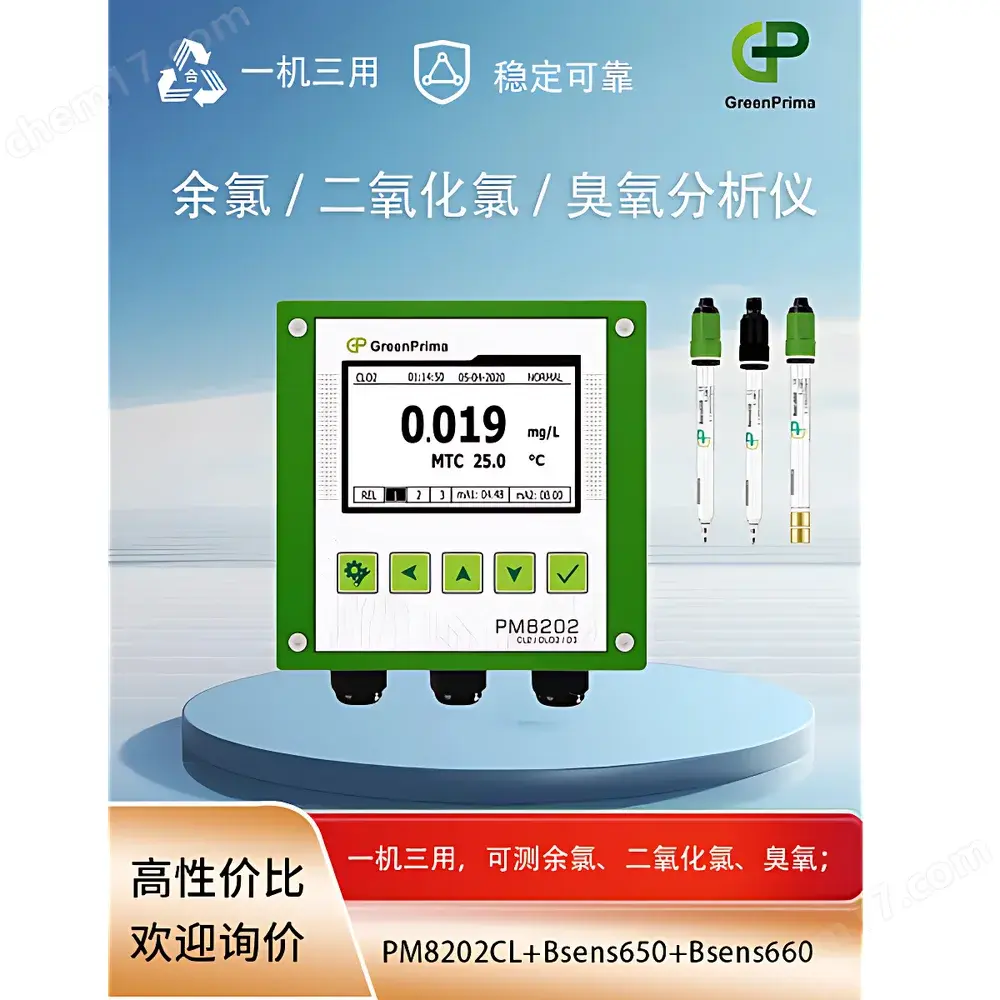
GreenPrima PM8202C-L Residual Chlorine, Chlorine Dioxide and Ozone Analyzer
| Brand | GreenPrima |
|---|---|
| Origin | United Kingdom |
| Manufacturer Type | Original Equipment Manufacturer (OEM) |
| Product Category | Imported Instrument |
| Model | PM8202C-L |
| Instrument Type | Online Analyzer |
| Measurement Principle | Amperometric Detection at Constant Potential (Fixed-Voltage Amperometry) |
| Measured Parameters | Free Chlorine, Total Chlorine, Chlorine Dioxide, Ozone |
| Range | 0.00–20.00 ppm / 0.00–200.00 ppb |
| Accuracy | ±2% of Full Scale |
| Resolution | 0.001 ppm / 0.01 ppm |
| Temperature Compensation | -10 to 130 °C (NTC10K or PT1000 selectable) |
| Operating Temperature | -10 to 70.0 °C |
| Storage Temperature | -20 to 70.0 °C |
| Display | Backlit Graphic LCD (Chinese/English Switchable) |
| Data Storage | 600,000 records |
| Power Supply | 90–260 VAC, 50/60 Hz or 24 VDC optional |
| Output | Dual isolated 4–20 mA (0.1% FS, max. loop resistance 500 Ω) |
| Cleaning Control | Adjustable interval (0.1–1000 h) and duration (1–1000 s) |
| Enclosure Rating | IP65 |
| Dimensions | 144 × 144 × 108 mm |
| Panel Cutout | 138 × 138 mm |
| Weight | 0.87 kg |
Overview
The GreenPrima PM8202C-L is an online amperometric analyzer engineered for continuous, reagent-free measurement of residual chlorine (free and total), chlorine dioxide, and ozone in aqueous systems. It operates on the principle of fixed-voltage amperometry—applying a stable polarizing potential across a dual-platinum (Bsens650) or gold (Bsens660) working electrode assembly immersed in flowing sample water. This electrochemical detection method generates current proportional to oxidant concentration, eliminating dependence on colorimetric chemistry or membrane diffusion kinetics. The integrated BAF615 constant-flow cell ensures laminar, velocity-controlled hydrodynamics—critical for minimizing boundary layer effects and achieving high reproducibility in real-time monitoring. Designed for deployment in dynamic water matrices—including potable water distribution networks, hospital wastewater effluents, secondary water supply systems, and industrial process loops—the PM8202C-L delivers stable, drift-resistant performance without manual calibration intervention over extended operational cycles.
Key Features
- Triple-analyte capability: Simultaneous configuration for residual chlorine, chlorine dioxide, and ozone via electrode selection and software parameterization
- Membrane-free, reagentless operation: No consumable membranes, electrolytes, or chemical reagents required—reducing total cost of ownership and maintenance frequency
- Dual-platinum or gold electrode options: Bsens650 (Pt/Pt) optimized for chlorine stability in chlorinated mains; Bsens660 (Au/Au) preferred for ozone-selective response in low-chlorine, high-oxidant environments
- BAF615 precision flow cell: Maintains consistent sample velocity (±1% repeatability) to ensure electrochemical signal integrity under variable inlet pressure conditions
- Full temperature compensation: Integrated NTC10K or PT1000 sensor support with automatic compensation across -10 to 130 °C—enabling accurate readings in hot water recirculation or chilled process lines
- Robust human-machine interface: Backlit graphic LCD with dual-language (English/Chinese) navigation, password-protected configuration access, and intuitive menu hierarchy
- Industrial-grade I/O architecture: Two isolated 4–20 mA analog outputs (configurable for measured value or temperature), RS485 Modbus RTU for SCADA integration, and three relay outputs (one multifunction, two dedicated alarms)
- Flexible mounting: Field-installable in wall-mounted, panel-cut, or inline pipe configurations—compliant with EN 61000-6-2/6-4 for electromagnetic immunity in utility environments
Sample Compatibility & Compliance
The PM8202C-L is validated for use in non-aggressive aqueous media with pH 4.0–9.0 and turbidity < 5 NTU. It meets CE marking requirements under the EU Electromagnetic Compatibility Directive 2014/30/EU and Low Voltage Directive 2014/35/EU. While not certified to specific drinking water standards (e.g., EPA Method 334.0 or ISO 7393-2), its amperometric methodology aligns with the functional equivalence criteria outlined in ASTM D1253 and EN ISO 10523 for residual disinfectant quantification. Data logging functionality supports GLP-compliant record retention per 21 CFR Part 11 when paired with validated third-party data acquisition systems—audit trails include timestamped measurements, calibration events, alarm triggers, and cleaning actuations.
Software & Data Management
Embedded firmware provides local configuration via keypad or remote setup through Modbus register mapping. All operational parameters—including range scaling, alarm thresholds, relay hysteresis, cleaning schedules, and temperature sensor type—are stored in non-volatile memory. The instrument logs up to 600,000 timestamped records (measurement value, temperature, status flags) with millisecond-resolution timestamps. Data export is supported via Modbus polling or optional USB-to-serial adapter (not included). Firmware updates are performed via secure .bin file upload through the service menu, requiring administrator-level authentication. No cloud connectivity or proprietary software installation is required—integration into existing PLC or DCS platforms is achieved using standard Modbus function codes (03h, 06h, 10h).
Applications
- Municipal drinking water treatment: Real-time monitoring at chlorination contact tanks, clearwells, and distribution system entry points
- Hospital and pharmaceutical facility water systems: Continuous verification of disinfectant residuals in purified water (PW) and water-for-injection (WFI) loops per USP
- Food & beverage processing: Sanitizer concentration control in CIP rinse stages and final product water contact lines
- Swimming pool and spa management: Automated dosing feedback for chlorine and ozone-based oxidation systems
- Industrial cooling tower water: Corrosion-inhibiting oxidant level maintenance compliant with ASHRAE Guideline 12-2020
- Wastewater disinfection: Post-secondary effluent validation prior to environmental discharge per local regulatory limits
FAQ
Does the PM8202C-L require daily calibration?
No. The amperometric sensor exhibits long-term baseline stability. Factory calibration is traceable to NIST-certified standards; field verification is recommended quarterly using certified standard solutions (e.g., potassium iodate for chlorine, indigo trisulfonate for ozone).
Can it distinguish between free and total chlorine?
Yes—when configured with the Bsens650 platinum electrode and operated in sequential measurement mode, the instrument applies timed reagent injection (via external solenoid valve, not included) to convert combined chlorine to free form, enabling differential calculation per Standard Methods 4500-Cl G.
Is the BAF615 flow cell compatible with pressurized pipelines?
Yes. Rated for continuous operation up to 6 bar (87 psi) at 25 °C; includes integral pressure relief and flow straightening vanes to minimize pulsation-induced signal noise.
What maintenance intervals are recommended?
Electrode polishing every 6–12 months depending on water hardness and organic load; annual verification of temperature sensor accuracy; routine inspection of flow cell gaskets and tubing for degradation.







