
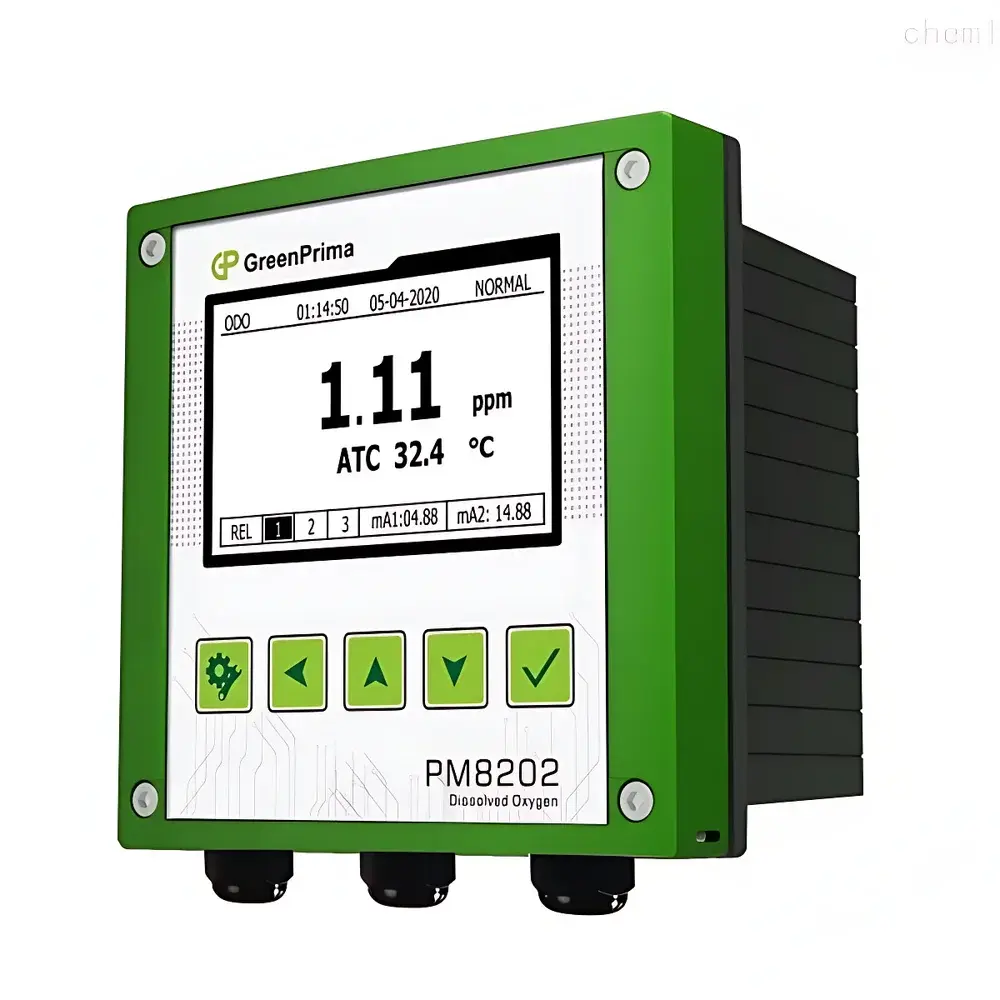
GreenPrima PM8202O Fluorescence-Based Online Dissolved Oxygen Analyzer
| Brand | GreenPrima |
|---|---|
| Origin | United Kingdom |
| Manufacturer Type | Original Equipment Manufacturer (OEM) |
| Product Category | Imported Instrument |
| Model | PM8202O |
| Instrument Type | Online Analyzer |
| Measurement Principle | Fluorescence Quenching |
| Measurement Range | 0.00–20.00 ppm |
| Resolution | 0.01 ppm |
| Accuracy | ±0.01 ppm |
| Temperature Compensation | -10 to 130 °C (NTC30K or PT1000 selectable) |
| Operating Temperature | -10 to 70.0 °C |
| Storage Temperature | -20 to 70.0 °C |
| Display | Backlit Graphic LCD |
| Language | English & Chinese |
| Data Storage | 600,000 records |
| Power Supply | 90–260 VAC, 50/60 Hz or 24 VDC optional |
| Output | Two isolated 4–20 mA outputs (max. loop resistance 500 Ω, accuracy 0.1% FS), RS485 Modbus RTU |
| Cleaning Control | Adjustable cleaning interval (0.1–1000 h) and duration (1–1000 s) |
| Alarm Outputs | Two independent Hi/Lo relay outputs (5 A / 250 VAC / 30 VDC) |
| Enclosure Rating | IP65 |
| Mounting Options | Wall-mounted, pipe-mounted, panel-mounted |
| Dimensions | 144 × 144 × 108 mm |
| Cut-out Size | 138 × 138 mm |
| Weight | 0.87 kg |
| Electrode Material | 316L Stainless Steel |
| Optional Feature | Air-driven self-cleaning system |
Overview
The GreenPrima PM8202O is an online dissolved oxygen (DO) analyzer engineered for continuous, high-stability monitoring in municipal and industrial wastewater treatment applications. It employs optical fluorescence quenching technology—where molecular oxygen modulates the intensity and lifetime of fluorescent emission from a proprietary ruthenium-based luminophore immobilized on the sensor surface. Unlike electrochemical Clark-type sensors, this method requires no oxygen consumption, eliminates membrane permeability limitations, and avoids electrolyte depletion or polarization drift. As a result, the PM8202O delivers true zero-maintenance operation in low-flow or stagnant environments—critical for effluent channels, oxidation ditches, and final clarifier outfalls where traditional amperometric probes suffer from signal lag or biofouling-induced drift.
Key Features
- Fluorescence-based sensing principle with lifetime-based measurement—immune to ambient light interference and insensitive to flow velocity or pressure fluctuations.
- Zero-consumption design: no oxygen is consumed during measurement, ensuring accurate readings even in low-turnover or diffusion-limited zones.
- Membrane-free and electrolyte-free architecture—eliminates routine consumables, calibration drift, and response hysteresis associated with polarographic systems.
- Digital sensor interface with embedded temperature compensation (NTC30K or PT1000 configurable) enabling accurate DO reporting across -10 to 130 °C.
- Robust 316L stainless steel sensor housing rated IP65, compatible with aggressive wastewater matrices containing sulfides, fats, and suspended solids.
- Two fully isolated 4–20 mA analog outputs assignable to DO concentration and/or temperature, compliant with IEC 61000-6-2/4 for electromagnetic immunity.
- RS485 Modbus RTU protocol support for integration into SCADA, DCS, or PLC-based process control systems—fully compatible with industry-standard HMI platforms.
- Configurable air-pulse self-cleaning module (optional) mitigates biofilm accumulation on the optical window without chemical dosing or manual intervention.
- Secure operational interface with password-protected parameter configuration and audit-trail-capable event logging.
Sample Compatibility & Compliance
The PM8202O is validated for use in raw influent, activated sludge basins, anaerobic digesters, tertiary filtration effluents, and discharge streams. Its optical sensor remains stable in turbid, high-suspended-solid, and chemically aggressive media—including chlorinated, sulfide-rich, or fatty wastewater typical of food processing and textile effluents. The analyzer conforms to EN 50178 (electrical safety for power-driven equipment), meets EMC Directive 2014/30/EU, and supports data integrity requirements aligned with ISO/IEC 17025 laboratory quality management principles. While not certified for pharmaceutical-grade validation, its digital output traceability, timestamped data logging, and configurable alarm hysteresis support GLP-aligned operational documentation.
Software & Data Management
The onboard firmware enables local configuration via intuitive menu navigation (English/Chinese toggle). All measurements—including DO value, temperature, sensor status, and diagnostic flags—are timestamped and stored in non-volatile memory (600,000 records). Data export is supported via Modbus polling or manual USB dump (via optional adapter). The dual 4–20 mA outputs can be scaled independently to match PLC input ranges, while relay alarms provide fail-safe interlocks for aeration control loops or pump sequencing. Firmware updates are performed via secure serial interface under controlled access, preserving calibration history and user-defined thresholds.
Applications
- Real-time DO optimization in aerobic bioreactors and SBR tanks to maintain nitrification efficiency and reduce energy consumption.
- Effluent compliance monitoring per local discharge permits (e.g., EU Urban Wastewater Treatment Directive, US EPA NPDES limits).
- Process diagnostics in denitrification zones where sub-ppm DO detection sensitivity is required.
- Long-term trend analysis of diurnal DO cycling in surface water receiving streams downstream of WWTP outfalls.
- Integration into smart aeration control strategies leveraging predictive algorithms trained on historical PM8202O time-series data.
FAQ
Does the PM8202O require periodic calibration?
No—fluorescence lifetime measurement is inherently stable and does not drift over time. A single factory calibration is retained for the instrument’s service life; field verification using air-saturated water or Winkler titration is recommended only for QA/QC audits.
Can it operate in seawater or brackish environments?
Yes—the 316L sensor body and optical coating are corrosion-resistant up to 3.5% salinity; however, salinity compensation must be applied externally via SCADA or configured manually if conductivity input is available.
Is the air self-cleaning function mandatory?
No—it is optional and most beneficial in high-fouling installations (e.g., primary sedimentation tanks or grease-laden influent channels); in clean secondary effluent, maintenance intervals exceed 12 months without cleaning.
How is temperature compensation handled?
Dual-sensor input support (NTC30K or PT1000) allows automatic real-time compensation per ISO 5814:2012, with user-selectable reference temperature (e.g., 20 °C or 25 °C) for standardized reporting.
What cybersecurity safeguards are implemented?
Modbus communication uses read-only register mapping by default; write-access requires authenticated session initiation via local keypad or encrypted serial command—no network-facing services or remote web interfaces are exposed.
Related Products







