
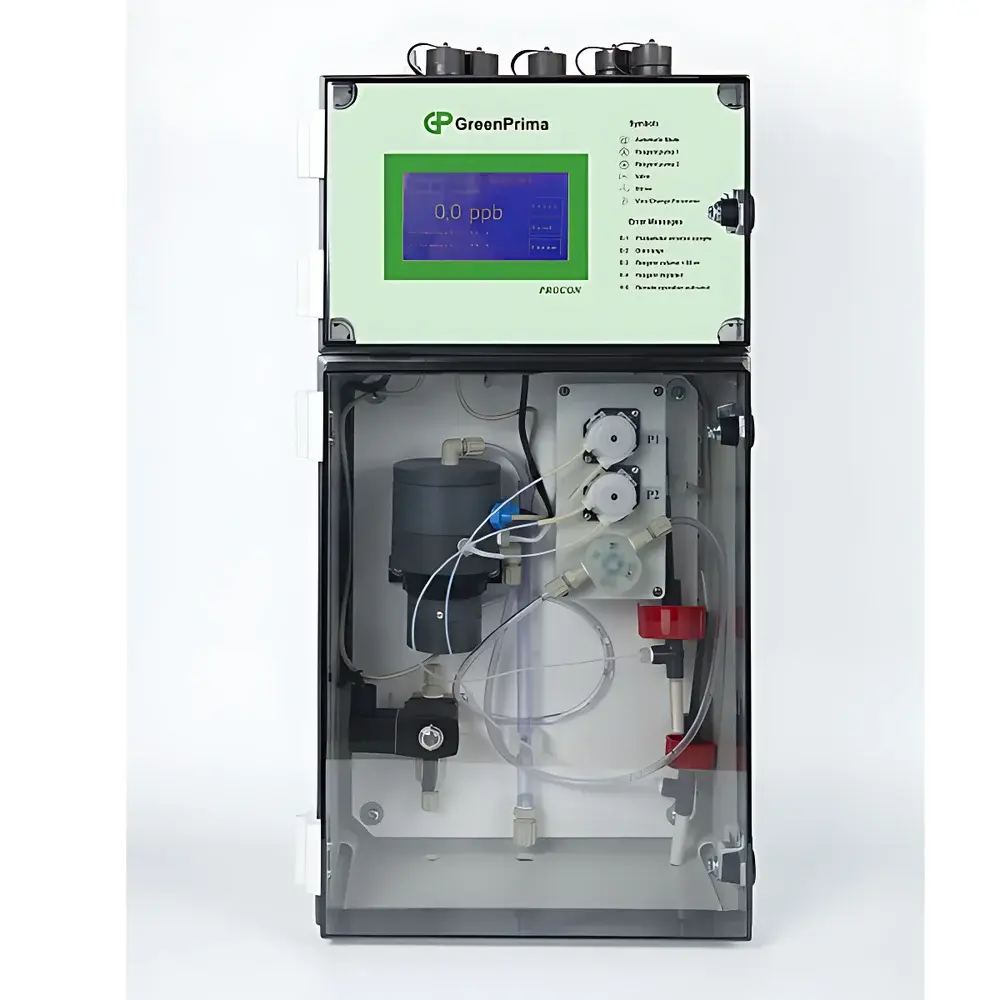
GreenPrima PROCON 6000 Online Silica Analyzer
| Brand | GreenPrima |
|---|---|
| Origin | UK |
| Manufacturer Type | Manufacturer |
| Origin Category | Imported |
| Model | PROCON 6000 |
| Instrument Type | Online Analyzer |
| Measurement Method | Photometric (β-Molybdenum Blue Reduction) |
| Silica Range Options | 1–100 ppb |
| Resolution | 0.1 ppb |
| Accuracy | ±2% of full scale |
| Repeatability | 0.5 ppb |
| Zero Stability | Automatic drift compensation |
| Analysis Cycle | 13 min (standard), adjustable 1–99 min or external trigger |
| Dimensions (H×W×D) | 640 × 315 × 190 mm |
| Display | 240 × 128 pixel monochrome touchscreen |
| Analog Output | 0/4–20 mA, max. load 500 Ω |
| Relay Outputs | 3 × SPDT, zero-potential, 230 V AC / 3 A (alarm, limit, analysis) + 1 × remote start/stop (18 V DC, ~4 mA) |
| Environmental Operating Temp. | 5–45 °C |
| Power Supply | 110–230 V AC, 50/60 Hz |
| Enclosure Rating | IP65 |
| Power Consumption | ~16 VA |
| Connectivity | USB (optional data logging) |
Overview
The GreenPrima PROCON 6000 is a fully automated, online photometric silica analyzer engineered for continuous, high-stability measurement of dissolved reactive silica (SiO₂) in ultrapure water streams. It operates on the well-established β-molybdenum blue reduction method: soluble silicate ions react with molybdate under acidic conditions to form heteropoly acids, which are subsequently reduced to an intensely colored blue complex. The absorbance of this complex—measured at 815 nm using a stable LED light source and precision photodiode detector—is directly proportional to the silica concentration. Designed for critical applications where trace-level silica control is non-negotiable, the PROCON 6000 delivers robust performance in high-pressure boiler feedwater, turbine condensate, nuclear primary coolant loops, and semiconductor process rinse water. Its architecture integrates fluidic precision, optical stability, and embedded microprocessor control to minimize operator intervention while maintaining compliance with operational requirements of power generation and regulated manufacturing environments.
Key Features
- Fully autonomous operation with integrated self-diagnostic routines, including automatic zero-point adjustment and real-time drift compensation—eliminating manual recalibration during routine operation.
- Three selectable measurement ranges (1–100 ppb, 4–999 ppb, 0.02–3 ppm SiO₂) optimized for distinct process zones—from ultra-low-silica steam condensate to higher-concentration pretreatment effluents.
- Industrial-grade 240 × 128 pixel monochrome touchscreen interface with intuitive navigation, enabling configuration, status monitoring, and alarm review without external software.
- Configurable analysis interval (13 min standard; programmable 1–99 min) and external start/stop capability via dry-contact input, supporting synchronization with plant DCS or sampling cycles.
- Dual-mode analog output (0/4–20 mA) with user-defined scaling and maximum 500 Ω load compatibility—designed for seamless integration into legacy and modern control systems.
- IP65-rated enclosure with ring-terminal electrical connections for relays (alarm, limit, analysis) and remote control—suitable for installation in utility corridors, chemical dosing rooms, or outdoor instrument shelters.
- Low-power design (~16 VA) compatible with wide-input AC supply (110–230 V, 50/60 Hz), minimizing infrastructure impact in distributed monitoring deployments.
Sample Compatibility & Compliance
The PROCON 6000 is validated for use with low-conductivity (< 1 µS/cm), particle-free water samples typical of demineralized, reverse-osmosis permeate, and condensate polishing loops. Sample inlet pressure must remain within 0.1–3 bar; particulate filtration (≤ 5 µm) upstream is recommended. The analyzer complies with IEC 61000-6-2 (immunity) and IEC 61000-6-4 (emissions), and its relay outputs meet EN 61810-1 for safety-related switching. While not certified to ISO/IEC 17025 as a standalone testing laboratory, its measurement methodology aligns with ASTM D859 (Standard Test Method for Silica in Water) and supports GLP/GMP documentation workflows through timestamped event logs and configurable alarm records. Data integrity is reinforced by non-volatile memory retention during power interruption.
Software & Data Management
Control logic resides in an embedded ARM-based microcontroller running a deterministic real-time firmware stack. All operational parameters—including range selection, cycle timing, alarm thresholds, and analog output mapping—are stored in EEPROM with write-protection against unintended changes. USB port (optional accessory) enables periodic download of time-stamped measurement history (up to 30 days at 1-min resolution), system events (e.g., reagent low, valve timeout), and diagnostic snapshots. No proprietary drivers are required; exported CSV files are natively readable in Excel or SCADA historian platforms. Audit trail functionality includes user-initiated actions (e.g., manual calibration override, range change) logged with timestamp and operator ID—supporting FDA 21 CFR Part 11 readiness when deployed with external identity management.
Applications
- Thermal power plants: Continuous monitoring of silica in boiler feedwater and steam condensate to prevent silica deposition on turbine blades and heat exchanger surfaces—directly supporting ASME PTC 19.11 and EPRI guidelines.
- Nuclear facilities: Detection of leached silica from ion-exchange resins or concrete containment structures in primary coolant circuits.
- Semiconductor fabs: Verification of < 1 ppb silica in UPW used in wafer rinsing, where even sub-ppb excursions risk gate oxide defects.
- Pharmaceutical water systems: Compliance support for USP and EU GMP Annex 1 requirements for purified water and water-for-injection quality assurance.
- Chemical and fiber production: Optimization of silica removal efficiency in multi-stage demineralization trains serving high-purity process water networks.
FAQ
What silica species does the PROCON 6000 measure?
It quantifies dissolved reactive silica (monosilicic acid, Si(OH)₄), the predominant bioavailable and deposit-forming form in neutral-to-acidic aqueous systems. It does not detect colloidal or polymerized silica without prior acid hydrolysis.
Is daily maintenance required?
No. Routine tasks include quarterly reagent replacement (molybdate and reducing agent), biannual tubing inspection, and annual photometer verification using factory-certified calibration standards.
Can the analyzer be integrated into a DCS via Modbus?
The base model supports only 4–20 mA and dry-contact I/O. Modbus RTU (RS-485) is available as a factory-installed option—contact GreenPrima Technical Support for firmware and hardware revision compatibility.
What is the minimum sample flow rate needed?
A continuous, pressurized flow of 100–300 mL/min is required; flow interruption triggers automatic flush-and-restart sequence to preserve measurement integrity.
Does it comply with USP or Ph. Eur. water specifications?
While not a pharmacopoeial instrument per se, its measurement uncertainty and detection capability meet the technical validation criteria outlined in USP for silica testing in purified water systems when operated within specified environmental and sample-handling conditions.
Related Products







