
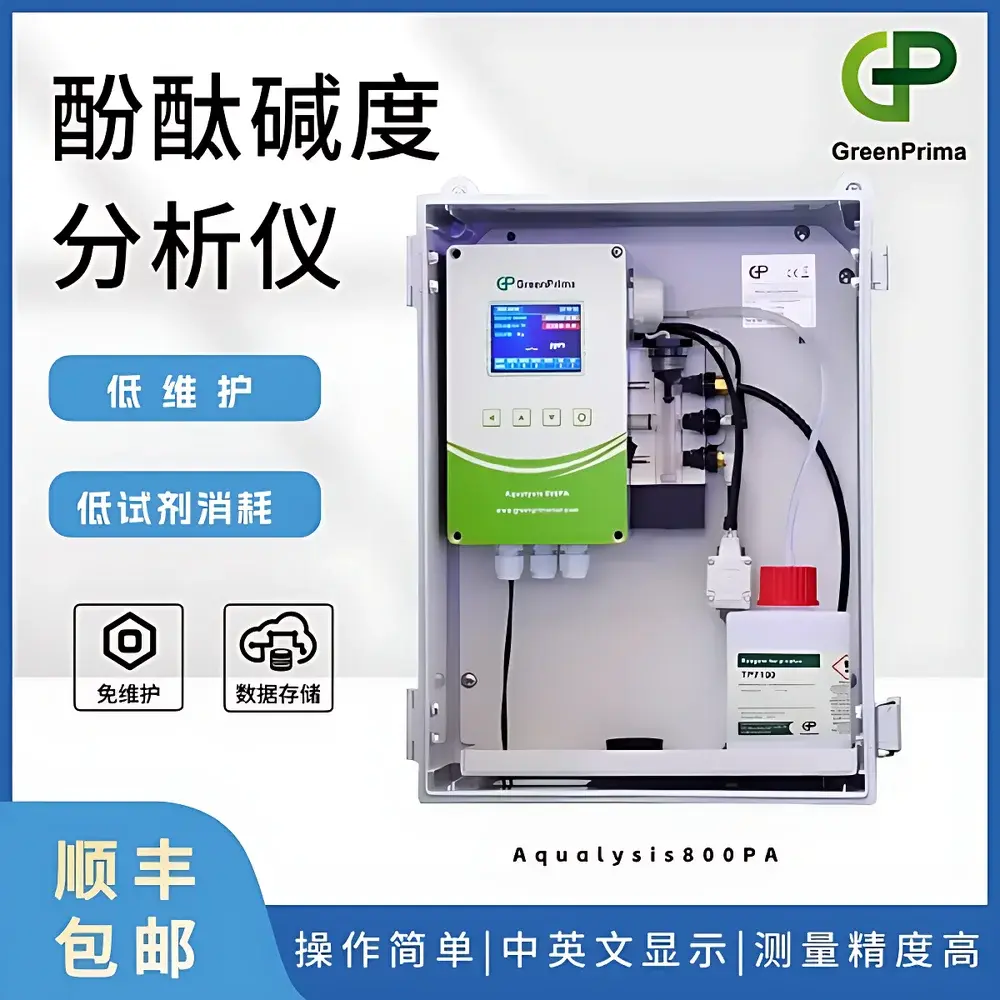
GreenPrima Aqualysis 800PA Phenolphthalein Alkalinity Analyzer
| Brand | GreenPrima |
|---|---|
| Origin | United Kingdom |
| Manufacturer Type | Original Equipment Manufacturer (OEM) |
| Product Origin | Imported |
| Model | Aqualysis 800PA |
| Pricing | Upon Request |
Overview
The GreenPrima Aqualysis 800PA Phenolphthalein Alkalinity Analyzer is an automated, benchtop-to-industrial inline water quality analyzer engineered for precise, real-time determination of phenolphthalein alkalinity (P-alkalinity) in process and utility water streams. It operates on the principle of potentiometrically guided acid–base titration coupled with photometric endpoint detection: a precisely metered volume of standardized hydrochloric acid (HCl) is delivered to the sample, followed by controlled dosing of phenolphthalein indicator; the resulting color transition—from pink (basic) to colorless (acidic) at pH ≈ 8.3—is quantified via dual-wavelength spectrophotometry (typically 525 nm and 620 nm reference). This method conforms to standard wet-chemistry protocols aligned with ASTM D1066, ISO 9963-1, and APHA 2320 B. The instrument’s embedded microprocessor governs reagent delivery, timing, photometric acquisition, and endpoint calculation—ensuring high reproducibility (< ±0.1 mg/L as CaCO₃ typical), minimal operator intervention, and compliance-ready audit trails.
Key Features
- Integrated touchscreen control unit with 7-inch full-color LCD display supporting both English and Chinese UI languages
- Compact footprint (400 × 300 × 180 mm) and lightweight design (4 kg) enabling flexible installation in control rooms, skids, or field enclosures
- Automated calibration verification using certified standard solutions and built-in diagnostic routines for pump performance, optical path integrity, and valve actuation
- Programmable measurement intervals from 1 to 360 minutes—supports both continuous monitoring and scheduled batch analysis
- Low-reagent consumption architecture: average HCl and indicator usage < 1.2 mL per analysis cycle; typical reagent cartridge life exceeds 30 days at 15-min intervals
- Four programmable relay outputs (SPDT, 250 VAC/3 A) for alarm signaling, pump interlocks, or PLC integration
- Two opto-isolated digital inputs compatible with external start/stop triggers, flow switch signals, or multi-analyzer synchronization
- Onboard non-volatile memory storing ≥12 months of timestamped results, system logs, and fault event records (including error codes and recovery timestamps)
Sample Compatibility & Compliance
The Aqualysis 800PA is validated for use with turbid, low-conductivity, and moderately scaling aqueous matrices—including blast furnace gas scrubber water, turbid recirculating cooling water, boiler feedwater, and desalinated condensate. Its fluidic architecture incorporates self-cleaning solenoid valves and PTFE-lined tubing to mitigate fouling from suspended solids (< 50 mg/L TSS) and carbonate precipitates. All wetted materials comply with FDA 21 CFR §177.2420 for indirect food contact. The analyzer meets IEC 61326-1 (EMC for industrial environments) and IP65-rated enclosure protection. Data integrity features—including electronic signature support, user-level access control (admin/operator/guest), and time-stamped audit logs—facilitate alignment with GLP, GMP, and ISO/IEC 17025 documentation requirements.
Software & Data Management
Data export is supported via isolated RS-485 Modbus RTU protocol (slave ID configurable) and analog 4–20 mA output (linearly scaled to 0–500 mg/L as CaCO₃ range). Optional Modbus TCP/IP or OPC UA gateway modules enable integration into SCADA, DCS, or MES platforms. Firmware supports remote firmware updates over Ethernet and includes configurable data logging intervals (1 min to 24 h). All measurements are stored with UTC timestamps, operator ID (if authenticated), and QC flag status (e.g., “calibration valid”, “out-of-range warning”). Raw absorbance values, titrant volume consumed, and calculated P-alkalinity are retained per measurement cycle—enabling retrospective validation per FDA 21 CFR Part 11 Annex 11 principles.
Applications
The Aqualysis 800PA is deployed in metallurgical water treatment plants for real-time optimization of lime dosing in gas scrubber circuits; in power generation facilities for boiler water alkalinity control to prevent caustic embrittlement; in HVAC systems for closed-loop cooling water chemistry management; and in municipal reuse applications where phenolphthalein alkalinity serves as a proxy for carbonate buffer capacity. Its compatibility with GreenPrima’s MCS-series multi-channel selector manifolds allows unattended parallel analysis across 2–8 sampling points without manual valve switching—ideal for comparative monitoring of influent/effluent streams or zonal distribution networks.
FAQ
What is the measurement range for phenolphthalein alkalinity?
The standard configuration covers 0–500 mg/L as CaCO₃; extended-range variants (0–2000 mg/L) are available upon request with recalibrated photometric gain and acid concentration adjustments.
Does the analyzer require daily maintenance?
No routine daily maintenance is required. Scheduled tasks include monthly optical window inspection, quarterly reagent line purge, and biannual calibration verification—consistent with ISO 5667-3 guidance for automated analyzers.
Can it interface with existing plant DCS systems?
Yes—via Modbus RTU over RS-485 or optional Ethernet-based protocols (Modbus TCP, OPC UA). Configuration files and register maps are supplied in vendor-neutral XML format.
Is the photometric detection susceptible to interference from colored or turbid samples?
Dual-wavelength compensation and automatic baseline correction minimize interference; however, samples exceeding 50 NTU turbidity or containing strong chromophores (e.g., humic acids) may require pre-filtration or dilution per APHA 2130 B recommendations.
How is data security and traceability ensured?
All user actions trigger immutable log entries with cryptographic timestamping. Role-based access control, password complexity enforcement, and session timeout policies meet NIST SP 800-53 AC-2 and IA-4 controls for analytical instrumentation.




