
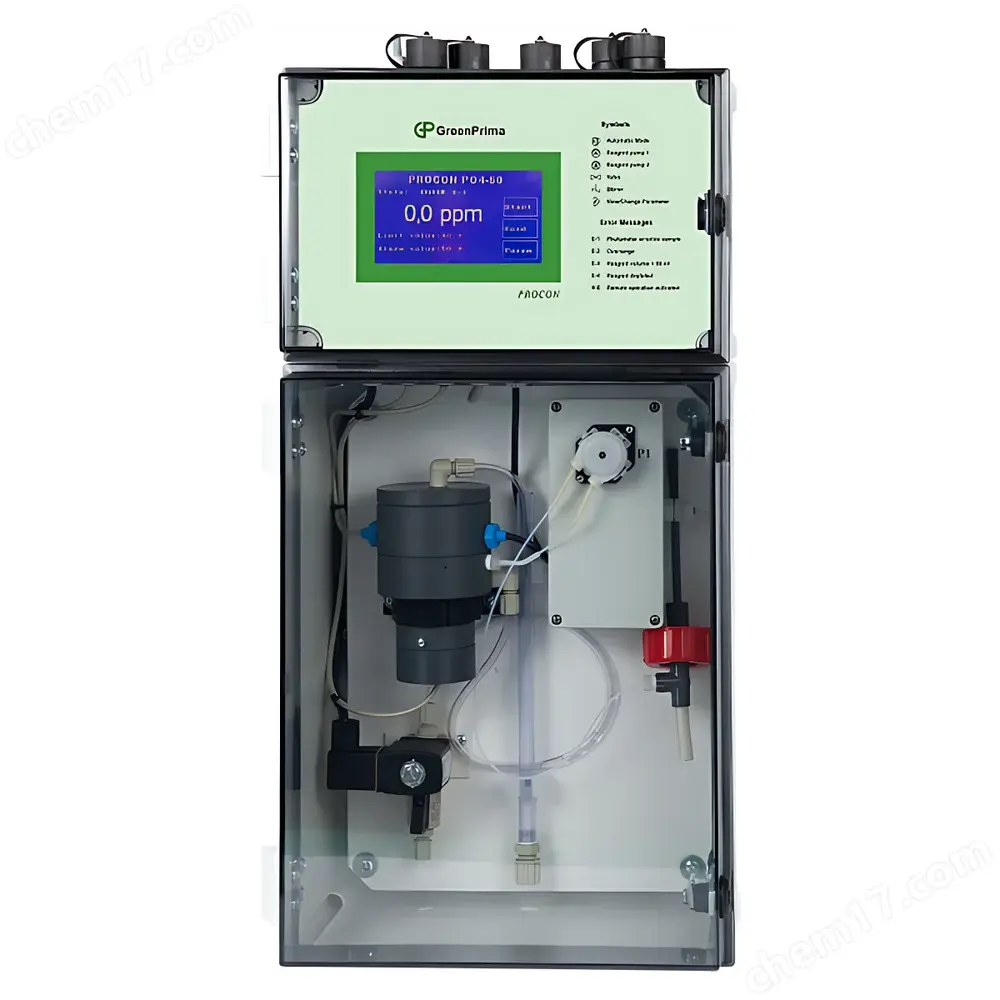
GreenPrima PRO CON 4000 Online Silicate Analyzer
| Brand | GreenPrima |
|---|---|
| Origin | United Kingdom |
| Manufacturer Type | Original Equipment Manufacturer (OEM) |
| Product Category | Imported Instrument |
| Model | PRO CON 4000 |
| Instrument Type | Online Analyzer |
| Measurement Principle | Photometric Analysis of Reduced β-Molybdo-Silicic Acid Complex |
| Measuring Range Options | 1–100 ppb, 4–999 ppb, 0.02–3 ppm SiO₂ |
| Resolution | 0.1 ppb / 1 ppb / 0.01 ppm |
| Accuracy | ±2% of full scale |
| Repeatability | ±0.5 ppb / ±4 ppb / ±0.02 ppm |
| Zero Stability | Automatic Drift Compensation |
| Analysis Cycle Time | 13 min (standard), adjustable from 1–99 min or externally triggered |
| Display | 240 × 128 pixel backlit touchscreen |
| Output | Isolated 0/4–20 mA (max. 500 Ω load) |
| Analog Outputs | Programmable |
| Digital Interface | USB data logging (optional) |
| Environmental Operating Temperature | 5–45 °C |
| Power Supply | 110–230 V AC, 50/60 Hz |
| Power Consumption | ~16 VA |
| Enclosure Rating | IP65 |
| Dimensions (H×W×D) | 640 × 315 × 190 mm |
| Relay Outputs | 3 × zero-potential contacts (230 V AC, 3 A each) for alarm, limit, and analysis status |
Overview
The GreenPrima PRO CON 4000 is a dedicated online silicate analyzer engineered for continuous, high-precision measurement of dissolved reactive silica (SiO₂) in ultra-pure water streams. It operates on the photometric principle of the reduced β-molybdo-silicic acid method—where orthosilicic acid reacts with molybdate under acidic conditions to form a yellow-colored heteropoly acid complex, subsequently reduced to yield a stable blue chromophore measurable at 815 nm. This chemically selective assay ensures minimal interference from phosphate, chloride, sulfate, or common cations found in power plant and semiconductor-grade water systems. Designed for integration into closed-loop monitoring networks, the PRO CON 4000 delivers real-time data essential for maintaining steam purity, preventing silica deposition in turbine blades, and ensuring compliance with ASTM D4582, ASTM D859, and IAPWS Technical Guidance Document TR-07 (2021) for boiler feedwater and steam condensate.
Key Features
- Fully automated analysis cycle—including sample aspiration, line flushing, reagent dosing, reaction incubation, optical detection, and waste discharge—executed under microprocessor control without manual intervention.
- Three selectable measurement ranges (1–100 ppb, 4–999 ppb, 0.02–3 ppm SiO₂) optimized for distinct process zones: condensate polishing, demineralized makeup water, and high-pressure drum boiler feed.
- Self-calibrating optical path with integrated LED light source and photodiode detector; zero-point stability maintained via automatic baseline correction between cycles.
- Industrial-grade 240 × 128 pixel resistive touchscreen interface supporting multilingual menus (English, German, French, Spanish), configurable alarm thresholds, and user-defined analysis intervals.
- Robust mechanical architecture featuring corrosion-resistant wetted materials (e.g., PTFE, FEP, and 316L stainless steel), precision metering pumps, and pneumatically actuated solenoid valves rated for >500,000 cycles.
- Comprehensive I/O suite: three isolated relay outputs (alarm, limit, analysis status), one dry-contact remote start/stop input, and fully programmable 4–20 mA analog output compliant with NAMUR NE43 signal standards.
- IP65-rated enclosure suitable for installation in turbine halls, chemical dosing rooms, and utility corridors per IEC 60529 environmental classification.
Sample Compatibility & Compliance
The PRO CON 4000 is validated for use with low-conductivity water samples (pH 10) without pre-filtration or pH adjustment. The analyzer meets CE marking requirements under the EU Electromagnetic Compatibility Directive 2014/30/EU and Low Voltage Directive 2014/35/EU. Its operational protocol aligns with ISO 5667-3 for water sampling preservation and ASTM D5117 for silica determination in high-purity water. For regulated environments, audit-trail-capable data logging (via optional USB module) supports GLP/GMP documentation practices under FDA 21 CFR Part 11 when paired with validated software.
Software & Data Management
The embedded firmware supports local data storage of up to 10,000 measurement records with timestamps, range selection flags, and system diagnostic logs (e.g., pump actuation count, reagent level warnings, optical intensity drift). USB export enables CSV-formatted data transfer for trend analysis in Excel or LIMS integration. Optional Modbus RTU (RS-485) communication allows seamless connection to DCS/SCADA platforms such as Siemens Desigo, Honeywell Experion, or ABB 800xA. All configuration changes—including calibration coefficients, alarm hysteresis, and relay logic—are timestamped and stored in non-volatile memory to satisfy traceability requirements.
Applications
- Power generation: Monitoring silica breakthrough in mixed-bed ion exchange polishers, condensate return lines, and once-through boiler feedwater systems.
- Semiconductor manufacturing: Ensuring sub-ppb silica levels in UPW distribution loops feeding immersion lithography tools and wafer cleaning stations.
- Pharmaceutical water systems: Verifying silica compliance in purified water (PW) and water for injection (WFI) per USP and EP 2.2.42.
- Chemical processing: Controlling silica carryover in caustic recovery circuits and evaporator blowdown streams.
- Research laboratories: Providing reference-grade silica data for membrane fouling studies and RO pretreatment optimization.
FAQ
What is the minimum detectable silica concentration for the PRO CON 4000?
The lower limit of quantification (LLOQ) is 0.5 ppb SiO₂ in the 1–100 ppb range, verified per ICH Q2(R2) guidelines using standard addition methodology.
Does the analyzer require daily maintenance or manual calibration?
No routine calibration is required; the system performs automatic zero compensation and uses factory-characterized reagent batches with lot-specific calibration curves stored in barcode-scanned reagent cartridges.
Can the PRO CON 4000 be installed outdoors?
It is rated IP65 for dust and water jet resistance but must be mounted in a temperature-controlled shelter or indoor cabinet to maintain ambient operating conditions between 5–45 °C.
Is phosphate interference corrected algorithmically?
Phosphate does not interfere with the reduced molybdo-silicic acid reaction under the specified acidification and reduction conditions; cross-sensitivity is <0.1% relative to silica signal per ASTM D859 Annex A1 validation data.
How frequently should reagents be replaced?
Reagent kits (molybdate, reducing agent, acid) are supplied in sealed, light-protected cartridges with shelf life of 12 months unopened; typical consumption supports 30–90 days of continuous operation depending on cycle frequency.







