
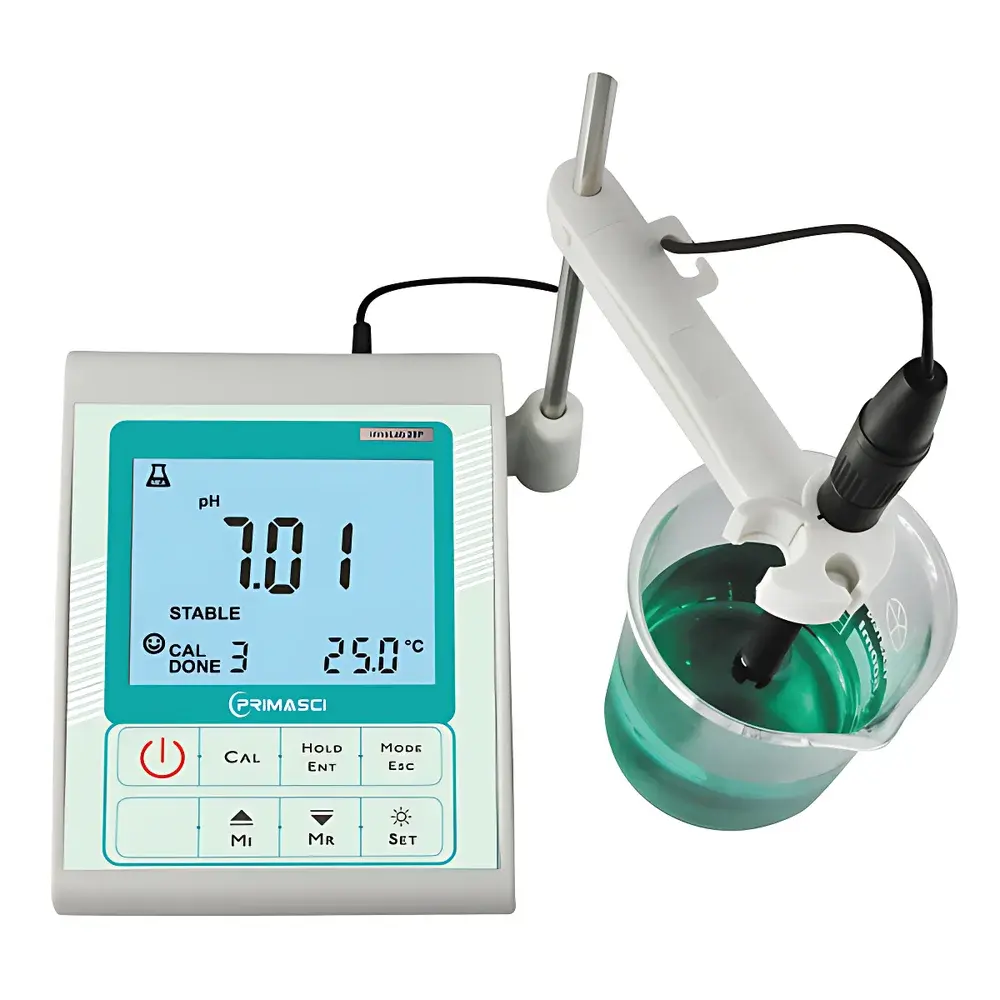
PRIMASCI innoLab 20P Benchtop pH/ORP Analyzer
| Brand | PRIMASCI |
|---|---|
| Model | innoLab 20P |
| Type | Benchtop pH Meter |
| Parameters | Single-parameter (pH, ORP, Temperature) |
| Measurement Range | −2.00 to +16.00 pH |
| Resolution | ±0.01 pH |
| Accuracy | ±0.01 pH |
| Calibration | Auto-recognizing 1–3-point calibration with USA-standard buffers |
| Electrode Compatibility | Glass electrode or antimony electrode (HF-resistant mode) |
| Temperature Compensation | Automatic (ATC) or manual (MTC), −5.0 to 120.0 °C |
| Data Storage | 100 measurement records |
| Power | AC 100–240 V adapter + built-in rechargeable Li-ion battery (1300 mAh) |
| Dimensions | 150 × 194 × 56 mm (W × L × H) |
| Weight | 1.0 kg |
Overview
The PRIMASCI innoLab 20P is a precision-engineered benchtop pH/ORP analyzer designed for rigorous laboratory, environmental monitoring, and industrial process control applications. Based on potentiometric measurement principles, it determines hydrogen ion activity (pH) via glass electrode potential difference relative to a stable reference electrode, while ORP (oxidation-reduction potential) is measured as the millivolt output of a noble metal indicator electrode against the same reference. The instrument operates under Nernstian response theory and incorporates differential signal circuitry to minimize electromagnetic interference—critical in shared lab environments or near variable-frequency drives in manufacturing settings. Its extended pH range (−2.00 to +16.00) supports highly acidic or alkaline sample analysis, including aggressive industrial effluents and semiconductor cleaning baths. Temperature compensation is implemented per IUPAC-recommended algorithms, supporting both automatic (ATC) and manual (MTC) modes—ensuring thermodynamic consistency across measurements.
Key Features
- 100 × 74 mm high-contrast LCD display with 120° viewing angle and scratch-resistant, splash-proof front panel
- Differential input circuit architecture for enhanced noise immunity in electrically noisy facilities
- Up to 5-point calibration with multi-segment curve fitting—enabling high linearity across full pH range
- Real-time electrode diagnostics: slope (%), offset (mV), and electrode health indicator based on Nernstian deviation thresholds
- HOLD function with STABLE visual confirmation for reliable endpoint capture during titration or slow-response samples
- Dual electrode mode support: standard glass electrode for general use; antimony electrode option for HF-containing matrices where glass dissolution is prohibitive
- Integrated rechargeable 1300 mAh Li-ion battery enabling uninterrupted operation during power fluctuations or field deployment
- Patented dual-side universal electrode holder with telescopic clamp (145–220 mm travel) and 300 mm vertical support rod (Φ6 mm)
- User-configurable auto-off (10 min idle timeout) and adjustable temperature unit (°C/°F)
Sample Compatibility & Compliance
The innoLab 20P accommodates aqueous and low-ionic-strength samples typical in drinking water, wastewater, pharmaceutical buffers, electroplating baths, and chemical synthesis intermediates. It complies with ISO 7888 (water quality — determination of pH), ASTM D1293 (standard test method for pH of water), and US EPA Method 150.1. When used with traceable NIST-traceable calibration standards (e.g., USA-certified pH 4.01, 7.00, 10.01 buffers), the system supports GLP/GMP documentation requirements. The antimony electrode configuration meets safety requirements for hydrofluoric acid handling per OSHA 1910.1200 and IEC 61000-4-3 immunity standards. All firmware and calibration logs are timestamped and non-editable—facilitating audit readiness under FDA 21 CFR Part 11 when paired with validated data export workflows.
Software & Data Management
While the innoLab 20P operates as a standalone instrument, its 100-entry internal memory stores date/time-stamped pH, ORP, temperature, and electrode diagnostic data. Each record includes calibration status flags (e.g., “Calibrated @ 25.0°C, Slope = 98.6%”) for retrospective traceability. Data export is supported via USB interface using PRIMASCI’s optional PC software (innoLog v2.1), which generates CSV-compatible reports compliant with ISO/IEC 17025 Clause 7.7 (result reporting). The software enforces electronic signature prompts and maintains immutable audit trails—including user ID, action type (e.g., “3-point cal completed”), and system time—meeting ALCOA+ data integrity criteria for regulated laboratories.
Applications
- Environmental labs: Surface water, groundwater, and wastewater pH profiling per ISO 5667-3 and EU WFD monitoring protocols
- Pharmaceutical QC: Buffer preparation verification, cleaning validation (e.g., CIP rinse water), and stability-indicating assays
- Food & beverage: Fermentation pH tracking, brine acidity control, and shelf-life modeling
- Electroplating & metal finishing: Acid bath concentration monitoring and passivation solution verification
- Academic research: Teaching potentiometry fundamentals, electrode kinetics studies, and sensor material development
FAQ
Does the innoLab 20P support GLP-compliant calibration logging?
Yes—each calibration event is stored with date/time stamp, buffer IDs, measured mV values, calculated slope/offset, and operator-annotated notes (via optional software).
Can the instrument be used with non-aqueous solvents?
It is optimized for aqueous systems. For organic solvent applications (e.g., ethanol/water mixtures), use only certified solvent-compatible electrodes and validate performance per ISO 17025 method validation guidelines.
What is the recommended recalibration frequency?
Per ISO/IEC 17025, recalibration is required before each analytical batch, after electrode replacement, following exposure to extreme pH or temperature, or at intervals defined by risk-based assessment—typically every 2–8 hours in continuous operation.
Is MTC (manual temperature compensation) necessary if an ATC probe is installed?
No—ATC automatically applies temperature correction using real-time probe input. MTC is reserved for cases where no temperature probe is connected or when ambient temperature differs significantly from sample temperature.
How is electrode drift monitored during routine use?
The instrument continuously calculates and displays slope (%) and offset (mV) post-calibration. A slope below 85% or offset exceeding ±35 mV indicates electrode aging or contamination—triggering maintenance per SOP-EM-022.



