
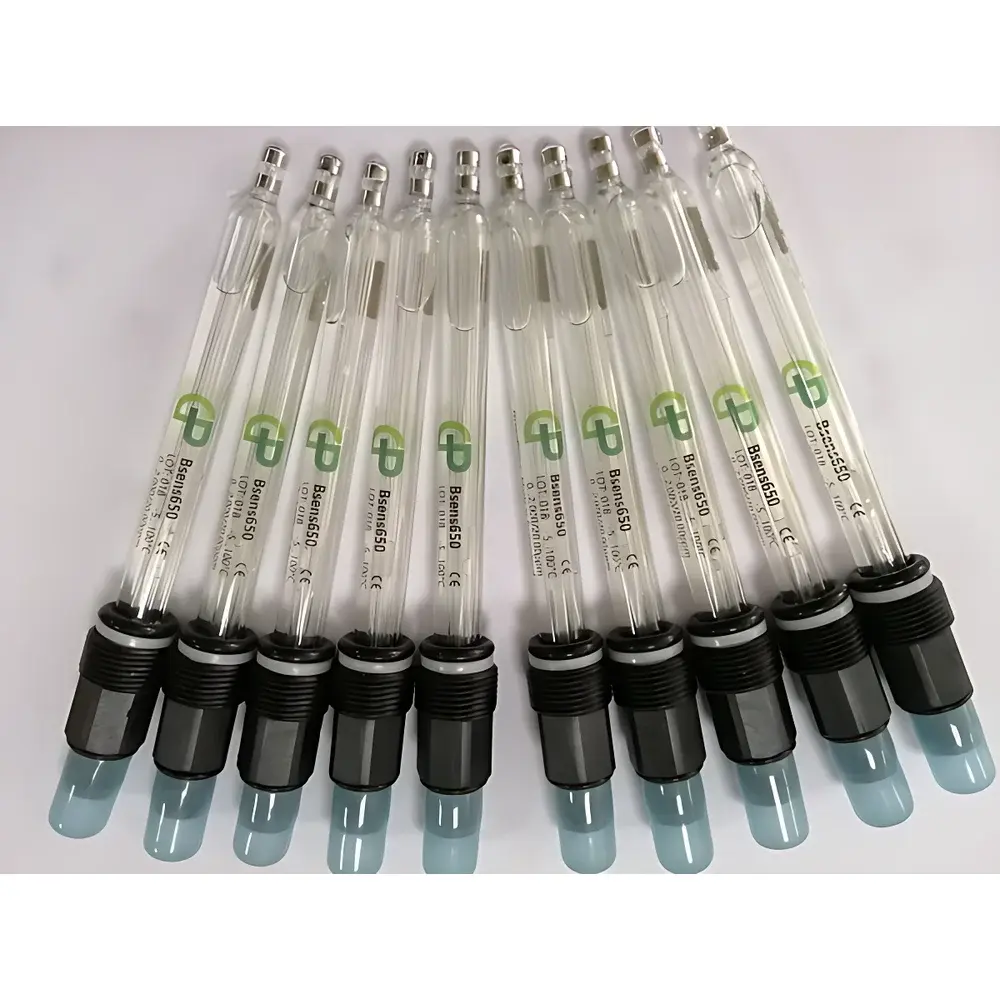
GreenPrima Bsens 660 Online Residual Chlorine Analyzer
| Brand | GreenPrima |
|---|---|
| Origin | Switzerland |
| Manufacturer Type | OEM Manufacturer |
| Origin Category | Imported |
| Model | Bsens 660 |
| Instrument Type | Online Analyzer |
| Measurement Principle | Amperometric Electrochemical Sensor (Constant Potential Method) |
| Measured Parameter | Free Residual Chlorine |
| Measurement Ranges | 0–2.000 ppm and 0–20.00 ppm |
| Accuracy | ≤ ±2% of Full Scale |
| Repeatability | ±0.001 ppm / ±0.01 ppm |
| Resolution | 0.001 ppm / 0.01 ppm |
| Detection Limit | 0.001 ppm / 0.01 ppm |
| Temperature Compensation Range | –10 to 130 °C |
| Operating Temperature | 0–70.0 °C |
| Storage Temperature | –20 to 70 °C |
| Output Signals | Dual 4–20 mA (residual chlorine & temperature), RS485 Modbus RTU |
| Cleaning Cycle | Adjustable from 0.1 to 1000 h |
| Duration | 1–1000 s |
| Enclosure Rating | IP65 |
| Controller Dimensions | 144 × 144 × 106 mm |
| Electrode Dimensions | Ø12 × 120 mm |
| Electrode Mounting | PG13.5 thread, compatible with BAF615 flow cell |
Overview
The GreenPrima Bsens 660 Online Residual Chlorine Analyzer is a high-stability, maintenance-free amperometric sensor system engineered for continuous, real-time monitoring of free residual chlorine in potable water distribution networks, municipal drinking water treatment plants, swimming pools, hospital sterilization loops, and industrial process water systems. It operates on the constant-potential amperometric principle: a precise, stable polarization voltage is applied between a gold-ring working electrode and an integrated Ag/AgCl reference electrode. At this optimized potential, hypochlorous acid (HOCl) and hypochlorite ion (OCl⁻) undergo selective electrochemical reduction, generating a diffusion-controlled current linearly proportional to the active chlorine concentration. Unlike colorimetric or membrane-based sensors, the Bsens 660 eliminates reagent consumption, membrane replacement, and electrolyte refilling—reducing total cost of ownership while maintaining long-term zero-point stability and resistance to common interferences such as nitrite, bromide, and oxidizing disinfectants.
Key Features
- Gold-ring amperometric sensor (Bsens 660) optimized for low-range detection (0–2 ppm) with sub-ppb resolution and minimal drift
- No chemical reagents, no replaceable membranes, no liquid electrolyte—designed for >24-month operational life without recalibration under typical conditions
- Integrated temperature compensation (–10 to 130 °C) with automatic or manual mode; dual 4–20 mA outputs for chlorine concentration and temperature, each traceable to NIST-traceable calibration standards
- Configurable cleaning protocol via relay output: programmable interval (0.1–1000 h) and duration (1–1000 s) to mitigate biofilm accumulation in low-flow or stagnant applications
- IP65-rated controller housing with backlit graphical LCD display supporting English and Chinese language interfaces, 600,000-point internal data logging (timestamped, with alarm flags)
- Flexible mounting options: wall-mount, panel-mount, or pole-mount controller; PG13.5-threaded electrode interface compatible with standard BAF615 constant-flow cells for laminar, bubble-free sample delivery
Sample Compatibility & Compliance
The Bsens 660 is validated for use in clear, non-turbid aqueous matrices with pH 5.0–8.5 and conductivity ≥50 µS/cm. It meets ISO 7888:2019 (water quality — determination of residual chlorine by amperometric titration) performance benchmarks for field-deployable electrochemical analyzers. The system supports GLP/GMP-compliant operation through audit-trail-capable data export (CSV via USB or Modbus TCP), configurable alarm thresholds (high/low, rate-of-change), and password-protected parameter configuration. While not FDA 21 CFR Part 11 certified out-of-the-box, its data integrity architecture—including write-protected memory, time-stamped event logs, and tamper-evident calibration records—facilitates validation for regulated utilities and pharmaceutical water systems.
Software & Data Management
Data acquisition and remote supervision are enabled via RS485 Modbus RTU (slave ID configurable) or optional Ethernet gateway. The embedded firmware supports SCADA integration with standard PLCs (Siemens S7, Allen-Bradley, Schneider EcoStruxure). Local storage retains 600,000 measurement records with microsecond-resolution timestamps, temperature readings, and diagnostic flags (e.g., “low flow,” “electrode saturation,” “cleaning active”). Export is supported via USB mass storage mode (FAT32), generating ISO 8601-compliant CSV files suitable for LIMS ingestion or statistical process control (SPC) analysis. Firmware updates are performed via signed binary packages to ensure cryptographic integrity.
Applications
- Municipal drinking water treatment: post-chlorination point-of-contact monitoring and distribution network surveillance
- Swimming pool & spa management: automated dosing feedback control per EN 15288-1 and CDC Model Aquatic Health Code requirements
- Hospital central sterile supply departments (CSSD): verification of chlorine concentration in instrument washer-disinfectors and rinse water loops
- Pharmaceutical purified water (PW) and water-for-injection (WFI) systems: routine release testing in accordance with USP and EP 2.2.42
- Food & beverage processing lines: sanitizing rinse water verification prior to product contact surfaces
FAQ
Does the Bsens 660 require daily calibration or zero adjustment?
No. The gold-ring electrode exhibits intrinsic zero stability due to its solid-state reference design and constant-potential operation. Calibration is recommended quarterly using NIST-traceable chlorine standards (e.g., DPD-based reference solutions), or after extended exposure to high-chlorine shock events.
Can it measure combined chlorine (chloramines)?
No. The Bsens 660 is specifically optimized for free residual chlorine (HOCl/OCl⁻). Combined chlorine requires separate analytical methods such as iodometric titration or selective membrane sensors.
Is the BAF615 flow cell mandatory for installation?
Yes. Accurate amperometric measurement demands consistent laminar flow and elimination of air bubbles. The BAF615 ensures 100–300 mL/min flow rate control and pressure stabilization, which is critical for reproducible current response and long-term electrode health.
What maintenance intervals are specified for the electrode?
Under normal operating conditions (pH 6.5–7.8, <5 NTU turbidity, no oil or grease), electrode polishing is required only every 12–18 months. No membrane or electrolyte servicing is needed.
How does temperature compensation affect accuracy across wide ambient ranges?
The built-in Pt1000 RTD provides real-time thermal correction based on the Arrhenius relationship for chlorine diffusion kinetics. Accuracy remains within ±2% FS from 5 to 45 °C; outside this range, compensation follows ISO 7888-defined polynomial coefficients.







