
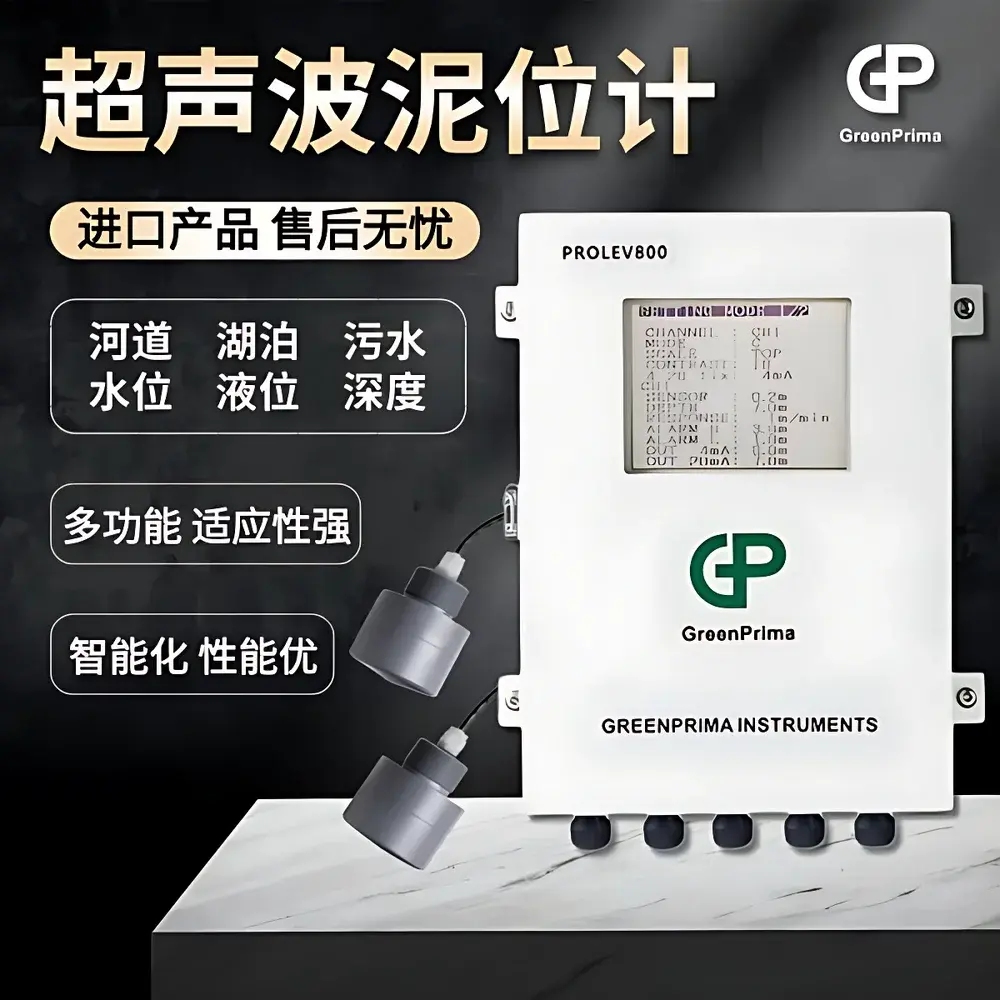
GreenPrima PROLEV 800 Ultrasonic Sludge Level Interface Gauge
| Brand | GreenPrima |
|---|---|
| Origin | United Kingdom |
| Manufacturer Type | Original Equipment Manufacturer (OEM) |
| Product Origin | Imported |
| Model | PROLEV 800 |
| Pricing | Available Upon Request |
| Measurement Range | 0.4–10 m |
| Sensor Capacity | Up to 2 independent ultrasonic transducers |
| Accuracy | ±1 cm |
| Response Time | 1 s |
| Operating Ambient Temperature | −20 to +60 °C |
| Display | Large-backlit LCD with graphical interface (numeric, trend plot, echo waveform) |
| Enclosure Rating | IP68 |
| Weight | 3.6 kg (transmitter), 3 kg per probe |
| Output Signal | 4–20 mA analog output |
| Alarm Outputs | 2 programmable high/low level relay contacts |
| Communication Interface | RS-232C (cable length ≤10 m) |
| Power Supply | 85–264 VAC, 10 VA |
| Cable Length | 20 m |
| Brightness Adjustment | Yes |
| Trend Logging Duration | 5 minutes to 48 hours on display |
Overview
The GreenPrima PROLEV 800 is an industrial-grade ultrasonic sludge level interface gauge engineered for continuous, non-contact measurement of the sludge–supernatant interface in sedimentation and thickening basins. It operates on the principle of time-of-flight ultrasonic pulse reflection: a high-frequency acoustic signal (typically 50–100 kHz) is emitted downward from a submersible or top-mounted transducer; the transit time between emission and return echo from both the liquid surface and the denser sludge layer is precisely measured. By analyzing dual-echo profiles—surface reflection and interface reflection—the system calculates real-time sludge blanket height and thickness with ±1 cm repeatability. Designed for deployment in demanding wastewater treatment environments—including primary clarifiers, secondary settling tanks, gravity thickeners, and ash settling ponds—the PROLEV 800 delivers stable, drift-free interface tracking without mechanical moving parts or calibration dependency on sludge rheology.
Key Features
- Large backlit LCD display supporting simultaneous numeric readout, real-time echo waveform visualization, and dynamic trend plotting (5 min to 48 h)
- Dual-transducer capability: single transmitter unit interfaces with two independent ultrasonic probes—enabling differential monitoring or redundancy configuration
- Embedded microprocessor with adaptive signal processing algorithms for robust echo discrimination in turbid, aerated, or scum-covered conditions
- No moving parts or consumables—IP68-rated transmitter and probe housings ensure long-term reliability in submerged or splash-zone installations
- Configurable 4–20 mA analog output with linear or square-root scaling options, plus two user-defined relay outputs for high/low interface alarms
- RS-232C serial interface for local diagnostics, parameter configuration, and firmware updates (cable run ≤10 m)
- Adjustable display brightness and customizable trend time windows for operational flexibility across varying ambient lighting conditions
Sample Compatibility & Compliance
The PROLEV 800 is validated for use in municipal and industrial wastewater streams containing suspended solids up to 30,000 mg/L, including activated sludge, anaerobic digester feed, chemical coagulant flocs, and coal-washing effluents. It maintains accuracy across temperature gradients (−20 to +60 °C) and resists interference from surface foam, floating scum, or moderate gas entrainment. The device conforms to IEC 61326-1 (EMC for industrial environments) and IEC 60529 (IP68 ingress protection). Its analog output and alarm relays support integration into SCADA systems compliant with ISA-88 and ISA-95 architecture frameworks. While not intrinsically safe, optional ATEX-certified variants are available for Zone 2 hazardous locations upon request.
Software & Data Management
Configuration and diagnostics are performed via ASCII command protocol over RS-232C using standard terminal emulation software (e.g., PuTTY, Tera Term). No proprietary drivers or cloud connectivity are required. All setup parameters—including measurement range, damping factor, echo threshold, alarm setpoints, and trend duration—are stored in non-volatile memory. The onboard trend buffer retains timestamped interface height data at 10-second intervals for up to 48 hours, viewable directly on the LCD without external logging hardware. For permanent archival, users may log RS-232 output to third-party historian systems (e.g., Ignition SCADA, Siemens Desigo CC) that support Modbus RTU or ASCII parsing. Audit trails and change logs are not natively supported; however, configuration snapshots can be manually exported and version-controlled per GLP documentation practices.
Applications
- Optimization of return activated sludge (RAS) flow rates based on real-time sludge blanket depth in secondary clarifiers
- Monitoring interface stability in primary sedimentation tanks to detect early signs of septicity or hydraulic overload
- Control of underflow withdrawal from gravity thickeners and dissolved air flotation (DAF) units
- Interface tracking in coal preparation plant tailings ponds and power station ash settling basins
- Performance verification of lamella settlers and tube settlers in potable water treatment plants
- Supporting predictive maintenance programs by trending interface rise rate and detecting abnormal sludge compaction behavior
FAQ
Can the PROLEV 800 distinguish between multiple sludge layers (e.g., light and heavy sludge)?
No—the system identifies only the dominant acoustic impedance discontinuity between supernatant and the uppermost cohesive sludge layer. It does not resolve stratified sludge profiles.
Is installation possible in tanks with mechanical surface scrapers?
Yes—provided the transducer is mounted outside the scraper path and protected from direct impact; top-mount flange or submersible mounting options are both field-proven.
Does the device require periodic recalibration?
No—ultrasonic time-of-flight measurement is inherently self-referencing; only initial range setup and echo threshold tuning are needed during commissioning.
Can it operate in highly aerated or foaming basins?
It tolerates moderate surface foam but may require increased echo threshold settings; dense, persistent foam >5 cm thick may attenuate signals and necessitate alternative mounting geometry.
What is the maximum cable distance between transmitter and probe?
Standard configuration supports 20 m; extended-length versions (up to 100 m) are available with low-capacitance shielded cable and signal conditioning upgrades.
Related Products







