
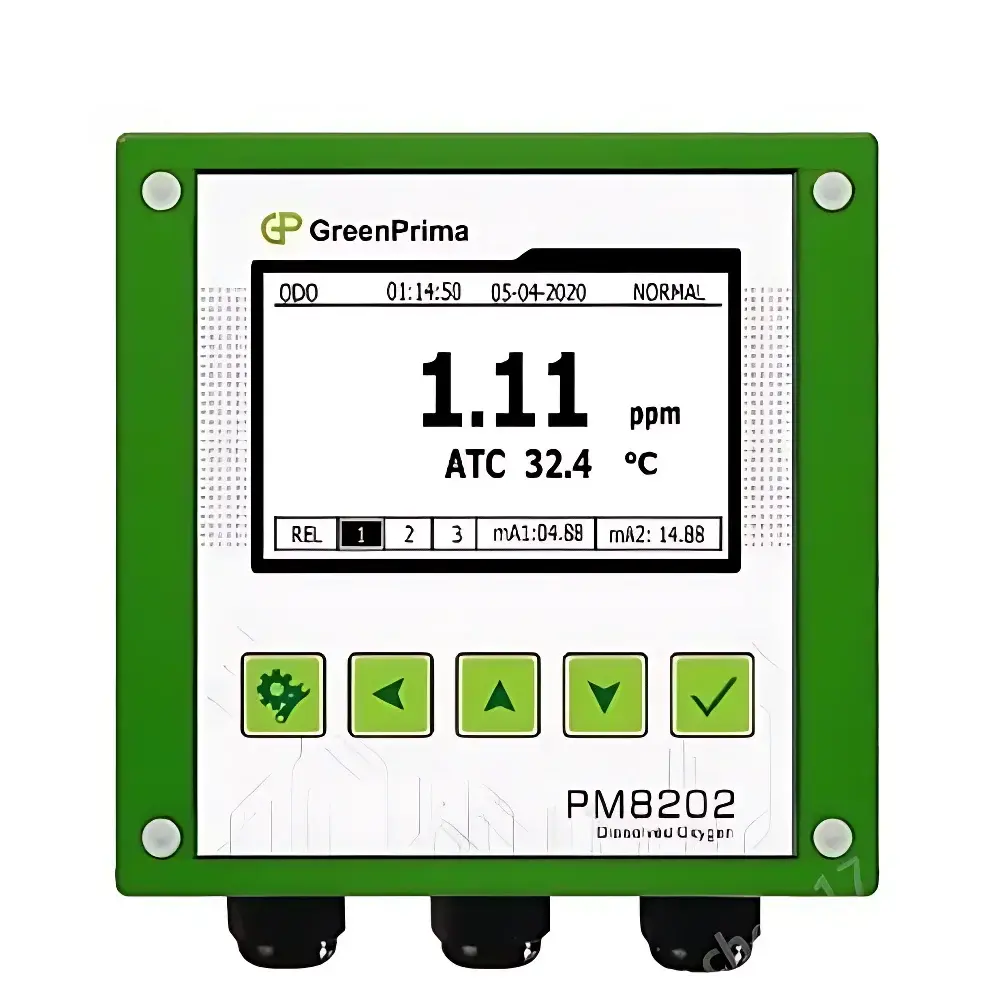
GreenPrima PM8202 O Fluorescence-Based Online Dissolved Oxygen Analyzer
| Brand | GreenPrima |
|---|---|
| Origin | United Kingdom |
| Manufacturer Type | Original Equipment Manufacturer (OEM) |
| Product Category | Imported Instrument |
| Model | PM8202 O |
| Instrument Type | Online |
| Measurement Principle | Fluorescence Quenching |
| Measurement Range | 0.00–20.00 ppm |
| Accuracy | ±0.01 ppm |
Overview
The GreenPrima PM8202 O is an online dissolved oxygen (DO) analyzer engineered for continuous, maintenance-free monitoring in demanding water quality applications. It employs the optical fluorescence quenching principle—where molecular oxygen dynamically quenches the excited-state lifetime of a ruthenium-based luminophore immobilized on a gas-permeable sensor cap. Unlike electrochemical sensors (e.g., Clark-type polarographic or galvanic cells), this method eliminates oxygen consumption during measurement, requires no electrolyte replenishment or membrane replacement, and delivers stable calibration over extended periods. The instrument is designed for integration into municipal wastewater treatment plants, drinking water distribution networks, aquaculture systems, industrial process streams, and environmental monitoring stations where long-term reliability, low drift, and immunity to flow velocity or hydrogen sulfide interference are critical.
Key Features
- Optical fluorescence sensing with solid-state luminophore coating—no consumables, zero polarization time, and insensitivity to H2S, CO2, or chloride ions
- High-precision analog and digital (4–20 mA, Modbus RTU RS-485) outputs for seamless PLC/SCADA integration
- Stainless steel 316L housing rated IP68 for submersible or wall-mounted installation in wet, corrosive environments
- Operating temperature range: −10 °C to +60 °C; sensor cap rated for intermittent exposure up to +80 °C during cleaning or disinfection cycles
- Maximum pressure rating: 5 bar (72.5 psi), suitable for pressurized pipelines and submerged installations
- Factory-calibrated with NIST-traceable standards; optional two-point field calibration using air-saturated water and zero-oxygen solution (sodium sulfite)
- Integrated temperature compensation via built-in Pt1000 RTD, compliant with ISO 5814 and ASTM D888–22
Sample Compatibility & Compliance
The PM8202 O is validated for use in freshwater, seawater, activated sludge, filtered process water, and low-conductivity ultrapure water (≥10 µS/cm). Its optical design avoids fouling-related signal attenuation common in electrochemical DO probes—making it especially suited for high-solids or biofilm-prone applications. The sensor meets IEC 61000-6-2 (immunity) and IEC 61000-6-4 (emissions) for industrial electromagnetic compatibility. It supports GLP-compliant data logging when paired with GreenPrima’s optional DO-LogPro acquisition module, and its firmware architecture enables audit trails and user-access controls aligned with FDA 21 CFR Part 11 requirements for regulated water utilities and pharmaceutical water systems.
Software & Data Management
The analyzer operates standalone but is fully compatible with GreenPrima’s AquaView™ Configuration & Diagnostics Suite (Windows/macOS), enabling remote parameter configuration, real-time waveform visualization of fluorescence decay kinetics, diagnostic event logging (e.g., sensor cap degradation alerts), and export of timestamped CSV datasets. All calibration events, firmware updates, and alarm triggers are recorded with user ID and UTC timestamps. Optional cloud connectivity via MQTT or OPC UA allows ingestion into centralized water intelligence platforms (e.g., OSIsoft PI System, Siemens Desigo CC) for predictive maintenance modeling and regulatory reporting per EU WFD or US EPA Clean Water Act guidelines.
Applications
- Continuous DO monitoring in aeration basins and secondary clarifiers to optimize blower energy consumption
- Real-time control of dissolved oxygen setpoints in membrane bioreactors (MBRs) and moving bed biofilm reactors (MBBRs)
- Compliance tracking for discharge permits requiring hourly DO reporting (e.g., NPDES, UK EA standards)
- Process validation in purified water (PW) and water-for-injection (WFI) loops per USP and
- Long-term ecological monitoring in rivers, reservoirs, and estuarine zones using solar-powered telemetry enclosures
- Quality assurance in recirculating aquaculture systems (RAS) where DO fluctuations directly impact feed conversion ratios and mortality rates
FAQ
How does fluorescence-based DO measurement differ from polarographic methods?
Fluorescence quenching measures oxygen concentration via non-contact optical detection of luminescent decay time—eliminating electrode poisoning, electrolyte depletion, and flow dependence inherent in Clark-type sensors.
Is the PM8202 O suitable for seawater applications?
Yes—the sensor cap uses hydrophobic fluoropolymer matrix resistant to salt crystallization and biofouling; optional antifouling gel coating available for extended deployment in marine environments.
What maintenance intervals are recommended?
No routine maintenance is required; annual verification against certified standard solutions is advised. Sensor cap replacement is typically needed every 24–36 months depending on exposure conditions.
Can the output be integrated with existing SCADA systems?
Yes—4–20 mA analog output with HART protocol support and native Modbus RTU over RS-485 ensure plug-and-play interoperability with major industrial automation platforms.
Does the analyzer comply with drinking water safety regulations?
It meets material compliance requirements per NSF/ANSI 61 and EN 14897 for contact with potable water, and its measurement uncertainty falls within the ±0.01 ppm tolerance specified in ISO 5814:2012 for Class A instruments.







