
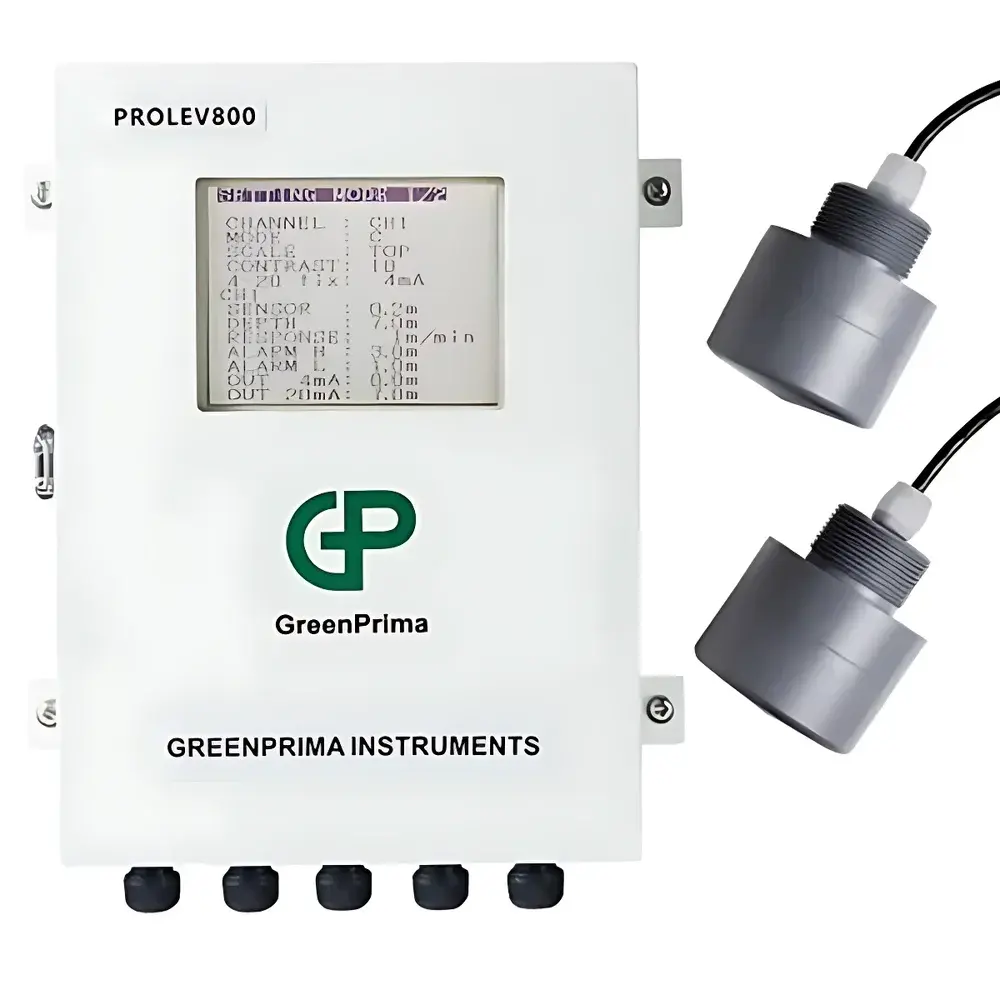
GreenPrima PROLEV-800 Ultrasonic Sludge Level Interface Gauge
| Brand | GreenPrima |
|---|---|
| Origin | United Kingdom |
| Manufacturer Type | Original Equipment Manufacturer (OEM) |
| Origin Category | Imported |
| Model | PROLEV-800 |
| Pricing | Upon Request |
| Measurement Range | 0.4–10 m |
| Sensor Capacity | Up to 2 independent transducers |
| Accuracy | ±1 cm |
| Response Time | 1 s |
| Operating Ambient Temperature | −20 to +60 °C |
| Display | Large-backlit LCD with graphical interface (numerical readout, trend plot, echo waveform) |
| Enclosure Rating | IP68 |
| Weight | 3.6 kg (transmitter), 3 kg (per probe) |
| Output Signal | 4–20 mA analog output |
| Alarm Outputs | Dual programmable high/low level relay outputs |
| Communication Interface | RS-232C (cable length ≤10 m) |
| Power Supply | 85–264 VAC, 10 VA |
| Cable Length | 20 m |
| Brightness Adjustment | Yes |
| Trend Logging Duration | 5 minutes to 48 hours on display |
Overview
The GreenPrima PROLEV-800 is a purpose-engineered ultrasonic sludge interface gauge designed for continuous, non-contact measurement of sludge blanket depth and sediment layer thickness in wastewater treatment basins. Operating on the principle of time-of-flight ultrasonic pulse echo, the device emits high-frequency acoustic waves (typically 20–50 kHz) from a submerged or top-mounted transducer; the time delay between transmission and reception of echoes reflected at the liquid–sludge and sludge–supernatant interfaces is converted into precise vertical distance measurements. Unlike optical or conductivity-based methods, ultrasonic sensing remains unaffected by turbidity, suspended solids concentration, or chemical composition—making it especially robust for primary clarifiers, secondary settling tanks, gravity thickeners, and ash slurry ponds where stratification dynamics are critical to process stability. The PROLEV-800 delivers real-time interface profiling, enabling operators to quantify sludge blanket rise rate, detect early-stage bulking events, and validate hydraulic retention time assumptions—all without mechanical intrusion or calibration drift.
Key Features
- Large backlit LCD display supporting simultaneous numerical depth values, real-time echo waveform visualization, and dynamic trend plots (5 min to 48 h)
- Dual-transducer capability: single transmitter unit supports two independent ultrasonic probes—ideal for differential interface monitoring (e.g., supernatant–sludge and sludge–settled solids)
- Embedded microprocessor with adaptive signal averaging and noise suppression algorithms ensures stable readings under variable surface agitation or gas entrainment
- No moving parts or consumables; maintenance-free operation compliant with long-term unattended deployment requirements
- Adjustable display brightness for optimal legibility under varying ambient lighting conditions (e.g., outdoor tank walkways or indoor control rooms)
- Programmable dual relay outputs for high/low sludge level alarms—configurable via front-panel interface or RS-232 command set
- IP68-rated transmitter housing and probe encapsulation suitable for permanent submersion in aggressive wastewater environments
Sample Compatibility & Compliance
The PROLEV-800 is validated for use across heterogeneous sludge matrices—including activated sludge, anaerobic digester feed, primary settleable solids, coal-wash plant tailings, and fly ash slurries—with densities ranging from 1.02 to 1.15 g/cm³. Its ultrasonic methodology eliminates interference from organic loading fluctuations, polymer dosing, or seasonal temperature shifts common in municipal and industrial wastewater streams. The instrument conforms to IEC 61326-1 (EMC for industrial environments) and meets CE marking requirements for electromagnetic compatibility and low-voltage safety. While not intrinsically safe, optional ATEX-certified variants are available upon request for Zone 2 hazardous area deployment. Data integrity aligns with GLP/GMP-aligned operational practices through deterministic response timing (<1 s), traceable analog output (4–20 mA), and audit-ready parameter configuration logs stored onboard.
Software & Data Management
Configuration and diagnostics are performed locally via the integrated keypad and LCD interface or remotely via ASCII-based RS-232 protocol (baud rate up to 115.2 kbps). Standard Modbus RTU firmware extension is available for integration into SCADA systems (e.g., Siemens Desigo, Honeywell Experion, or Schneider EcoStruxure). All user-modifiable parameters—including damping factor, echo threshold, alarm hysteresis, and trend interval—are password-protected and retain settings after power cycle. No proprietary software installation is required; terminal emulation tools (e.g., PuTTY, Tera Term) suffice for commissioning. The device does not store historical data beyond the on-screen trend buffer; however, its 4–20 mA output provides seamless connection to PLCs or DCS historians for long-term archival per ISO 55000 asset management frameworks.
Applications
- Primary and secondary clarifiers in municipal wastewater treatment plants (WWTPs) for optimizing return activated sludge (RAS) and waste activated sludge (WAS) flow rates
- Gravity thickeners and dissolved air flotation (DAF) units requiring accurate sludge blanket control to prevent overflow or under-thickening
- Coal preparation plants monitoring sedimentation efficiency in coal-wash effluent ponds
- Power generation facilities managing bottom ash and fly ash slurry levels in settling basins and recycle sumps
- Industrial pretreatment systems handling high-solids influents from food processing, pulp & paper, or textile manufacturing
- Research-scale bioreactors and pilot plants where sludge volume index (SVI) validation and settling velocity profiling are essential
FAQ
Can the PROLEV-800 distinguish between multiple layers (e.g., scum, sludge, and settled solids)?
Yes—the device identifies up to two distinct acoustic impedance boundaries within its 0.4–10 m range, enabling separate tracking of supernatant–sludge and sludge–compacted solids interfaces when properly configured and installed.
Is calibration required after installation?
No field calibration is needed; factory-trimmed transducers ensure ±1 cm accuracy across the full measurement span. Zero offset may be adjusted via menu if mounting geometry changes.
What is the maximum cable distance between transmitter and probe?
Standard configuration includes 20 m of armored, shielded cable rated for submersion. Extended lengths up to 50 m are supported with signal repeater modules (optional accessory).
Does the unit support HART or Profibus communication protocols?
The base model features RS-232 only; HART-enabled versions (4–20 mA + digital overlay) and Profibus DP slave modules are available as custom-order configurations.
How does the system handle foam or floating scum layers?
Foam attenuates ultrasonic energy but does not eliminate detection—advanced echo processing prioritizes the strongest consistent reflection, typically from the underlying sludge interface, unless foam exceeds 30 cm thickness and exhibits high acoustic absorption.







