
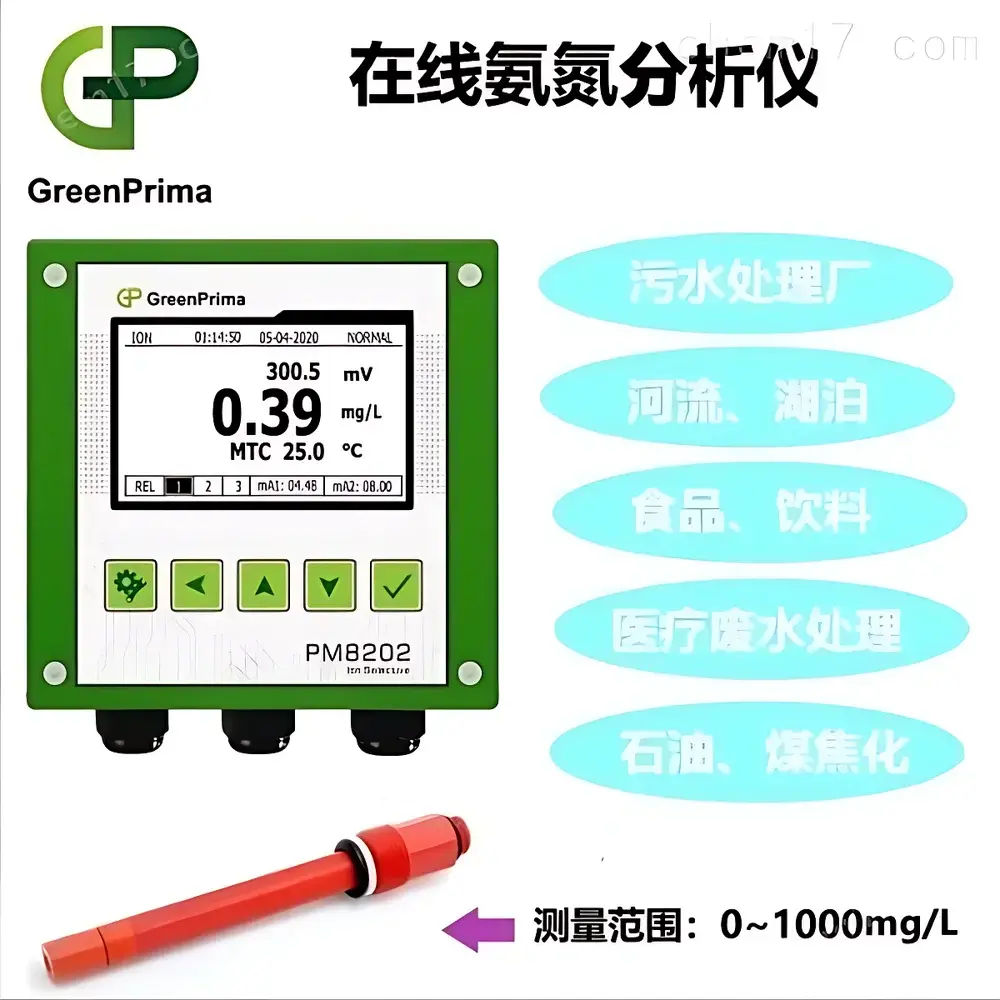
GreenPrima PM 8202I Online Ammonia-Nitrogen (NH₃-N) Analyzer
| Brand | GreenPrima |
|---|---|
| Origin | United Kingdom |
| Manufacturer Type | Manufacturer |
| Origin Category | Imported |
| Model | PM 8202I |
| Instrument Type | Online Analyzer |
| Ion Measured | Ammonium/NH₃-N |
| Measurement Range | 0–1000 mg/L |
| Detection Limit | 0.1 mg/L |
| Response Time | 5 min |
| Measurement Accuracy | ±5% F.S. |
| Operating Temperature Range | 0–80 °C |
| Resolution | 0.01 mg/L |
| Temperature Compensation | -10–130 °C (NTC10K/PT1000, manual/auto) |
| Display | Backlit dot-matrix LCD |
| Communication | RS485 Modbus RTU (HART optional) |
| Output | Dual isolated 4–20 mA (max 500 Ω, 0.1% F.S.) |
| Alarm Outputs | 2 independent Hi/Lo relays (5 A / 250 VAC / 30 VDC) |
| Enclosure Rating | IP65 |
| Dimensions | 144 × 144 × 108 mm |
| Panel Cutout | 138 × 138 mm |
| Weight | 0.87 kg |
| Sensor Model | Bsen730 |
| Electrode Material | PPS |
| Max Pressure Rating | 3.5 bar |
| Cable Length | 5 m |
Overview
The GreenPrima PM 8202I Online Ammonia-Nitrogen (NH₃-N) Analyzer is a dedicated, ion-selective electrode (ISE)-based continuous monitoring system engineered for reliable, real-time quantification of total ammonia nitrogen in aqueous matrices. It operates on the potentiometric principle: the Bsen730 ammonium-selective sensor generates a stable Nernstian voltage response proportional to the logarithm of NH₄⁺ activity in solution, which the PM 8202I controller converts into concentration (mg/L as NH₃-N) with integrated temperature compensation. Designed for unattended operation in demanding environmental and industrial water streams, the analyzer delivers high reproducibility and long-term stability without reagent consumption or optical path fouling—making it particularly suitable for applications where colorimetric or UV-based methods suffer from interferences (e.g., turbidity, organic coloration, or chloride masking).
Key Features
- Robust IP65-rated, fully sealed enclosure with corrosion-resistant housing—engineered for wall-mount, pipe-mount, or panel-mount installation in wet or dusty environments.
- Dual isolated 4–20 mA analog outputs configurable for NH₃-N concentration and process temperature; each calibrated to 0.1% full-scale accuracy with galvanic isolation.
- RS485 Modbus RTU interface standard; optional HART protocol support enables integration into legacy DCS/SCADA systems and centralized asset management platforms.
- Backlit high-contrast dot-matrix LCD display showing real-time NH₃-N value, measured temperature, relay status, and diagnostic flags—supporting both English and Chinese menu navigation.
- User-configurable cleaning cycle (0.1–1000 h interval; 1–1000 s duration) via programmable relay output to drive external solenoid valves or air-burst systems—critical for maintaining sensor performance in suspended-solids-rich influent streams.
- Two independent alarm relays with adjustable hysteresis, supporting fail-safe shutdown, pump activation, or data logging triggers under out-of-spec conditions.
- Secure access control via password-protected calibration (default code: 1010) and configuration modes (default: 2020), ensuring operational integrity in shared or regulated facilities.
Sample Compatibility & Compliance
The PM 8202I is validated for continuous monitoring of municipal drinking water, wastewater effluent, industrial cooling water, and aquaculture recirculation systems. The Bsen730 sensor exhibits minimal cross-sensitivity to common anions (Cl⁻, NO₃⁻, SO₄²⁻) and cations (Na⁺, Ca²⁺, Mg²⁺) within typical water matrices. It complies with ISO 7888 (water quality — determination of ammonium — ion-selective electrode method) and supports GLP/GMP-aligned data integrity through timestamped calibration logs and event-driven audit trails. While not intrinsically certified for hazardous areas, its 24 VDC option and low-power architecture facilitate safe deployment in Zone 2 classified environments when paired with appropriate barrier systems.
Software & Data Management
The controller stores up to 30 days of 1-minute interval historical data onboard, including NH₃-N readings, temperature, calibration timestamps, and alarm events. Data export is supported via Modbus polling or manual USB dump (via optional adapter). All calibration actions—including standard addition, two-point slope verification, and zero-point adjustment—are digitally logged with user ID (if enabled), date/time stamp, and pre-/post-calibration deviation. The system meets foundational requirements for FDA 21 CFR Part 11 compliance when deployed with external electronic logbook solutions that enforce electronic signatures, audit trail retention, and role-based access control.
Applications
- Real-time monitoring of ammonia breakthrough at drinking water treatment plant final effluent points.
- Process control of nitrification/denitrification basins in activated sludge plants—enabling dynamic DO and carbon dosing adjustments.
- Regulatory compliance reporting for NPDES or EU Urban Wastewater Treatment Directive discharge permits.
- Early-warning detection of ammonia spikes in industrial cooling towers or boiler feedwater circuits.
- Automated feedback control of ammonium removal via ion exchange or breakpoint chlorination systems.
- Long-term trend analysis in surface water bodies and groundwater monitoring wells using solar-powered telemetry configurations.
FAQ
What is the recommended calibration frequency for the Bsen730 sensor in continuous operation?
Calibration should be performed at least once every 7 days in clean influent; for high-fouling or variable-pH applications, daily single-point verification against a mid-range standard (e.g., 50 mg/L NH₃-N) is advised.
Does the PM 8202I require pH adjustment or buffering of the sample stream?
No—ammonia ISE measurement is inherently pH-dependent above ~pH 9, but the Bsen730 sensor is optimized for direct measurement in natural waters (pH 6–9); outside this range, inline pH stabilization is required prior to sampling.
Can the analyzer measure free ammonia (NH₃) separately from total ammonia nitrogen (TAN)?
No—the PM 8202I reports total ammonia nitrogen (NH₃-N) as defined by standard regulatory practice; free ammonia calculation requires concurrent, synchronized pH and temperature inputs not provided by this platform.
Is the sensor compatible with automatic sample filtration?
Yes—Bsen730 accepts filtered samples down to 5 µm; however, mechanical filtration must precede the sensor inlet to prevent membrane clogging and ensure laminar flow across the electrode surface.
How does temperature compensation function in the PM 8202I?
The controller accepts input from either NTC10K or PT1000 sensors, applying a dual-coefficient polynomial algorithm per ISO 7888 Annex B to correct the Nernst slope and reference potential drift across 0–80 °C.







