
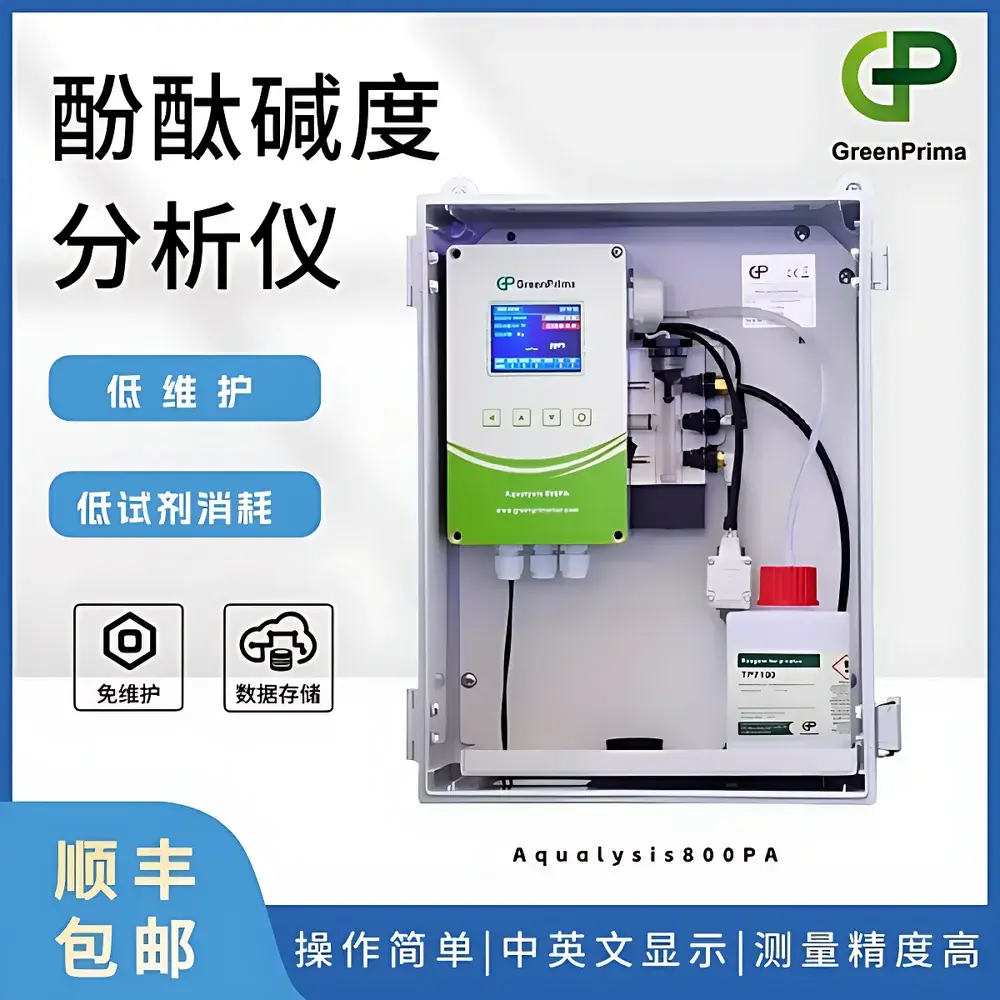
GreenPrima Aqualysis800PA Phenolphthalein Alkalinity Analyzer
| Brand | GreenPrima |
|---|---|
| Origin | United Kingdom |
| Manufacturer Type | Manufacturer |
| Origin Category | Imported |
| Model | Aqualysis800PA |
| Price | Upon Request |
Overview
The GreenPrima Aqualysis800PA Phenolphthalein Alkalinity Analyzer is a fully automated, benchtop-to-industrial inline analyzer engineered for precise, continuous determination of phenolphthalein alkalinity (P-alkalinity) in aqueous process streams. It operates on the principle of potentiometrically guided acid–base titration coupled with photometric endpoint detection: a precisely metered volume of standardized hydrochloric acid is delivered to the sample; upon reaching the phenolphthalein endpoint (pH ≈ 8.3), a proprietary indicator reagent is introduced, inducing a distinct color shift. This spectral change is quantified via a stable LED-based photometer with dual-wavelength optical path, enabling robust discrimination against turbidity and background chromatic interference. Designed for unattended operation in demanding industrial water management environments—including steelmaking gas scrubber effluents, recirculating cooling systems, boiler feedwater circuits, and municipal wastewater treatment—its architecture integrates microprocessor-controlled fluidics, real-time diagnostics, and fail-safe reagent delivery to ensure metrological integrity across extended deployment cycles.
Key Features
- Automated titration–photometric endpoint detection with ±1% repeatability and ±2% accuracy relative to selected reagent upper limit
- Compact footprint (400 × 300 × 180 mm; 4 kg) and IP65-rated enclosure for installation in semi-outdoor or utility-room environments
- Integrated 7-inch color LCD touchscreen interface supporting bilingual (English/Chinese) operation and contextual system diagnostics
- Configurable measurement modes: continuous analysis or programmable interval sampling (1–360 minutes)
- Low-consumption fluidic design—average reagent usage 30 days of uninterrupted operation on standard 500-mL reagent packs
- Four programmable relay outputs (250 V AC / 4 A max) for alarm signaling, pump control, or interlock integration
- Two digital inputs (IN1: start analysis trigger; IN2: stop/halt command) compatible with flow switches, level sensors, or DCS-initiated polling
- Power-efficient operation: 25 VA active power draw; 3.5 VA standby consumption
- Comprehensive data logging: internal non-volatile memory stores up to 10,000 measurement records, calibration logs, and fault timestamps with ISO 8601-compliant time stamping
Sample Compatibility & Compliance
The Aqualysis800PA is validated for use with clarified or low-turbidity aqueous matrices meeting specified physicochemical constraints: pH 4–10, dissolved iron < 3 ppm, copper < 0.2 ppm, aluminum < 0.1 ppm, and manganese < 0.2 ppm. Sample temperature must remain within 5–40°C; ambient operating range is 10–40°C. Inlet pressure tolerance spans 0.2–5 bar (recommended 1–2 bar). The analyzer complies with IEC 61000-6-2 (EMC immunity) and IEC 61000-6-4 (EMC emissions), and supports audit-ready operation under GLP and GMP frameworks via timestamped event logging, user-access-level authentication, and RS485 Modbus RTU protocol for traceable data export. While not certified to USP or ASTM D1066, its measurement methodology aligns with ISO 9963-1 (water quality — determination of alkalinity — part 1: titrimetric methods) for phenolphthalein endpoint determination.
Software & Data Management
Embedded firmware provides closed-loop control of all analytical sequences—including acid dosing, indicator injection, optical reading, endpoint validation, and auto-zero compensation. Calibration routines support single-point standard verification and multi-point linearization using certified CaCO₃ reference solutions. All configuration parameters, calibration coefficients, and diagnostic flags are stored with write-protected checksums. Data export occurs via isolated RS485 (Modbus RTU), analog 4–20 mA output (scalable to 0–200 mg/L as CaCO₃ or 0–5 mmol/L), and optional Ethernet gateway module (sold separately). Firmware updates are performed via USB flash drive with SHA-256 signature verification to ensure integrity.
Applications
The Aqualysis800PA delivers reliable P-alkalinity quantification in high-turnover industrial water loops where rapid pH buffering capacity assessment is critical to corrosion inhibition and scale prevention. Primary deployment contexts include: basic oxygen furnace (BOF) and electric arc furnace (EAF) gas scrubber water circuits; open- and closed-loop recirculating cooling systems in power generation and petrochemical facilities; low-pressure boiler feedwater monitoring to prevent caustic embrittlement; and tertiary treatment effluent verification prior to discharge or reuse. Its compatibility with GreenPrima’s MCS-series multi-channel selector manifolds enables synchronized, staggered analysis across 2–8 independent sample points without service interruption—ideal for comparative monitoring of parallel treatment trains.
FAQ
What is phenolphthalein alkalinity, and how does it differ from total alkalinity?
Phenolphthalein alkalinity (P-alkalinity) measures the hydroxide (OH⁻) and half the carbonate (CO₃²⁻) contribution to buffering capacity, titrated to pH 8.3. Total alkalinity (M-alkalinity) includes all OH⁻, CO₃²⁻, and HCO₃⁻ species, titrated to pH 4.5. The Aqualysis800PA reports P-alkalinity exclusively.
Can the instrument be integrated into a SCADA or DCS system?
Yes—via isolated RS485 Modbus RTU or 4–20 mA analog output. Configuration files and register maps are supplied in standard Modbus format compliant with IEC 61158.
Is routine maintenance required beyond reagent replacement?
No scheduled mechanical maintenance is needed. The system performs automatic line flushing (configurable 15–1800 s) and self-diagnostic checks at startup and between cycles. Valve wear is minimized via pulse-width-modulated actuation and ceramic-core solenoid valves rated for >500,000 cycles.
Does the analyzer support remote firmware updates or cloud connectivity?
Firmware updates are performed locally via USB; cloud connectivity requires optional Ethernet gateway hardware and third-party MQTT/OPC UA middleware—not provided by default.
What sample filtration is recommended upstream of the analyzer?
A 50-µm particulate filter is mandatory. For samples containing suspended solids >10 mg/L or oil emulsions, a coalescing prefilter or centrifugal separator is advised to prevent flow-path occlusion.







