
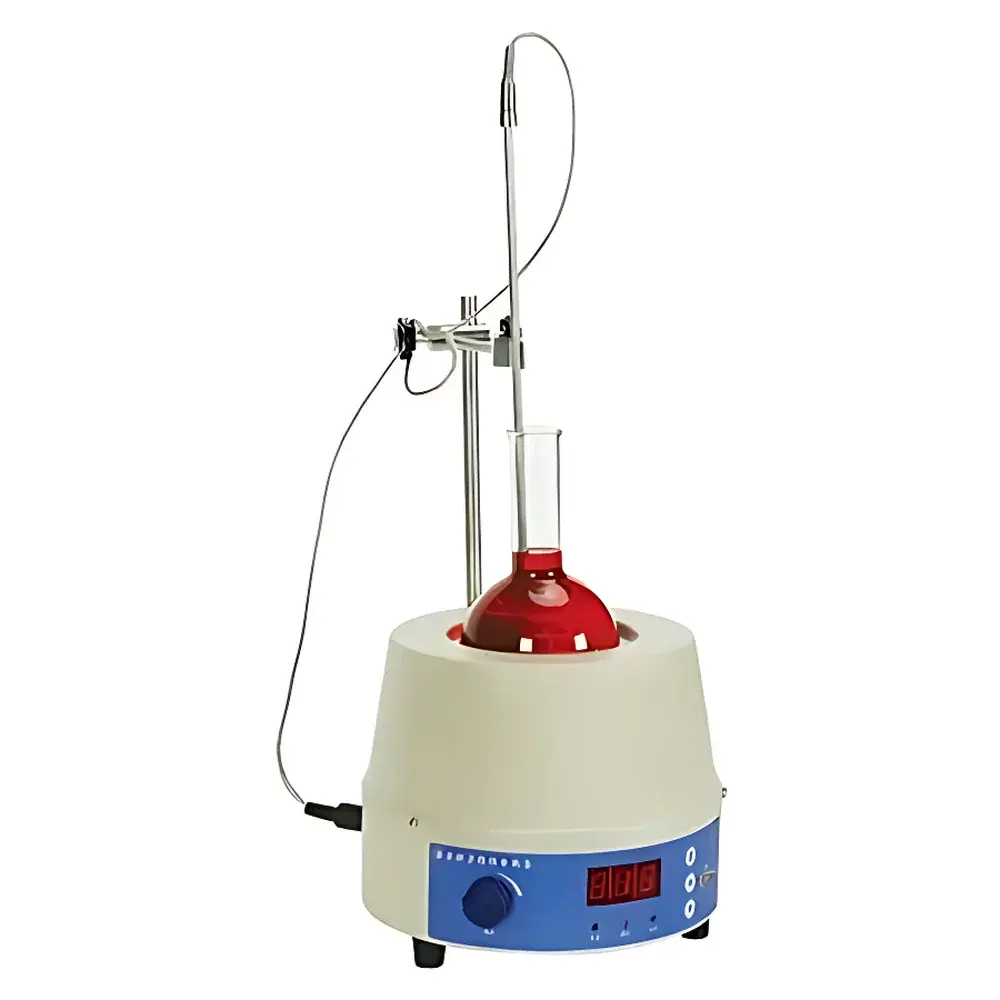
Zhongke Aobo HJ-6A Intelligent Magnetic Stirring Heating Mantle
| Brand | Zhongke Aobo |
|---|---|
| Origin | Beijing, China |
| Model | HJ-6A (100–2000 mL capacity variants) |
| Maximum Stirring Volume | 20 L |
| Speed Range | 0–1200 rpm |
| Temperature Control Range | Ambient to 380 °C (heating element surface temperature) |
| Power Rating | 100–4000 W (model-dependent) |
| Voltage | 220 V ±10%, 50 Hz |
| Insulation Material | High-temperature alkali-free fiberglass |
| Heating Element | Sealed Ni-Cr resistance wire |
| Enclosure | Seamless deep-drawn metal housing with epoxy coating |
Overview
The Zhongke Aobo HJ-6A Intelligent Magnetic Stirring Heating Mantle is a benchtop laboratory device engineered for simultaneous precise temperature control and magnetic agitation of liquid samples in glass vessels. It operates on the principle of resistive heating—where embedded Ni-Cr alloy resistance wire generates thermal energy—and electromagnetic coupling, wherein a rotating magnetic field beneath the mantle induces rotation of a PTFE-coated stir bar inside the vessel. Unlike hotplate stirrers, the HJ-6A employs a semi-spherical, conformal heating mantle design that envelops the lower portion of round-bottom or flat-bottom flasks, enabling uniform radial heat distribution and minimizing thermal gradients. This architecture supports consistent reaction kinetics and evaporation control in applications ranging from solvent reflux to catalyst synthesis. The unit is designed for continuous-duty operation under ambient laboratory conditions and complies with general electrical safety requirements for Class I laboratory equipment (IEC 61010-1).
Key Features
- Conformal semi-spherical heating mantle constructed from high-purity alkali-free fiberglass insulation, ensuring thermal stability up to 380 °C at the heating element surface without degradation or outgassing.
- Seamless deep-drawn metal enclosure with electrostatic epoxy powder coating, providing mechanical robustness and resistance to chemical splashes and moisture ingress.
- Zero-contact electronic speed regulation via solid-state circuitry—eliminating carbon brush wear, arcing, or speed drift across the 0–1200 rpm range.
- Non-contact electronic temperature regulation with proportional-integral (PI) control logic, delivering stable setpoint maintenance within ±5 °C under steady-state conditions (load-dependent).
- Modular capacity configuration: available in standardized mantle sizes supporting vessels from 100 mL to 2000 mL nominal volume; compatible with larger vessels (up to 20 L total volume) when used with appropriately sized stir bars and optimized geometry.
- Integrated thermal cut-off protection with dual-stage overtemperature sensing to prevent uncontrolled thermal runaway during extended operation.
Sample Compatibility & Compliance
The HJ-6A is compatible with standard borosilicate glassware including round-bottom flasks (e.g., ASTM E2879-compliant), flat-bottom beakers, and jacketed reactors. Its mantle geometry accommodates vessels with diameters ranging from 45 mm to 150 mm. The device does not require direct contact between heating surface and vessel wall, reducing risk of thermal shock or localized overheating. While not certified to ISO/IEC 17025 or GLP-specific validation protocols out-of-the-box, its analog control architecture and traceable calibration points support user-led IQ/OQ documentation per internal SOPs. For regulated environments, it may serve as ancillary equipment in non-critical process steps where temperature and agitation parameters are independently monitored and recorded via external data loggers compliant with FDA 21 CFR Part 11 requirements.
Software & Data Management
The HJ-6A operates as a standalone analog instrument without embedded microprocessor-based software or digital communication interfaces (e.g., RS-232, USB, or Ethernet). All operational parameters—including speed setpoint and temperature setpoint—are adjusted manually via front-panel rotary dials with calibrated scales. Real-time status indicators include LED-based speed and temperature feedback. For integration into automated workflows, optional third-party analog signal adapters (0–10 V or 4–20 mA output modules) can be employed to interface with PLCs or SCADA systems. Users performing method validation or audit-ready operations are advised to pair the unit with external calibrated thermocouple probes (e.g., Type K or T) and tachometric sensors for independent parameter verification and electronic record generation.
Applications
- Controlled heating and mixing during organic synthesis, including Grignard reactions, esterifications, and polymerization initiations requiring inert atmosphere compatibility.
- Standardized dissolution testing in pharmaceutical QC labs, particularly for formulations requiring elevated temperatures beyond conventional water-bath limits.
- Environmental sample preparation—e.g., acid digestion of soil or sediment matrices prior to ICP-MS analysis—where reproducible ramp-and-hold thermal profiles improve analyte recovery.
- Biotechnology workflows involving enzyme-catalyzed reactions, microbial culture media preparation, or buffer equilibration under defined thermal and mixing conditions.
- Educational laboratories conducting calorimetry experiments, reaction rate studies, or viscosity assessments where variable-speed agitation correlates directly with shear history.
FAQ
Is the HJ-6A suitable for use with corrosive solvents such as concentrated HNO₃ or HF?
The mantle’s fiberglass insulation and epoxy-coated housing provide moderate resistance to incidental splashes of common lab acids and bases; however, prolonged exposure to hydrofluoric acid or fuming nitric acid is not recommended. Always verify chemical compatibility using manufacturer-supplied material safety data before deployment.
Can the unit maintain temperature uniformity across a 5-L flask?
While the HJ-6A supports vessels up to 20 L in total volume, optimal thermal uniformity is achieved in vessels ≤2 L. For larger volumes, supplemental insulation (e.g., glass wool sleeves) and reduced ramp rates are advised to mitigate axial temperature gradients.
Does the device include a timer function or programmable ramping capability?
No—the HJ-6A lacks built-in timing or multi-step thermal programming. Users requiring timed hold periods or linear temperature ramps must implement external controllers or manual intervention.
What stir bar size is recommended for maximum efficiency at 1200 rpm?
For vessels ≥500 mL, elliptical PTFE-coated stir bars measuring 40–60 mm in length and 8–10 mm in diameter demonstrate optimal torque transfer and vortex stability at upper speed ranges.



