
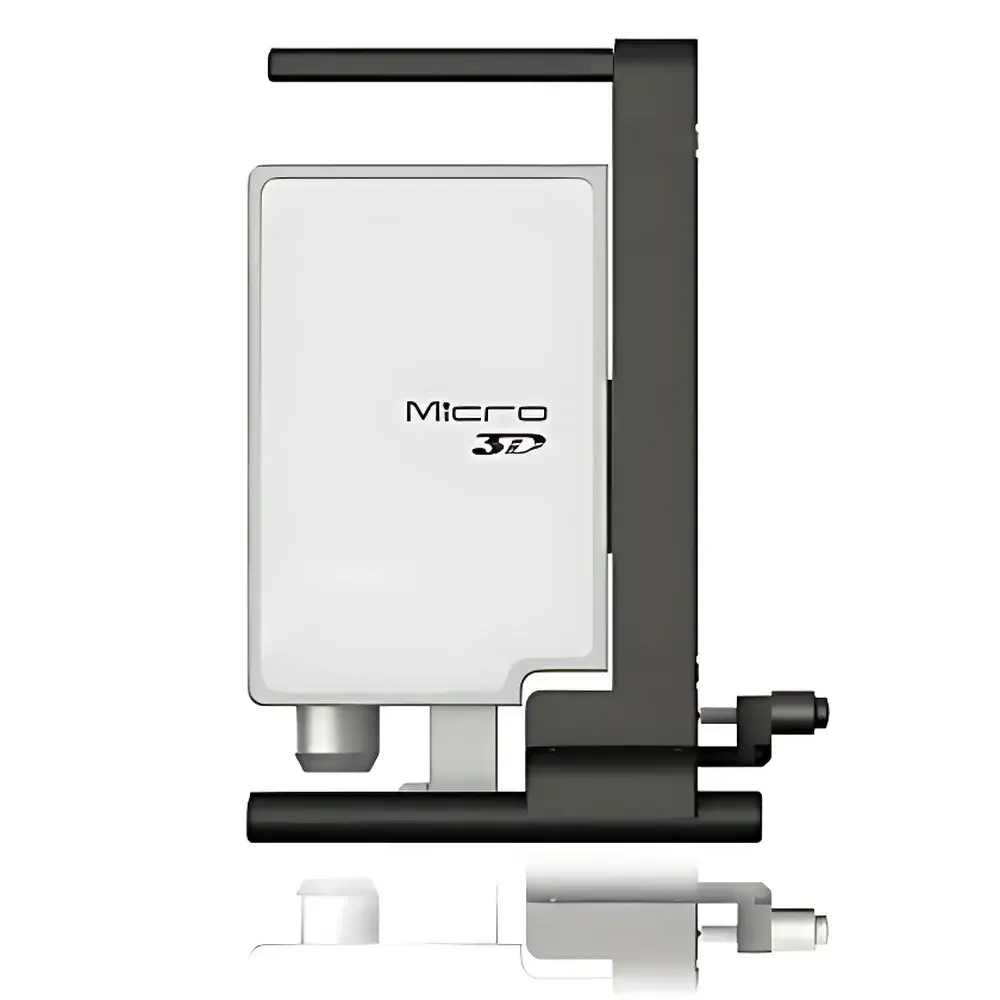
LEI-TECH LK-JCY3D2000 Portable 3D Anilox Roll Inspection System
| Brand | LEI-TECH |
|---|---|
| Origin | Tianjin, China |
| Manufacturer Type | Direct Manufacturer |
| Country of Origin | China |
| Model | LK-JCY3D2000 |
| Product Type | Portable |
| Image Analysis System | Integrated |
| Sensor | Color 2 MP CMOS with Global Shutter |
| Illumination | Coaxial + Stereoscopic Multi-Angle LED Lighting |
| Objectives | 5X, 10X, 20X, 50X Metallurgical-grade Optical Lenses |
| Interface | USB 2.0 |
| Dimensions (L×W×H) | 300 × 123 × 220 mm |
| Weight | ~1600 g |
| Depth Range | 3 mm |
| XY Measurement Accuracy | ±0.5 µm |
| Z-axis Resolution | 200 nm (encoder-based) |
| Z-axis Accuracy | ±1 µm |
| Roller Diameter Compatibility | 100–500 mm |
| XY Stage Travel | 10 mm |
| Image Format | BMP |
| Image Resolution | 1280 × 720 px |
| Software Functions | Multi-focus stacking, 3D surface reconstruction, cross-sectional profile extraction, BCM volume calculation, coating weight estimation, line spacing/angle/line count measurement, open-area quantification, PDF report generation |
Overview
The LEI-TECH LK-JCY3D2000 Portable 3D Anilox Roll Inspection System is a purpose-built optical metrology instrument engineered for non-contact, high-resolution topographic characterization of engraved cylindrical surfaces used in flexographic and gravure printing processes. Unlike conventional 2D microscopy or profilometry systems, the LK-JCY3D2000 employs focus-variation imaging—leveraging a high-stability global-shutter CMOS sensor, precision motorized Z-stage with 200 nm step resolution, and synchronized coaxial plus multi-angle stereoscopic illumination—to acquire depth-resolved image stacks across variable focal planes. These stacks are computationally fused using multi-focus depth-mapping algorithms to generate quantitative 3D surface models with sub-micrometer lateral fidelity and micron-level vertical repeatability. Designed specifically for quality assurance in anilox roll manufacturing and maintenance, the system enables traceable, objective evaluation of critical geometric parameters—including cell geometry (depth, volume, wall angle), engraving uniformity, wear progression, and defect morphology—without requiring sample sectioning or destructive sampling.
Key Features
- True portable architecture: Compact footprint (300 × 123 × 220 mm), battery-free operation via USB bus power, and integrated ball-joint roller support enabling rapid deployment on production floors or in service vans.
- Metallurgical-grade optical path: Interchangeable 5X–50X objectives optimized for high-NA imaging of micro-scale engraved features; combined coaxial and oblique illumination eliminates shadowing artifacts common in deep-cell inspection.
- Sub-micron motion control: Closed-loop piezoelectric-assisted Z-stage delivers 200 nm minimum step size and ±1 µm axial accuracy over a 3 mm depth range—validated per ISO 25178-6 for areal surface texture metrology.
- Vibration-immune mechanical design: Passive damping base and rigid monolithic frame mitigate ambient floor vibration, ensuring measurement stability in industrial environments without external isolation tables.
- Automated metrology workflow: One-click acquisition sequence captures full-depth image stacks; software automatically computes BCM (Billion Cells per Square Inch), volumetric capacity, cell opening area, line count (LPI), engraving angle, and linear dimensions per ASTM D7904 and ISO 12647-6 guidelines.
- Compliant reporting engine: Generates timestamped, audit-ready PDF reports containing raw images, 3D renderings, cross-section plots, statistical summaries, and operator metadata—structured to support GLP/GMP documentation requirements.
Sample Compatibility & Compliance
The LK-JCY3D2000 accommodates anilox rolls with diameters from 100 mm to 500 mm and supports all standard engraving technologies: chemical etching, electronic beam engraving, and laser ablation. Its spherical cradle mount ensures concentric alignment without mandrel-induced distortion. The system meets essential electromagnetic compatibility (EMC) standards per IEC 61326-1 and operates within Class II laser safety limits (IEC 60825-1). While not certified to ISO/IEC 17025 as a calibration laboratory, its measurement uncertainty budget—derived from NIST-traceable stage encoders and validated lens MTF performance—is documented in the user manual for internal quality audits. Data integrity complies with FDA 21 CFR Part 11 principles through secure user authentication, electronic signatures, and immutable audit trails embedded in exported reports.
Software & Data Management
The proprietary 3D Metrology Suite runs natively on Windows 10/11 and communicates exclusively via USB 2.0—no drivers or cloud dependencies required. All processing occurs locally: image stacking, surface reconstruction, and parameter extraction are performed on-device using deterministic C++ algorithms. Raw data (BMP stacks) and processed results (OBJ, CSV, PDF) are stored in folder-based project archives with SHA-256 checksums. Version-controlled software updates are distributed via encrypted firmware packages; no telemetry or remote access functionality is implemented. For integration into enterprise QA systems, the software exports structured CSV files containing all measured metrics—including mean cell depth, standard deviation of volume, skewness of profile distribution, and pass/fail flags against user-defined tolerances—enabling automated SPC charting in third-party platforms such as Minitab or JMP.
Applications
- Pre-delivery verification of new anilox rolls against OEM specifications (e.g., target BCM, cell geometry tolerance bands).
- In-process monitoring of engraving consistency during e-beam or laser roll production lines.
- Wear analysis of in-service rollers: quantifying volume loss, edge rounding, and plugging accumulation across circumferential zones.
- Root-cause investigation of print defects (e.g., mottling, streaking) by correlating local topography deviations with ink transfer behavior.
- Validation of cleaning efficacy following ultrasonic or plasma treatment protocols.
- Technical support documentation for customer-facing service reports—providing objective evidence of roller condition prior to refurbishment or replacement.
FAQ
Does the LK-JCY3D2000 require external calibration artifacts or reference standards?
No. The system uses factory-calibrated encoder feedback and lens-specific distortion maps embedded in firmware. Users may optionally verify Z-axis linearity using a NIST-traceable step-height standard (recommended annually).
Can the software export data in formats compatible with statistical process control (SPC) software?
Yes. All quantitative measurements are exportable as UTF-8 CSV files with header definitions compliant with ASME B89.1.10M and ISO 14253-1 conventions.
Is the system suitable for inspecting ceramic-coated anilox rolls?
Yes. The multi-angle illumination configuration minimizes specular reflection from glazed ceramic surfaces, while the 50X objective resolves features down to 1.2 µm lateral detail—sufficient for evaluating ceramic grain structure and coating integrity.
What is the typical measurement repeatability for BCM volume across repeated scans of the same cell array?
Under controlled environmental conditions (23 ± 2 °C, <50% RH), the coefficient of variation (CV) for BCM volume across five independent acquisitions is ≤4.2%, meeting the repeatability threshold specified in ISO 12647-6 Annex B.



