
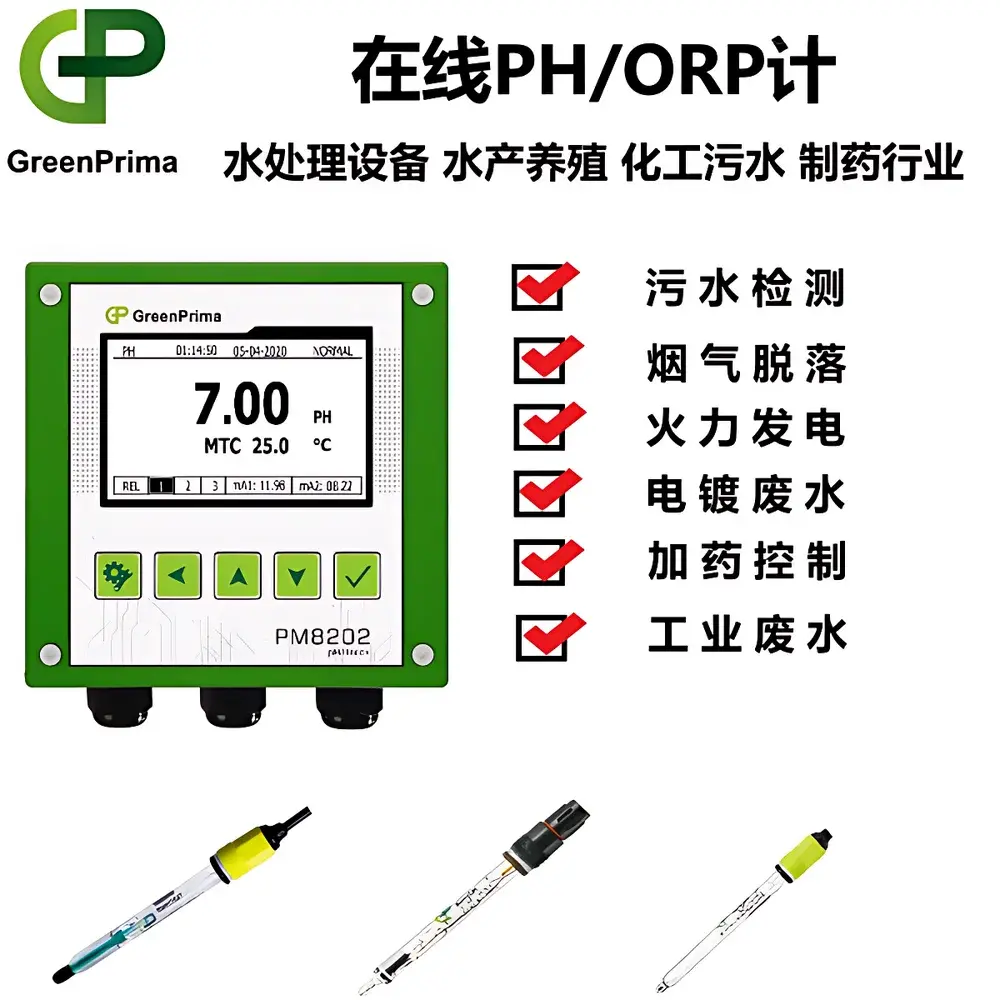
GreenPrima PM8202P Industrial Online ORP Analyzer
| Brand | GreenPrima |
|---|---|
| Origin | United Kingdom |
| Manufacturer Type | Original Equipment Manufacturer (OEM) |
| Product Category | Imported Industrial Online ORP Analyzer |
| Model | PM8202P |
| Instrument Type | Industrial Online ORP Analyzer |
| Measurement Range | −2000 to +2000 mV |
| Resolution | 1 mV |
| Accuracy | ±1 mV |
| Temperature Compensation | −10 to 130 °C (NTC10K / PT1000, manual or automatic) |
| Display | Backlit large-dot-matrix LCD |
| Data Storage | 600,000 records with query function |
| Output | Dual isolated 4–20 mA (max. loop resistance 500 Ω, accuracy 0.1% FS), RS485 Modbus RTU |
| Relay Outputs | 2 independent Hi/Lo alarm relays (5 A / 250 VAC / 30 VDC), 1 multifunction relay for cleaning/cycle/error alerts |
| Cleaning Control | Adjustable interval (0.1–1000 h) and duration (1–1000 s) |
| Enclosure Rating | IP65 |
| Mounting Options | Wall-mount, pipe-mount, panel-mount |
| Dimensions (H×W×D) | 144 × 144 × 108 mm |
| Panel Cutout | 138 × 138 mm |
| Weight | 0.87 kg |
| Power Supply | 90–260 VAC, 50/60 Hz or optional 24 VDC |
| Electrode Model | Bsens210 |
| Electrode Measuring Range | −2000 to +2000 mV |
| Electrode Accuracy | ±1 mV |
| Electrode Sensing Element | Platinum reference electrode with glass body |
| Electrolyte | Polymer-based gel |
| Max. Operating Pressure | 6 bar |
| Connection | PG13.5 fixed thread |
| Reference Junction | Open-flow junction |
| Cable Length | 5 m |
Overview
The GreenPrima PM8202P Industrial Online ORP Analyzer is a high-stability electrochemical monitoring system engineered for continuous redox potential (oxidation-reduction potential) measurement in demanding process environments. Based on the fundamental principle of potentiometric measurement—where the voltage difference between a noble metal sensing electrode (platinum) and a stable reference electrode (Ag/AgCl or similar, housed within a polymer electrolyte gel) is measured against a known reference potential—the analyzer delivers traceable, repeatable mV output proportional to the solution’s electron activity. Unlike pH measurement, ORP does not yield concentration values but serves as a robust, real-time indicator of oxidative or reductive capacity—critical for chlorine dosing control in potable water treatment, passivation verification in pharmaceutical clean-in-place (CIP) systems, cyanide destruction in metallurgical effluents, and redox-driven bioreactor optimization in biochemical manufacturing.
Key Features
- True industrial-grade architecture: Fully sealed IP65 enclosure with corrosion-resistant housing, rated for continuous operation in ambient temperatures from −10 °C to +70 °C and storage down to −20 °C.
- Dual isolated 4–20 mA analog outputs configurable for ORP value, temperature, or alarm status—each calibrated to 0.1% full-scale accuracy with maximum loop resistance support up to 500 Ω.
- RS485 serial interface compliant with Modbus RTU protocol, enabling seamless integration into SCADA, DCS, or PLC-based supervisory systems without proprietary drivers.
- Integrated multifunction relay supports programmable cleaning cycles (interval: 0.1–1000 hours; duration: 1–1000 seconds), error signaling, and timed maintenance alerts—reducing manual intervention and improving sensor longevity.
- Two independent SPDT alarm relays with user-defined setpoints, adjustable hysteresis, and fail-safe configuration options (e.g., energized-on-alarm or de-energized-on-fault).
- Backlit large-dot-matrix LCD display with adjustable contrast and auto-dimming after three minutes of inactivity—optimized for readability under variable lighting conditions in control rooms or field enclosures.
- Firmware-supported multilingual interface (English and Simplified Chinese) with intuitive navigation—designed to minimize operator training time while maintaining full parameter access without external documentation.
Sample Compatibility & Compliance
The PM8202P is compatible with aqueous and mildly aggressive media across a broad operational pH range (−2 to 16 pH equivalent) and temperature span (−5 °C to +100 °C at the electrode tip). Its Bsens210 sensor features an open-junction reference design and polymer electrolyte, minimizing clogging in suspended-solids-rich streams (e.g., wastewater influent, pulp & paper liquors) and ensuring stable potential drift < 2 mV/24 h under steady-state conditions. The system meets IEC 61000-6-2 (immunity) and IEC 61000-6-4 (emissions) standards for industrial environments. While ORP itself is not directly standardized under ISO or ASTM for calibration traceability, the analyzer supports documented calibration procedures aligned with ASTM D1129 (Standard Terminology Relating to Water) and EPA Method 150.2 (for oxidant residual monitoring). Data logging functionality—including timestamped mV, temperature, and relay status—supports GLP-compliant record retention when paired with validated external storage systems.
Software & Data Management
The embedded firmware enables local data acquisition and non-volatile storage of up to 600,000 timestamped records—comprising ORP value (mV), temperature (°C), system status flags, and relay activation events. Records are stored in chronological order with millisecond-level time resolution and support forward/backward search by date range, value threshold, or event type. No proprietary software is required for basic retrieval: logged data can be exported via Modbus register polling using standard industrial HMI tools or custom Python/Node-RED scripts. For audit-ready deployments, the system accommodates external historian integration via OPC UA gateways (when used with compatible edge controllers). Though the PM8202P does not implement FDA 21 CFR Part 11 electronic signature controls natively, its deterministic logging behavior—combined with write-protected memory and immutable timestamps—facilitates validation under GMP Annex 11 and EU GMP Chapter 4 requirements when deployed within controlled IT infrastructure.
Applications
- Drinking Water & Wastewater: Real-time monitoring of free chlorine, ozone, or permanganate residuals; breakpoint chlorination control; anaerobic digester redox profiling.
- Pharmaceutical Manufacturing: Validation of sanitization efficacy during steam-in-place (SIP) and chemical-in-place (CIP) cycles; redox mapping in bioreactor seed train operations.
- Chemical & Fertilizer Production: Monitoring nitric acid reduction, sodium hypochlorite stability, and ammonium nitrate crystallization endpoints.
- Food & Beverage Processing: Sanitizer concentration verification in rinse tanks; peracetic acid (PAA) dosing control in aseptic filling lines.
- Metal Surface Treatment: Passivation bath monitoring for stainless steel and aluminum alloys; chromate conversion coating process control.
FAQ
What is the recommended calibration frequency for the Bsens210 ORP electrode?
Calibration is not performed in absolute mV units like pH electrodes; instead, users verify electrode response using certified redox buffer solutions (e.g., quinhydrone at pH 4, Zobell’s solution at +228 mV vs. SHE). Daily verification is advised in critical applications; weekly checks suffice for stable processes.
Can the PM8202P operate with third-party ORP sensors?
Yes—provided the sensor outputs a stable DC mV signal referenced to the analyzer’s internal ground and complies with standard two-wire or three-wire connection topologies. However, GreenPrima’s factory calibration and temperature compensation algorithms are optimized for the Bsens210; performance deviations may occur with non-OEM probes.
Is temperature compensation mandatory for ORP measurement?
While ORP is intrinsically temperature-dependent, the Nernst slope for redox couples is typically smaller than for pH. Automatic temperature compensation (ATC) using NTC10K or PT1000 sensors improves inter-laboratory reproducibility and is strongly recommended for processes operating across >10 °C ambient swings.
How is sensor fouling mitigated in high-solids applications?
The open-junction design of the Bsens210 minimizes clogging, and the programmable cleaning relay allows scheduled air/water purging or ultrasonic agitation—integrated via external solenoid valves or cleaning pumps controlled by the analyzer’s relay outputs.
Does the PM8202P support HART communication?
No—the device implements RS485 Modbus RTU exclusively. HART-capable variants are not available in the PM8202P series; users requiring HART must select alternative models from GreenPrima’s broader process analytics portfolio.
Related Products





