
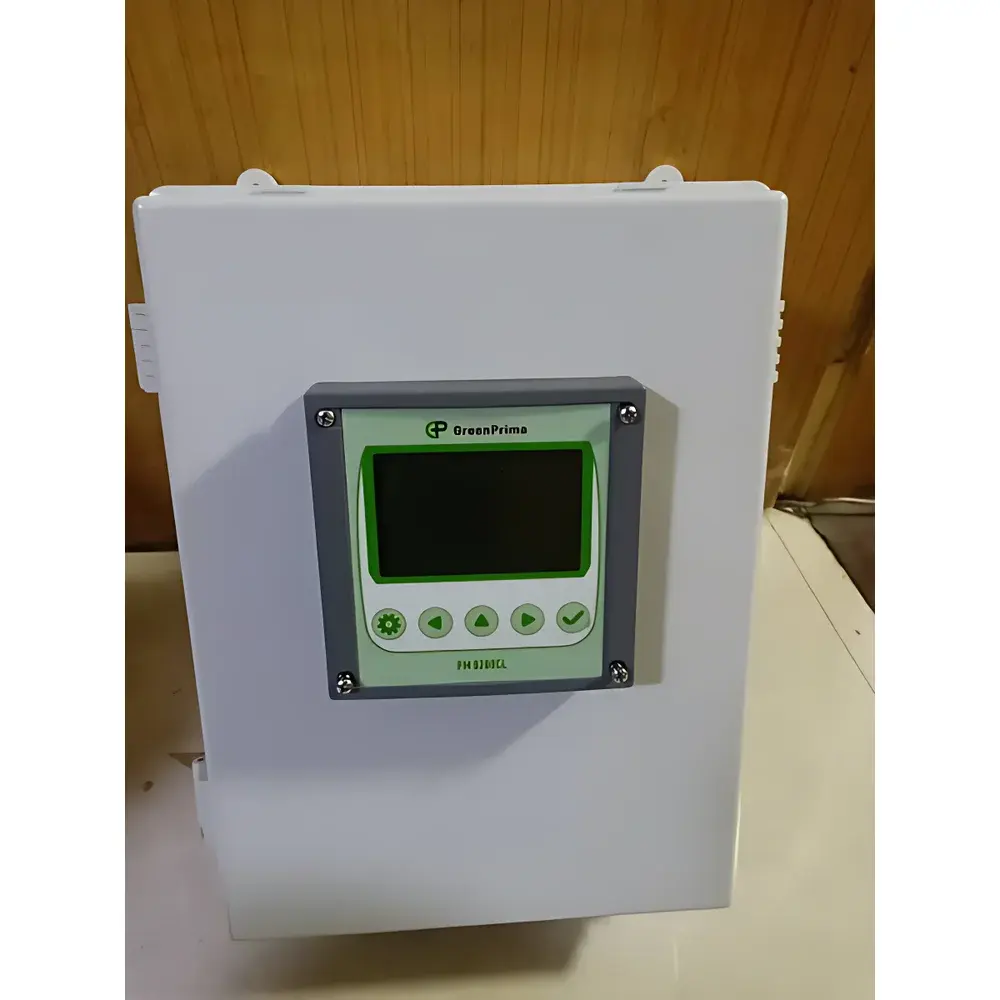
GreenPrima PM8200CL Residual Chlorine Analyzer
| Brand | GreenPrima |
|---|---|
| Origin | Switzerland |
| Manufacturer Type | OEM Manufacturer |
| Origin Category | Imported |
| Model | PM8200CL |
| Instrument Type | Online Analyzer |
| Measurement Principle | Electrochemical Amperometric Sensor |
| Measured Parameter | Free Residual Chlorine |
| Measurement Ranges | 0–2 ppm and 0–20 ppm |
| Accuracy | ≤2% of Full Scale |
| Repeatability | 0.001 ppm / 0.01 ppm |
| Resolution | 0.001 ppm / 0.01 ppm |
| Detection Limit | 0.001 ppm / 0.01 ppm |
Overview
The GreenPrima PM8200CL Residual Chlorine Analyzer is an online, amperometric electrochemical analyzer engineered for continuous, real-time monitoring of free residual chlorine in aqueous systems. It operates on the principle of constant-potential (galvanostatic) amperometry, where a stable bias voltage is applied across a three-electrode sensor cell—comprising a platinum or gold working electrode (Bsens650/Bsens660), a reference electrode, and a counter electrode—to selectively oxidize hypochlorous acid (HOCl) and hypochlorite ion (OCl⁻). The resulting diffusion-controlled current is linearly proportional to the concentration of active chlorine species, enabling high reproducibility and long-term stability without reagent consumption or membrane replacement. Designed for deployment in municipal drinking water distribution networks, cooling tower circuits, hospital wastewater treatment streams, and industrial process water lines, the PM8200CL delivers trace-level detection down to 0.001 ppm with full-scale accuracy compliant with ISO 7393-2 and ASTM D1253 standards for residual chlorine determination.
Key Features
- Triple-parameter capability: Configurable for free chlorine, ozone (O₃), or chlorine dioxide (ClO₂) measurement via sensor module selection and firmware calibration
- Integrated pH compensation: Real-time correction using external pH input (NTC10K or PT1000 compatible) to maintain accuracy across varying water chemistry conditions
- Dual-range auto-scaling: Seamless switching between 0–2.000 ppm (high-resolution mode) and 0–20.00 ppm (broad-range mode), both with programmable resolution
- Robust IP65-rated enclosure: Dust-tight and water-jet resistant housing suitable for indoor and outdoor mounting in humid, chemically aggressive environments
- Two isolated 4–20 mA analog outputs: Independently assignable to residual chlorine, temperature, or diagnostic status; each supports up to 500 Ω load impedance
- Three relay outputs: Programmable for alarm, control, or cleaning cycle activation with adjustable hysteresis and time-delay logic
- Extended data logging: Onboard storage capacity for up to 600,000 timestamped records (chlorine value, temperature, sensor status, calibration events)
- Multi-language interface: Simultaneous support for Simplified Chinese, Traditional Chinese, and English UI navigation with intuitive menu hierarchy
Sample Compatibility & Compliance
The PM8200CL is validated for use with potable water, recirculating cooling water, low-conductivity ultrapure water (≥10 µS/cm recommended), and pre-treated wastewater effluents. It complies with GLP-aligned operational requirements, including audit-trail-enabled calibration logging and user-accessible event history. Its sensor architecture meets the mechanical and electrical safety provisions of IEC 61000-6-2 (immunity) and IEC 61000-6-4 (emissions), and its analog output circuitry conforms to NAMUR NE43 signaling standards. For regulated pharmaceutical or food-grade applications, optional HART protocol integration supports traceable configuration management per FDA 21 CFR Part 11 requirements when paired with compliant SCADA systems.
Software & Data Management
Configuration, diagnostics, and historical data retrieval are managed via the front-panel keypad and backlit graphical LCD or remotely through RS485 Modbus RTU (standard) or HART (optional). All calibration entries—including zero point, span point, date/time stamp, operator ID, and sensor serial number—are stored with tamper-resistant timestamps. The device supports scheduled automatic cleaning cycles (adjustable from 0.1 to 1000 hours interval; duration 1–1000 seconds), triggered either by time or by conductivity drift thresholds. Export-ready CSV logs can be retrieved via Modbus register polling or local USB interface (with optional adapter), facilitating integration into LIMS, MES, or cloud-based water quality dashboards.
Applications
- Municipal drinking water disinfection control at entry points, reservoirs, and booster stations
- Real-time dosing feedback for sodium hypochlorite or chlorine gas feed systems
- Cooling water biocide management in HVAC and power generation facilities
- Disinfection validation in hospital sterilization wastewater discharge lines
- Process water monitoring in semiconductor fab UPW loops and beverage production lines
- Regulatory compliance reporting for EPA 40 CFR Part 141, WHO Guidelines for Drinking-water Quality, and EU Directive 98/83/EC
FAQ
Does the PM8200CL require daily maintenance or reagent addition?
No. The amperometric sensor operates without consumable reagents, electrolyte refills, or replaceable membranes. Routine verification involves periodic zero/span checks using certified standard solutions.
Can the instrument automatically compensate for temperature fluctuations?
Yes. It supports both manual and automatic temperature compensation across –10 °C to 130 °C using integrated NTC10K or external PT1000 probes.
Is it possible to connect this analyzer to a central SCADA system?
Yes. Standard RS485 Modbus RTU enables seamless integration with PLCs and supervisory systems. Optional HART communication provides enhanced device configuration and diagnostics.
What is the expected service life of the Bsens650/Bsens660 sensor under continuous operation?
With proper installation and routine verification, the sensor demonstrates ≥24 months of stable performance in typical municipal water applications, per GreenPrima’s accelerated aging validation protocol.
How does the analyzer handle interference from monochloramine or other chlorinated byproducts?
The Pt/Au electrode design exhibits high selectivity for free chlorine over combined chlorine species. For environments with >0.5 ppm monochloramine, optional UV pretreatment or application-specific calibration curves are recommended.
Related Products







