
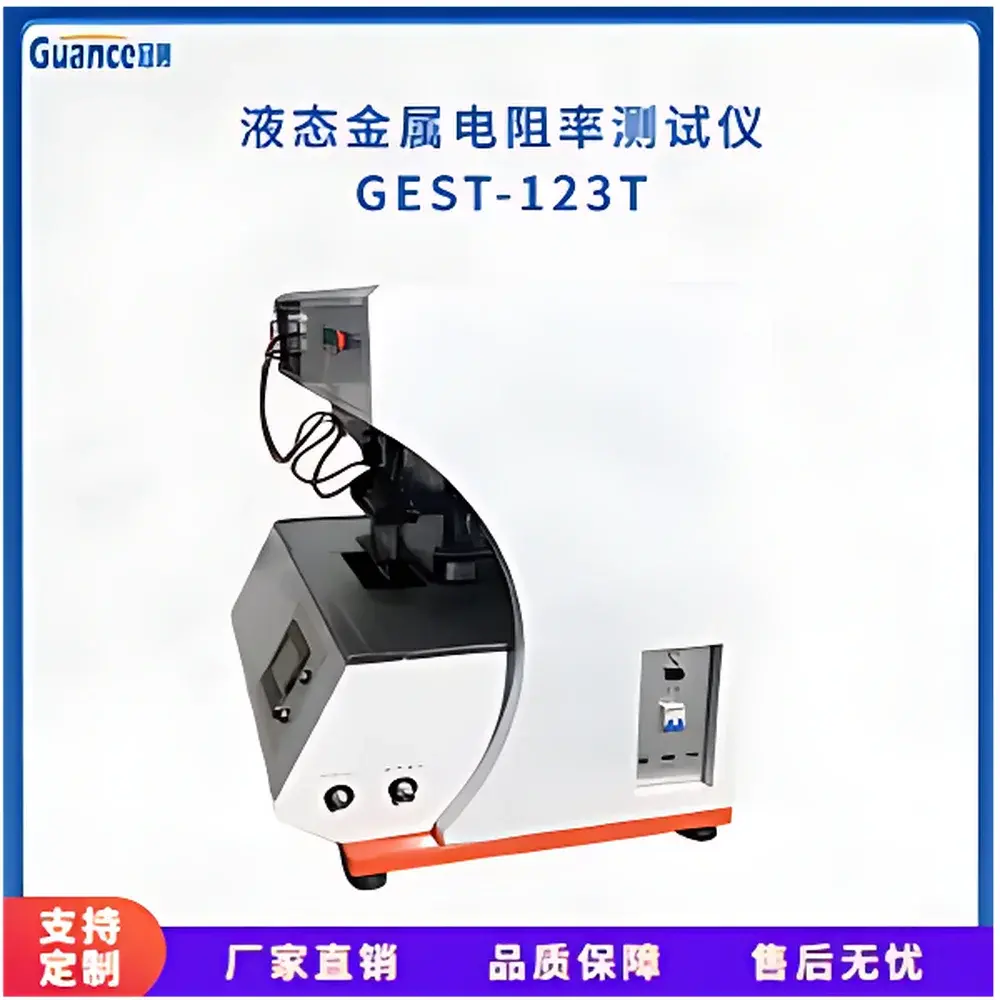
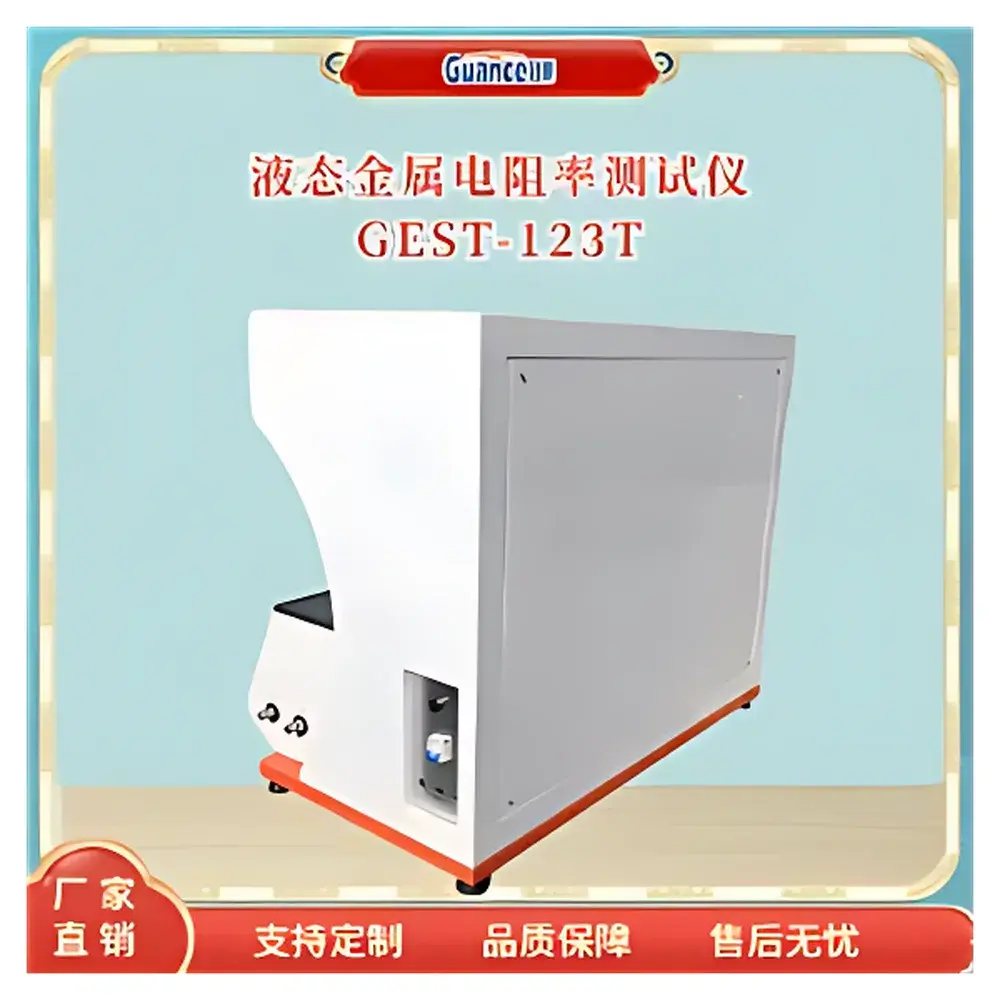
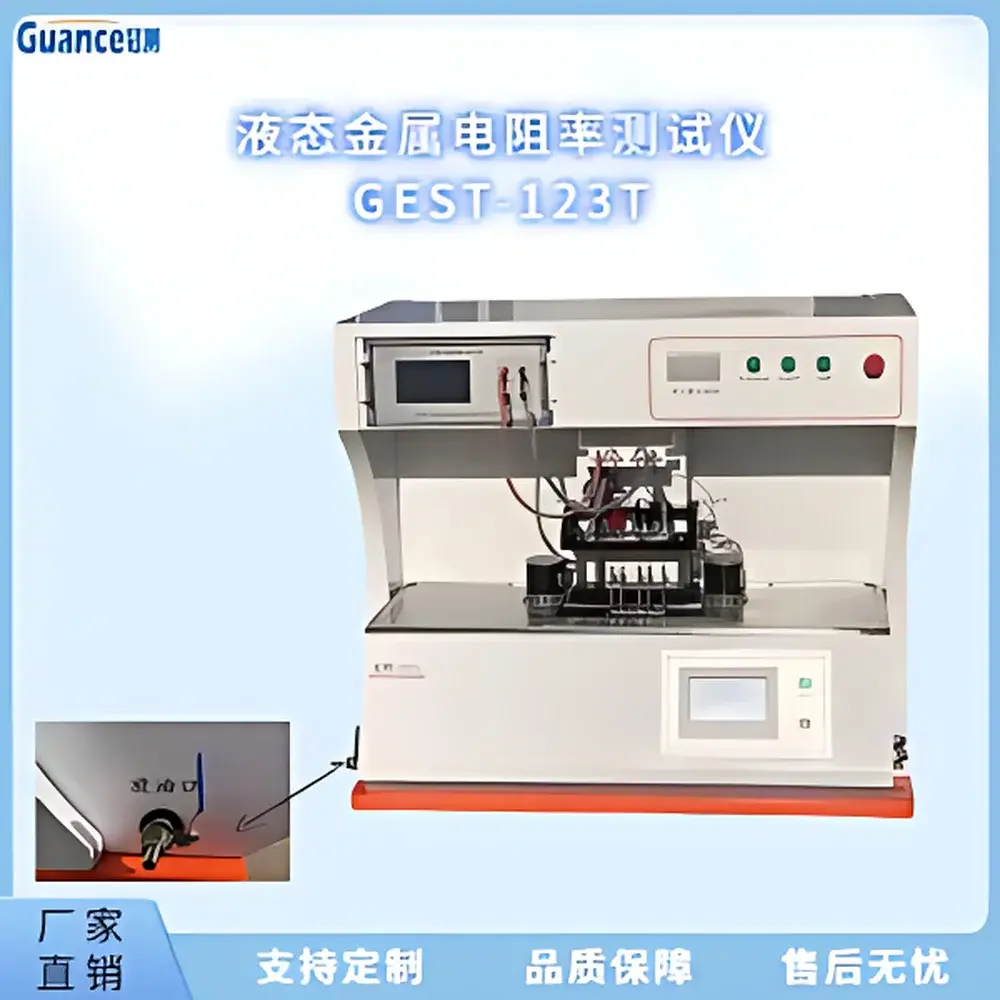
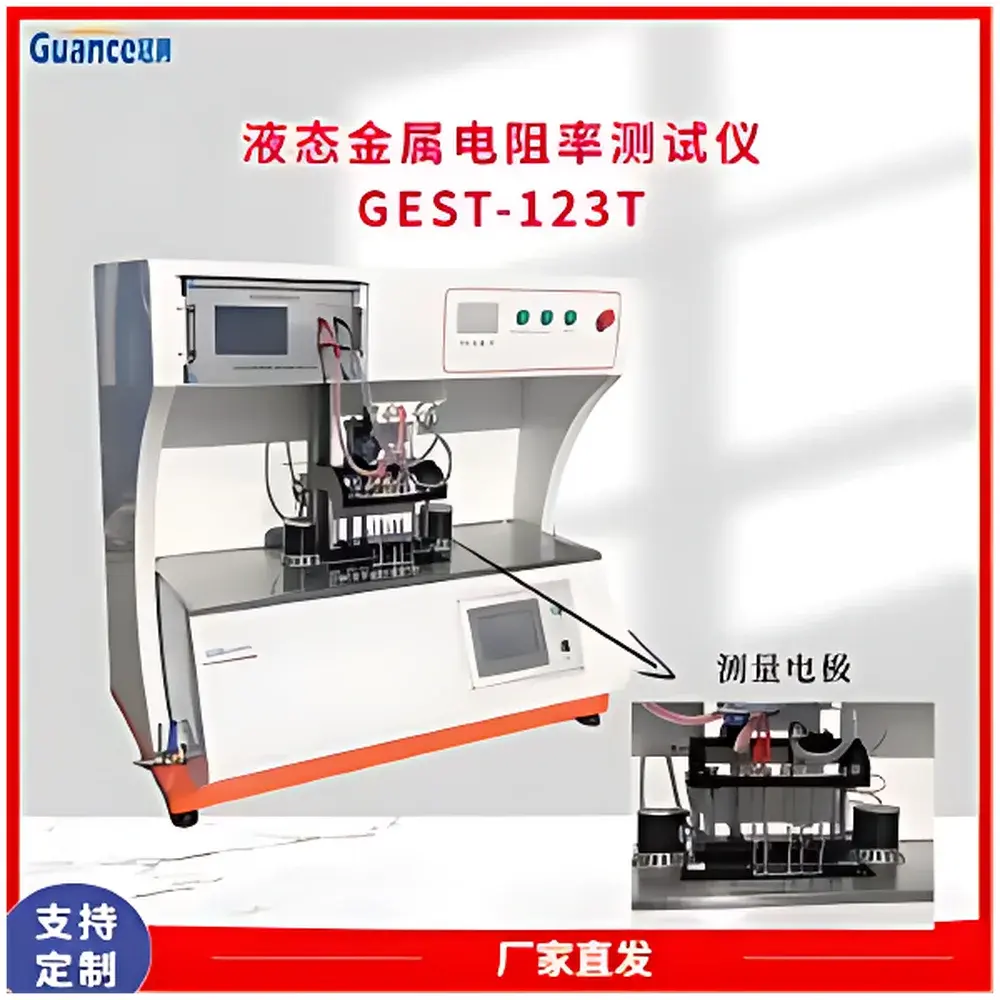
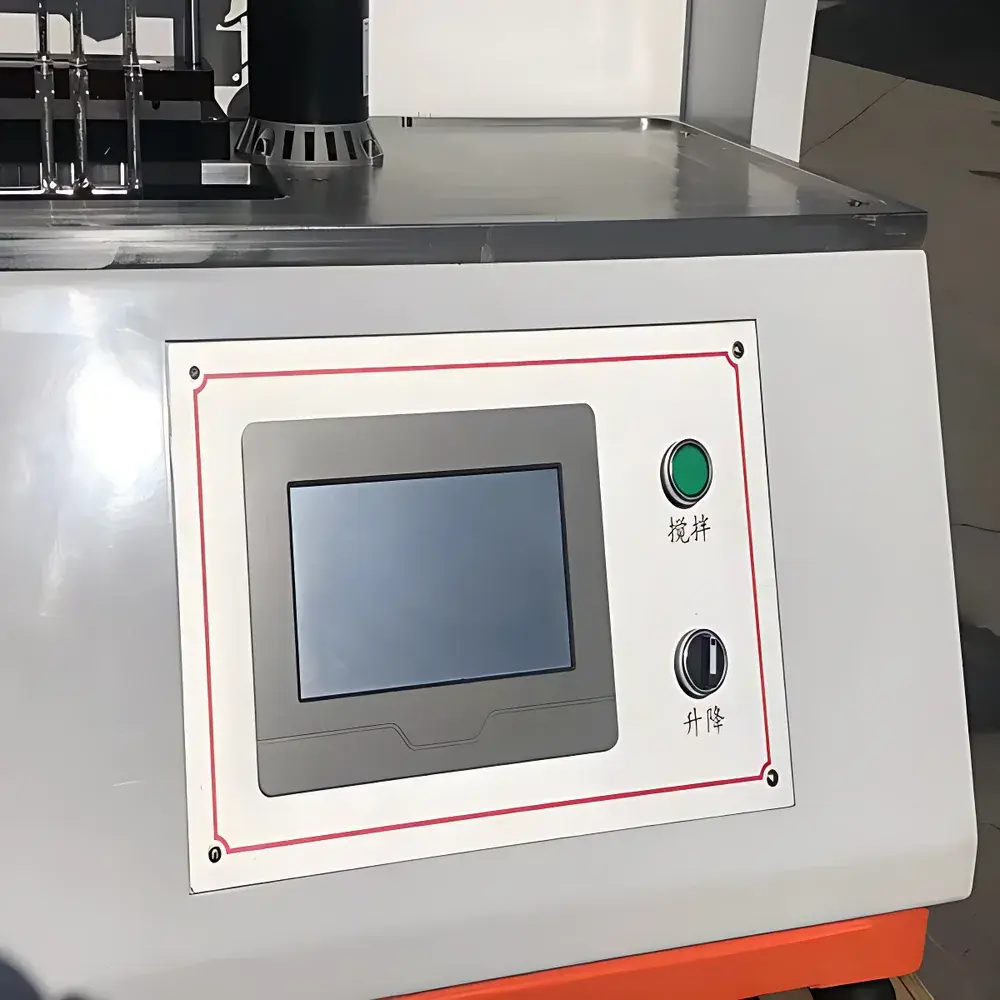
GuanCe GEST-123T2 High-Temperature Liquid Metal Resistivity Tester
| Brand | GuanCe Instruments |
|---|---|
| Origin | Beijing, China |
| Manufacturer Type | Authorized Distributor |
| Country of Origin | China |
| Model | GEST-123T2 |
| Price | USD 1,500 (approx.) |
| Temperature Range | Ambient to 300 °C |
| Max Heating Rate | ≤30 min from ambient to 300 °C |
| Electrode Travel Speed | 0–300 mm/min |
| Resistivity Measurement Range | 10⁻⁴ – 10⁵ Ω·cm |
| Resolution | 10⁻⁶ Ω·cm |
| Current Sources | 10 μA, 100 μA, 1 mA, 10 mA, 100 mA, 1 A |
| Current Accuracy | ±(0.5% of reading + 2 digits) |
| Electrode Material | Tungsten Carbide |
| Cell Material | Fused Quartz |
| Measurement Method | Four-Terminal (Kelvin) Technique |
| Control System | Siemens PLC + Windows-Based HMI Software |
| Compliance | GB/T 41079.2–2022 |
Overview
The GuanCe GEST-123T2 High-Temperature Liquid Metal Resistivity Tester is a precision-engineered system designed for the quantitative determination of electrical resistivity in molten metallic alloys under controlled thermal conditions. It operates on the fundamental principle of four-terminal (Kelvin) resistance measurement, eliminating lead and contact resistance errors to ensure traceable accuracy in high-temperature conductive media. The instrument employs oil-bath heating with dual-stage stainless-steel containment and asbestos insulation, enabling stable thermal environments up to 300 °C. Temperature regulation utilizes AI-enhanced PID algorithms interfaced with industrial-grade temperature controllers and Siemens PLC architecture—ensuring repeatability within ±0.5 °C across extended dwell periods. Unlike conventional solid-state resistivity testers, the GEST-123T2 integrates synchronized electrode positioning, active bath homogenization, and real-time multi-parameter acquisition (temperature, voltage, current, resistivity, conductivity), making it suitable for thermophysical property mapping in metallurgical R&D, nuclear coolant development, and advanced battery material synthesis.
Key Features
- Oil-bath heating system with 1.5 kW adjustable-power heating element and dual-layer insulated chamber for uniform thermal distribution
- Fused quartz electrochemical cell resistant to thermal shock, oxidation, and chemical corrosion at temperatures up to 300 °C
- Tungsten carbide electrodes with micron-level positional feedback via PLC-synchronized digital micrometer (0–50.4 mm, 1 µm resolution)
- Programmable multi-segment thermal ramping: user-defined heating rates, dwell times, and cooling profiles
- Four independent constant-current sources (10 μA to 1 A) with auto-ranging and built-in verification against certified standard resistors
- Integrated dual-motor stirring system (45 W each) ensuring <±0.3 °C axial and radial temperature uniformity in the bath
- Servo-driven vertical electrode actuation (750 W motor, 0–300 mm/min) with hard-limit protection and position logging
- Real-time data acquisition engine capturing temperature, voltage, current, resistivity, and conductivity at configurable sampling intervals (10–1000 ms)
- Comprehensive post-processing suite calculating statistical metrics—including mean, standard deviation, dρ/dT slope analysis—and exporting to CSV, Excel, or PDF formats
Sample Compatibility & Compliance
The GEST-123T2 accommodates low-melting-point liquid metals and eutectic alloys including Ga-In-Sn, NaK, Li, Mg-based melts, and Al-Si master alloys. Its fused quartz cell and tungsten carbide electrodes minimize interfacial reactions and polarization artifacts during prolonged immersion. All hardware and firmware comply with GB/T 41079.2–2022 (“Determination of Physical Properties of Liquid Metals — Part 2: Electrical Conductivity Measurement”), which aligns methodologically with ASTM E1077 (Standard Test Methods for Estimating Thermal Diffusivity of Solids) and ISO 8502-2 (Electrical Resistance Measurement of Metallic Coatings). While not certified to IEC 61000-4 EMC standards out-of-the-box, the system meets CE marking requirements for laboratory equipment when installed per manufacturer-specified grounding and shielding protocols. Data integrity conforms to GLP principles: all measurements include timestamped audit trails, operator ID tagging, and calibration event logging.
Software & Data Management
The system runs on a dedicated Windows-based HMI application communicating bidirectionally with the Siemens S7-1200 PLC via OPC UA. The interface provides simultaneous visualization of up to six real-time parameters on scalable XY plots, with overlay capability for comparative runs. Raw data streams are stored in encrypted binary format (.gtd) and exportable without loss of metadata (e.g., calibration IDs, environmental logs, sensor serial numbers). The software supports FDA 21 CFR Part 11–compliant configurations—including electronic signatures, role-based access control, and immutable audit logs—when deployed on validated domain-joined workstations. Batch reporting templates adhere to ISO/IEC 17025 documentation standards, automatically populating uncertainty budgets based on current source accuracy, thermocouple class, and geometric correction factors.
Applications
- Thermoelectric material screening: quantifying ρ(T) dependence in liquid-phase precursors for thermoelectric generators
- Nuclear engineering: evaluating sodium-potassium (NaK) and lead-bismuth eutectic (LBE) coolant stability under transient thermal loading
- Additive manufacturing feedstock development: characterizing resistivity hysteresis during repeated melt-solidification cycles of Al-, Mg-, and Zn-based powders
- Electrochemical battery research: correlating ionic vs. electronic conduction contributions in molten salt electrolytes (e.g., LiCl-KCl eutectics)
- Foundry process optimization: monitoring resistivity drift during alloy homogenization to infer phase segregation kinetics
- Calibration reference generation: producing NIST-traceable resistivity curves for in-line process sensors in continuous casting lines
FAQ
What temperature uniformity can be achieved across the oil bath during steady-state operation?
At 300 °C, axial and radial gradients remain within ±0.3 °C over the 60 mm active electrode span, verified using three calibrated Pt100 probes embedded at top/mid/bottom positions.
Is the system compatible with inert-atmosphere glovebox integration?
Yes—the quartz cell assembly and electrode feedthroughs support optional N₂ or Ar purge fittings; external gas manifolds must be configured by the end user per ISO 10648-2 specifications.
How often does the system require recalibration?
Temperature sensors should be verified annually against a certified dry-block calibrator; current sources require biannual validation using a 0.01% tolerance standard resistor traceable to NIM (China National Institute of Metrology).
Can the software generate automated compliance reports for GB/T 41079.2–2022 submission?
Yes—the report generator includes mandatory fields per Clause 7.3 of the standard: measurement uncertainty budget, electrode geometry correction factor, thermal equilibrium confirmation timestamp, and raw data appendices.
What maintenance is required for long-term operation above 250 °C?
Quartz cells should be inspected for microcracking after every 200 thermal cycles; silicone-based bath oils must be replaced every 18 months or upon viscosity increase >15% (measured per ASTM D445).



