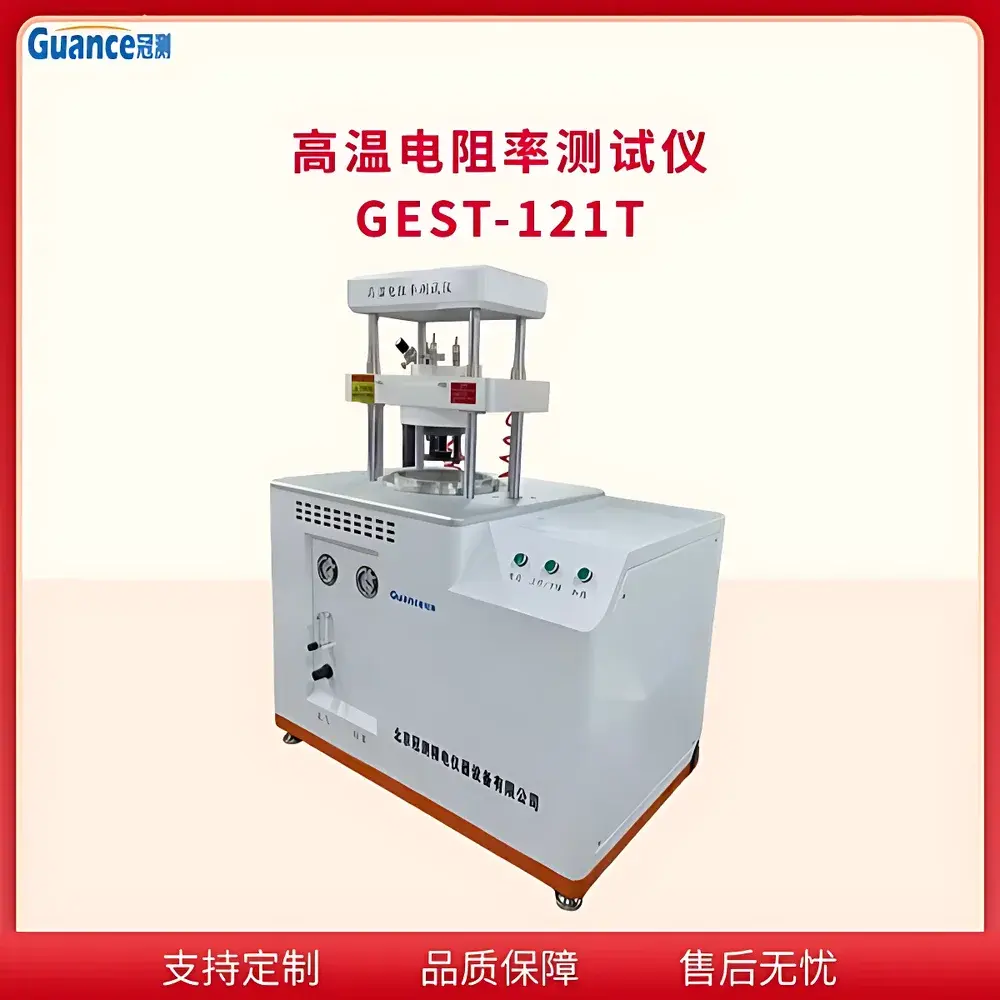
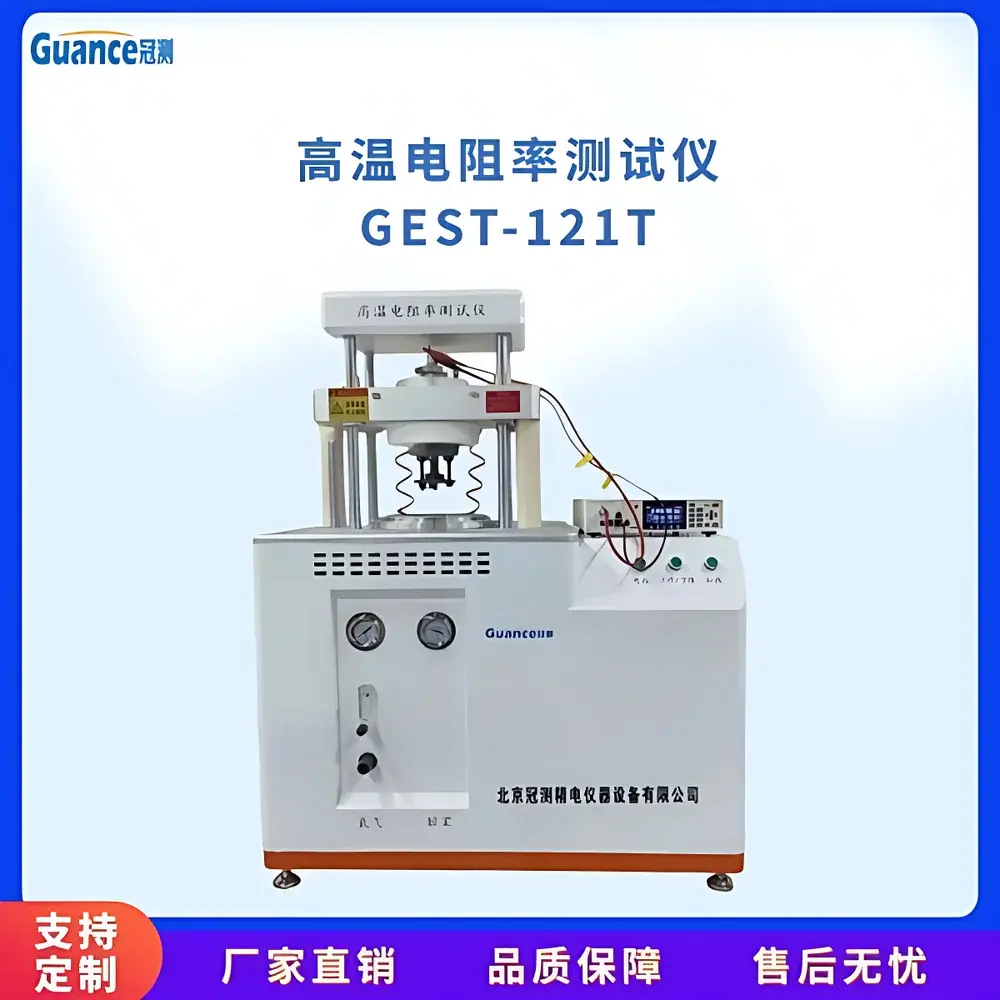
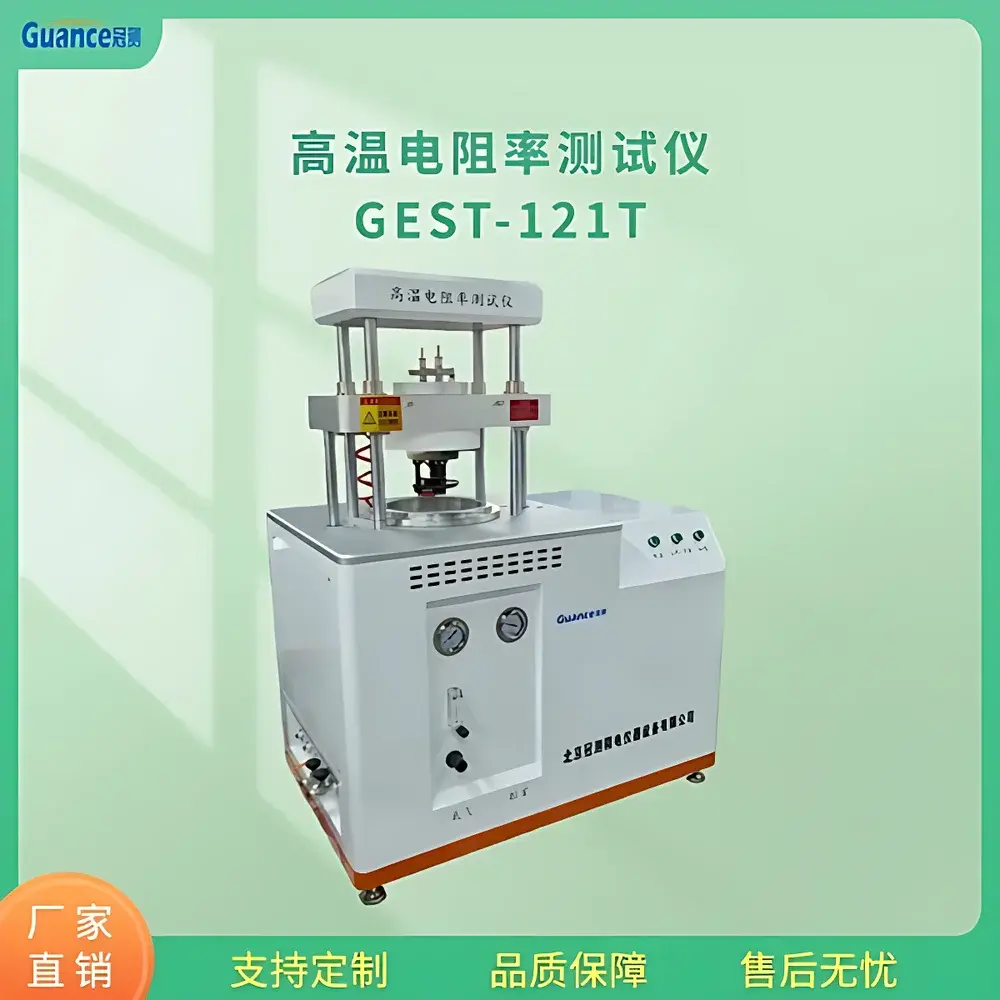
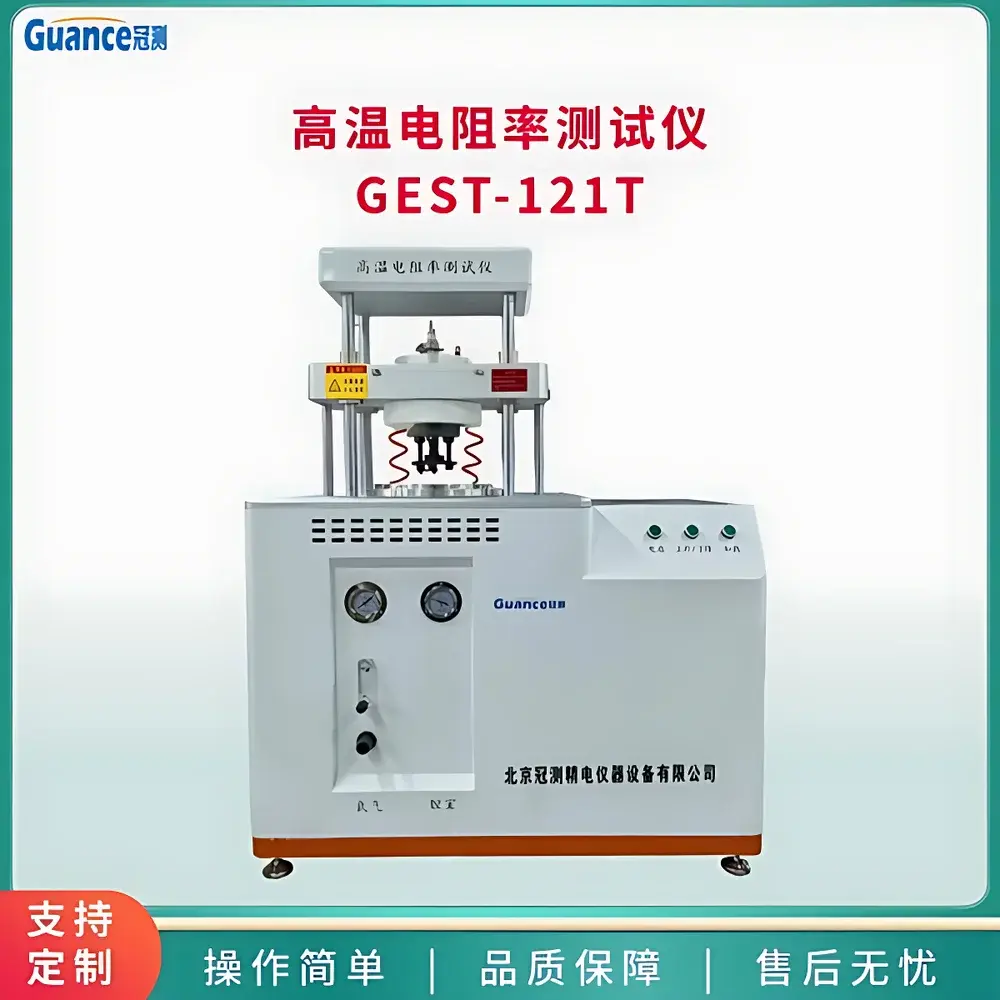
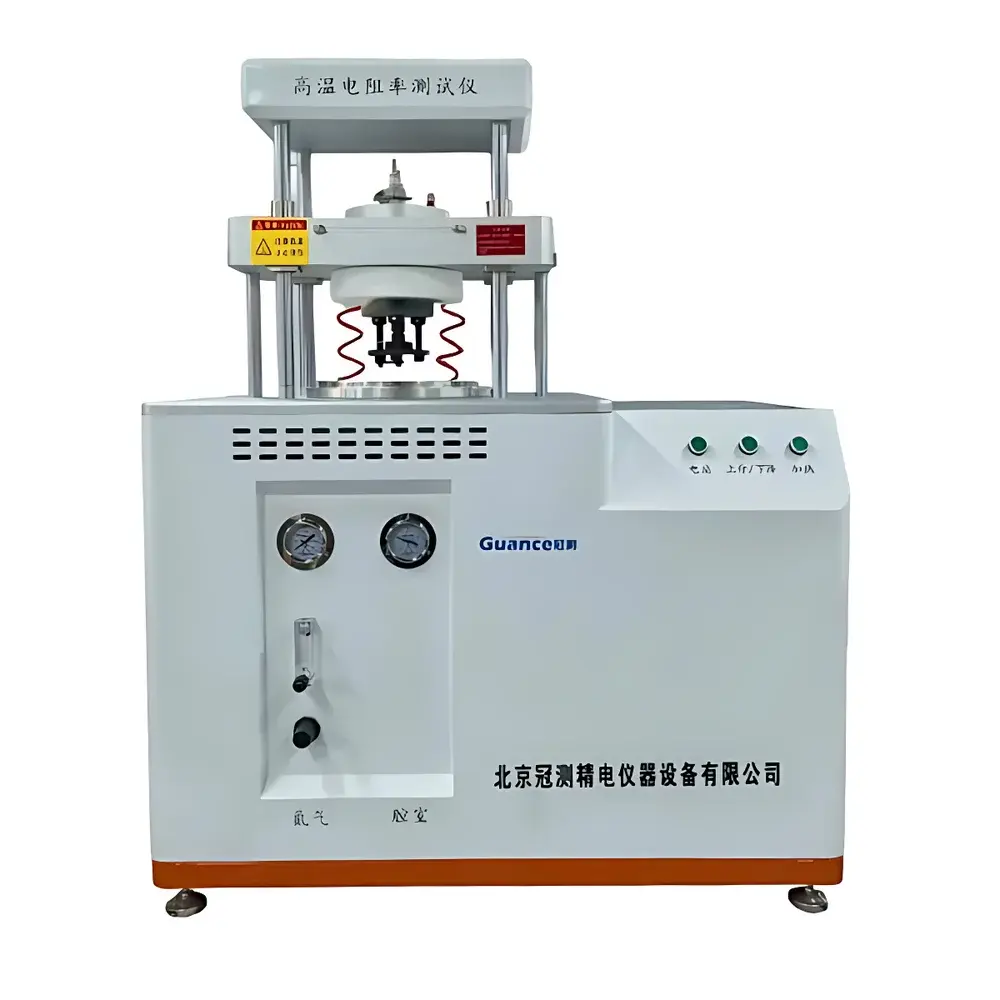
GuanCe GEST-121T High-Temperature Resistivity Tester
| Brand | GuanCe Instruments |
|---|---|
| Origin | Beijing, China |
| Manufacturer Type | Authorized Distributor |
| Region | Domestic (China) |
| Model | GEST-121T |
| Price | USD 1,850 (FOB Beijing) |
Overview
The GuanCe GEST-121T High-Temperature Resistivity Tester is an engineered precision instrument designed for quantitative characterization of electrical resistivity in insulating and semiconducting solid materials under controlled thermal conditions. It operates on the fundamental principle of Ohm’s Law (ρ = R × A / L), where bulk resistivity (ρ) is derived from measured resistance (R), sample cross-sectional area (A), and effective current path length (L). The system integrates a programmable high-temperature furnace with dual-mode voltage/current sourcing and nanovolt-level sensing capabilities, enabling direct four-terminal (Kelvin) measurements to eliminate lead and contact resistance errors. Designed for reproducible thermoelectric property evaluation, the GEST-121T supports continuous resistivity monitoring across temperature ramps from ambient up to 1000 °C (configurable per furnace module), with real-time acquisition of current, voltage, and temperature-synchronized resistivity values. Its architecture complies with core metrological requirements for materials qualification under ISO/IEC 17025–accredited laboratories and supports traceable calibration against NIST-traceable reference standards.
Key Features
- Programmable temperature control: Ramp rates from 0.1 to 10 °C/min; stability ±0.5 °C at setpoint (typical); maximum operating temperature up to 1000 °C (furnace-dependent)
- Four-terminal (Kelvin) measurement topology with guarded input circuitry to suppress leakage currents and ensure accuracy for resistivity values spanning 10⁶ to 10¹⁴ Ω·cm
- Integrated high-resolution data acquisition: 24-bit ADC, sampling rate up to 100 Hz, synchronized with thermocouple (Type K or S) inputs
- Automated test sequencing: User-defined temperature profiles with hold steps, dwell times, and multi-point resistivity logging
- Touchscreen HMI with dual-language support (English/Chinese); intuitive workflow navigation and real-time curve overlay (ρ vs. T, I vs. T, V vs. T)
- Comprehensive safety architecture: Over-temperature cutoff (hardware-based), short-circuit protection, interlocked chamber door, and ground-fault monitoring
- Modular probe interface: Compatible with standard two-probe, four-probe, and coaxial electrode fixtures for discs, rods, and rectangular blocks (sample dimensions: Ø6–30 mm or 10×10–25×25 mm²)
Sample Compatibility & Compliance
The GEST-121T accommodates solid dielectric and semiconductor specimens including technical ceramics (Al₂O₃, ZrO₂, SiC), glass-ceramics, polymer composites, sintered oxides, and doped polycrystalline semiconductors. Sample mounting is facilitated via spring-loaded or screw-clamp electrodes with platinum–rhodium or tungsten–rhenium contacts rated for inert/vacuum environments. Optional vacuum and controlled-atmosphere chambers (N₂, Ar, O₂, forming gas) enable testing per ASTM D257 (Standard Test Methods for DC Resistance or Conductance of Insulating Materials) and ISO 3915 (Electrical Resistance of Conductive Foams and Plastics). System design aligns with GLP documentation requirements: audit trails for parameter changes, user logins, and timestamped raw data export support FDA 21 CFR Part 11–compliant electronic records when paired with validated PC software.
Software & Data Management
The instrument ships with GuanCe LabSuite v3.2 — a Windows-based application supporting full remote operation, script-driven batch testing, and automated report generation (PDF/CSV/XLSX). Raw datasets include time-stamped columns for temperature (°C), applied voltage (V), measured current (A), calculated resistance (Ω), geometric correction factor, and derived resistivity (Ω·cm). Curve-fitting modules implement Arrhenius, Vogel–Fulcher, and Mott variable-range hopping models for activation energy extraction. Data export preserves metadata (operator ID, calibration date, furnace serial number) and conforms to ASTM E1447–22 (Standard Practice for Computerized Data Acquisition in Material Testing). All firmware updates are digitally signed and delivered via secure HTTPS portal.
Applications
- Materials science: Quantifying thermally activated conduction mechanisms in oxide ion conductors and fast-ion conductors for solid-state battery electrolytes
- Ceramic engineering: Correlating sintering temperature, grain boundary density, and bulk resistivity in alumina and yttria-stabilized zirconia systems
- Semiconductor R&D: Evaluating dopant activation efficiency and defect-related scattering in wide-bandgap nitrides and carbides
- Nuclear materials: Assessing radiation-induced resistivity shifts in insulating cladding ceramics under simulated thermal aging
- Quality assurance: In-process verification of resistivity uniformity in ceramic substrates and thick-film resistor pastes per IPC-4552B
FAQ
What temperature range is supported without optional furnace modules?
Standard configuration includes a muffle furnace rated for 1000 °C; extended ranges (e.g., 1400 °C) require custom MoSi₂ heating elements and quartz/ceramic insulation upgrades.
Is four-probe measurement mandatory, or can two-probe mode be used?
Both modes are supported; however, two-probe measurements are only recommended for low-resistivity samples (<10⁸ Ω·cm) where contact resistance is negligible relative to bulk resistance.
Does the system meet IEC 60243 or ASTM D150 for dielectric strength testing?
No — the GEST-121T is strictly a DC/low-frequency resistivity instrument; it does not generate high-voltage breakdown pulses and is not certified for dielectric strength or loss tangent measurement.
Can data be exported in SI units only, without imperial conversions?
Yes — all output units are configurable; default SI units (Ω·cm, °C, A, V) are enforced unless explicitly overridden in software settings.
What calibration standards are supplied with the instrument?
NIST-traceable resistivity reference standards (SRM 2800 series) and certified thermocouple calibrators are available as optional accessories; factory calibration certificate includes uncertainty budgets per ISO/IEC 17025 Annex A.