
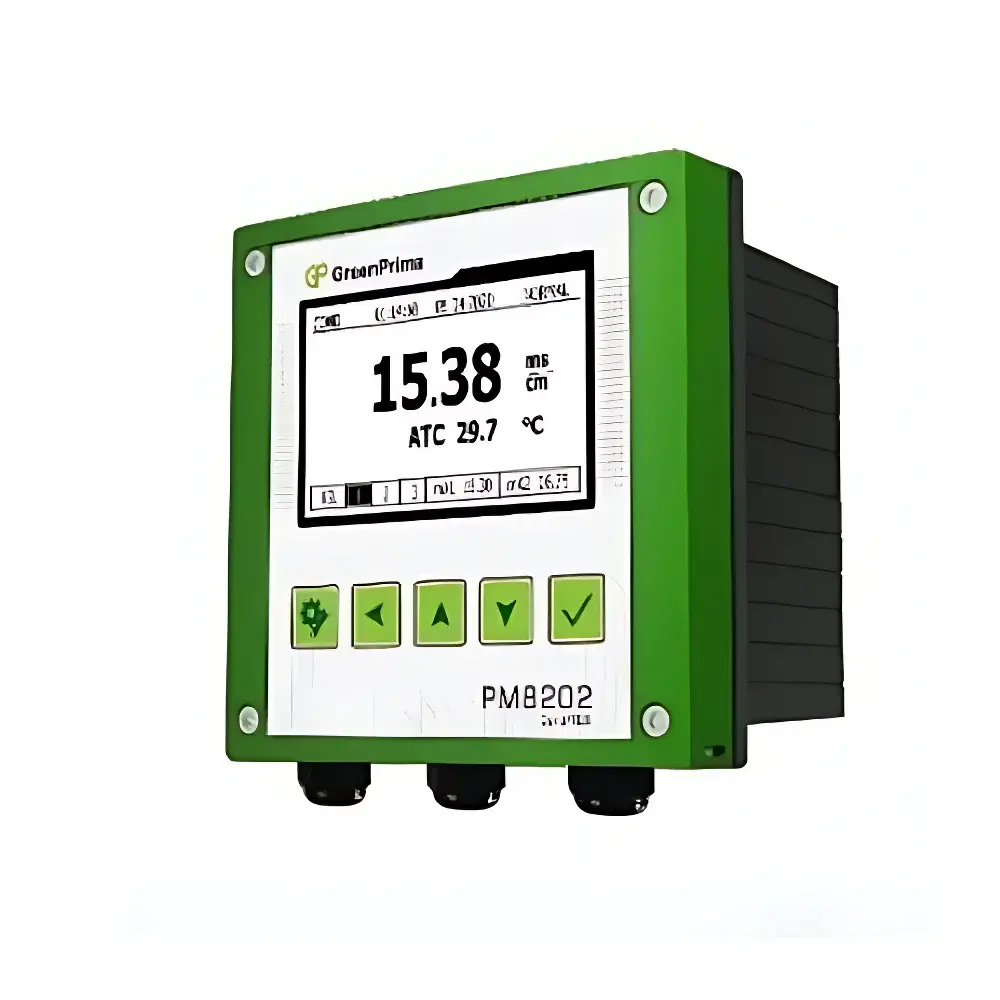
GreenPrima PM8202C Online Conductivity Analyzer
| Brand | GreenPrima |
|---|---|
| Origin | United Kingdom |
| Manufacturer Type | Original Equipment Manufacturer (OEM) |
| Product Category | Imported Industrial Online Analyzer |
| Model | PM8202C |
| Application | Continuous Process Monitoring in Industrial Water, Wastewater, and Chemical Processing |
| Conductivity Range | 0.00–2000 mS/cm |
| Salinity Range | 0.00–78.00 ppt |
| TDS Range | 0–120,000 ppm |
| Conductivity Resolution | 0.01 mS/cm |
| Salinity Resolution | 0.01 ppt |
| TDS Resolution | 1 ppm |
| Accuracy | ±1% of Full Scale |
| Temperature Range | –10 to +130 °C (manual/automatic compensation |
| Operating Temperature | –10 to +70 °C |
| Storage Temperature | –20 to +70 °C |
| Display | Backlit large-dot-matrix LCD |
| Language | English & Chinese (configurable) |
| Data Storage | 600,000 records |
| Power Supply | 90–260 VAC, 50/60 Hz or optional 24 VDC |
| Analog Outputs | Two isolated 4–20 mA outputs (max. loop resistance 500 Ω, accuracy 0.1% FS) |
| Digital Communication | RS485 Modbus RTU (HART optional) |
| Relay Outputs | One multifunction relay (programmable), two independent Hi/Lo alarm relays (5 A / 250 VAC / 30 VDC) |
| Cleaning Control Output | Adjustable interval (0.1–1000 h) and duration (1–1000 s) |
| Enclosure Rating | IP65 |
| Mounting Options | Wall-mount, panel-mount, pipe-mount |
| Dimensions (W×H×D) | 144 × 144 × 108 mm |
| Panel Cutout | 138 × 138 mm |
| Weight | 0.87 kg |
Overview
The GreenPrima PM8202C Online Conductivity Analyzer is an industrial-grade, microprocessor-based process analyzer engineered for continuous, real-time measurement of electrical conductivity, salinity, and total dissolved solids (TDS) in aqueous solutions. It operates on the principle of two- or four-electrode conductometric measurement, where conductivity is derived from the solution’s ability to carry electric current under a known applied voltage—calculated via Ohm’s law and corrected for cell geometry (cell constant). The instrument supports automatic temperature compensation using either NTC30K thermistors or PT1000 platinum resistance sensors, ensuring high reproducibility across dynamic thermal environments typical in cooling towers, desalination pre-treatment lines, boiler feedwater systems, and effluent monitoring stations. Designed for uninterrupted operation in harsh industrial settings, the PM8202C complies with IEC 61000-6-2 (immunity) and IEC 61000-6-4 (emission) standards and meets CE marking requirements for electromagnetic compatibility and low-voltage directive conformity.
Key Features
- Triple-parameter output: Simultaneous real-time measurement of conductivity (0.00–2000 mS/cm), salinity (0.00–78.00 ppt), and TDS (0–120,000 ppm) with configurable unit scaling
- Dual isolated 4–20 mA analog outputs—fully assignable to primary measurement, temperature, or derived values—with 0.1% full-scale accuracy and galvanic isolation up to 1500 VAC
- RS485 Modbus RTU serial interface for integration into DCS, SCADA, or PLC-based control architectures; optional HART protocol support available for legacy system compatibility
- Configurable multifunction relay and dual independent alarm relays (5 A resistive load rating) with adjustable hysteresis and latching/non-latching modes
- Automated cleaning sequence control output—enabling timed actuation of solenoid valves or ultrasonic cleaners to mitigate fouling on contacting conductivity cells
- Backlit high-contrast dot-matrix LCD display with intuitive dual-language (English/Chinese) menu navigation and password-protected configuration access
- Rugged IP65-rated enclosure with corrosion-resistant polycarbonate front panel and internal conformal coating for reliable operation in humid, dusty, or chemically aggressive environments
Sample Compatibility & Compliance
The PM8202C is compatible with a broad range of standard and custom conductivity sensors—including stainless steel 316L, titanium, and graphite electrode configurations—supporting both immersion and flow-through installations. It accommodates common cell constants (e.g., 0.01, 0.1, 1.0, and 10.0 cm−1) and allows user-defined calibration curves per ASTM D1125 and ISO 7888. All measurements adhere to traceable calibration protocols aligned with ISO/IEC 17025 laboratory practices. For regulated industries, the device supports audit-ready data logging (600,000 timestamped records) with optional time-stamped event logs for calibration, alarm, and relay activation events—facilitating GLP/GMP documentation and FDA 21 CFR Part 11 compliance when deployed with validated software infrastructure.
Software & Data Management
Data acquisition and configuration are managed locally via the front-panel interface or remotely via Modbus register mapping. The embedded non-volatile memory retains all settings—including calibration coefficients, temperature compensation parameters, and alarm thresholds—during power loss. Logged data can be exported via serial dump or integrated into enterprise historian systems (e.g., OSIsoft PI, Ignition, or Siemens Desigo CC) using standard Modbus function codes (03h, 04h, 06h, 10h). Optional PC-based configuration utility (Windows-compatible) provides graphical trend visualization, batch calibration report generation, and firmware update capability. All critical operational events—including sensor fault detection, out-of-range conditions, and relay state changes—are timestamped and stored with millisecond resolution.
Applications
- Power plant cycle chemistry monitoring: Condensate polishing, demineralizer effluent, and steam drum water quality assurance
- Pharmaceutical water systems: USP Purified Water and Water for Injection (WFI) conductivity verification at point-of-use
- Food & beverage production: CIP rinse water validation, brine concentration control, and syrup dilution monitoring
- Municipal and industrial wastewater treatment: Influent/effluent salinity profiling, membrane fouling early warning, and reverse osmosis reject stream management
- Chemical manufacturing: Batch reaction endpoint detection, acid/base neutralization control, and electrolyte concentration tracking in electroplating baths
FAQ
What temperature compensation methods does the PM8202C support?
It supports both automatic and manual temperature compensation using either NTC30K thermistors or PT1000 RTD inputs, with linear or nonlinear (CaCl₂ or NaCl reference) compensation algorithms selectable per application.
Can the PM8202C interface with a DCS using HART?
Yes—HART communication is available as a factory-configurable option, enabling seamless integration with Emerson DeltaV, Honeywell Experion, or Yokogawa CENTUM VP systems.
Is the data logger compliant with 21 CFR Part 11 requirements?
The device itself provides secure, time-stamped, and uneditable event logging; full Part 11 compliance requires implementation of complementary administrative controls, electronic signatures, and audit trail review procedures within the host supervisory system.
How often should the conductivity sensor be calibrated?
Calibration frequency depends on process stability and fouling tendency; typical practice ranges from daily (critical pharmaceutical applications) to quarterly (stable cooling water loops), following ASTM D1125 guidelines and documented SOPs.
Does the PM8202C support multi-point calibration?
Yes—it accepts up to three-point conductivity calibration using certified standard solutions (e.g., KCl 0.01 M, 0.1 M, and 1.0 M) with automatic cell constant calculation and drift assessment.
Related Products




