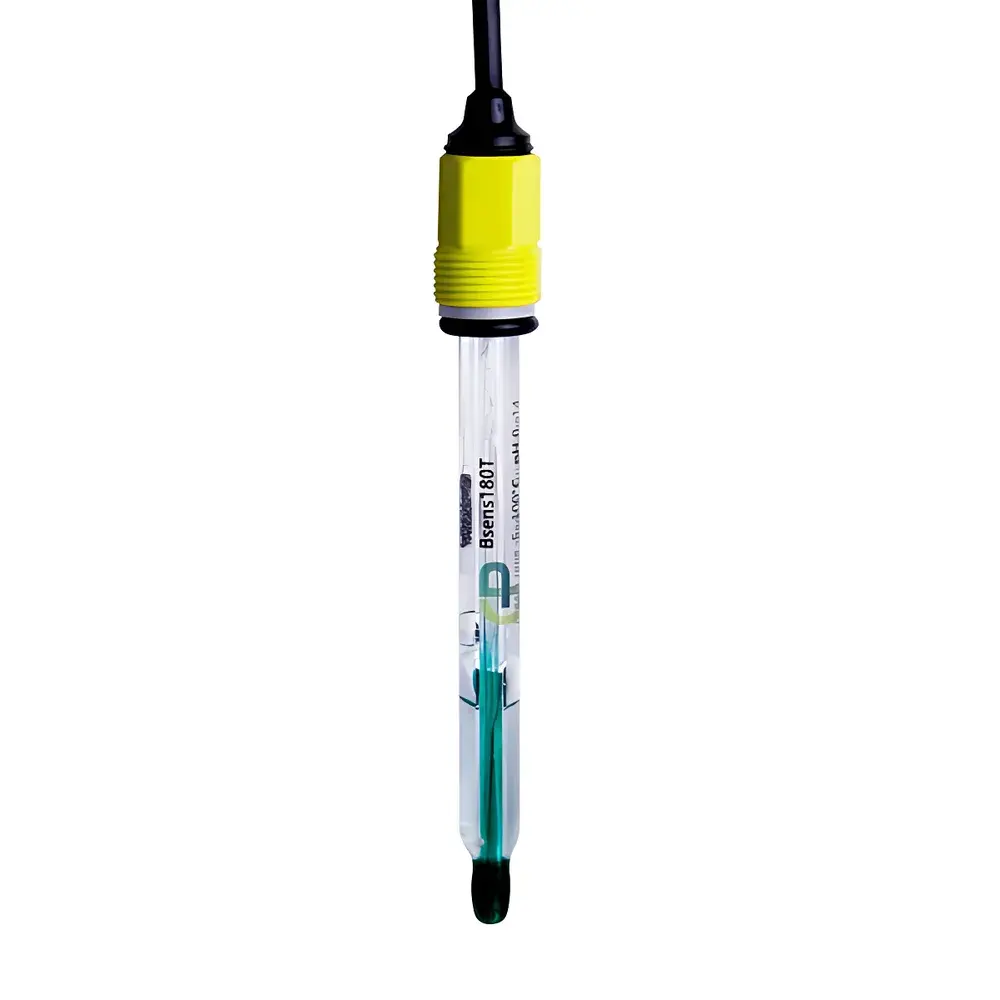
GreenPrima Bsens180T Chlor-Alkali Industry pH Electrode
| Brand | GreenPrima |
|---|---|
| Origin | Switzerland |
| Manufacturer Type | Original Equipment Manufacturer (OEM) |
| Origin Category | Imported |
| Model | Bsens180T |
| Pressure Rating | 6 bar |
| Operating Temperature | −5 to 100 °C |
| pH Range | 0–14 |
| Electrode Body Material | Chemically Resistant Glass |
| Reference System | Ag/AgCl Cartridge |
| Sensing Membrane | H-Type Glass |
| Junction | Triple Ceramic Porous Junction |
| Electrolyte | Polymer-Gel Filled |
| Temperature Sensor | Integrated PT1000 RTD |
| Diameter | 12 mm |
| Length | 120 mm |
| Electrical Resistance | ≤300 MΩ at 25 °C |
| Zero Potential | 0 ±20 mV |
| Slope Sensitivity | 57–59 mV/pH at 25 °C |
| Minimum Immersion Depth | 20 mm |
| Minimum Sample Conductivity | 50 µS/cm |
| Response Time (pH 4–7) | <30 s |
| Process Connection | PG13.5 Metric Thread |
| Cable Length | 5 m |
Overview
The GreenPrima Bsens180T is a purpose-engineered pH electrode designed specifically for continuous, high-stability measurement in aggressive chlor-alkali process environments. It operates on the fundamental principle of potentiometric pH sensing, where the potential difference between a hydrogen-ion-sensitive glass membrane and a stable Ag/AgCl reference system is measured against a known buffer standard. This voltage—linearly proportional to pH per the Nernst equation—is converted into a calibrated digital or analog output signal. Unlike general-purpose pH sensors, the Bsens180T integrates material selection, junction architecture, and thermal compensation strategies optimized for high chloride ion concentration, elevated temperature, and oxidizing conditions typical of brine electrolysis, chlorine gas scrubbing, caustic soda concentration, and hypochlorite synthesis loops. Its H-type glass membrane exhibits enhanced resistance to alkaline drift and sodium error above pH 12, while the triple-ceramic junction minimizes clogging and maintains stable liquid junction potential under suspended solids or viscous electrolytes.
Key Features
- Chemically inert borosilicate glass body with reinforced mechanical integrity for pressurized pipeline and tank installations up to 6 bar.
- H-glass membrane formulation delivering extended linear response and reduced alkaline error in concentrated NaOH streams (up to 50% w/w).
- Triple-porous ceramic junction providing balanced electrolyte outflow, minimizing contamination-induced potential drift and extending service life in high-salt media.
- Integrated PT1000 platinum resistance thermometer enabling real-time, traceable temperature compensation compliant with IEC 60751 Class A tolerances.
- Polymer-gel electrolyte eliminating leakage risk and maintenance associated with free-flowing liquid electrolytes—critical for vertical or inverted mounting configurations.
- PG13.5 metric process thread interface compatible with standard DIN 19213 and ISO 228-1 fittings for direct insertion into process lines or retractable housings.
- Low electrical resistance (<300 MΩ at 25 °C) ensuring robust signal transmission over 5 m shielded cable without significant noise susceptibility.
Sample Compatibility & Compliance
The Bsens180T is validated for use in non-aqueous, high-ionic-strength, and oxidizing aqueous matrices common in chlor-alkali plants—including saturated brine (NaCl), caustic soda (NaOH), sodium hypochlorite (NaOCl), chlorine water, and acid-wash effluents. It meets functional requirements outlined in ASTM D1293 (Standard Test Method for pH of Water), ISO 10523 (Water Quality — Determination of pH), and supports compliance with GMP and GLP documentation workflows when paired with validated transmitters. The device’s construction adheres to IP68 ingress protection and conforms to RoHS Directive 2011/65/EU. While not intrinsically safe certified, it is suitable for Zone 2/Class I Div 2 environments when installed with appropriate barrier systems.
Software & Data Management
When interfaced with GreenPrima-compatible pH transmitters (e.g., GP-TRM400 series) or third-party 4–20 mA/HART/Modbus-enabled controllers, the Bsens180T supports full digital diagnostics including electrode impedance monitoring, asymmetry potential tracking, and slope validation history. Transmitter firmware enables automatic calibration logging with timestamp, operator ID, and buffer identification—meeting audit requirements under FDA 21 CFR Part 11 when deployed in validated systems. Raw sensor data can be exported via CSV or integrated into SCADA platforms (e.g., Siemens Desigo, Honeywell Experion) using standard OPC UA or MQTT protocols.
Applications
- Real-time pH monitoring in chlorine gas absorption towers and scrubbers.
- In-line control of caustic concentration during evaporation and crystallization stages.
- Brine purification loop pH stabilization prior to membrane cell entry.
- Effluent neutralization control in wastewater treatment units handling chlorinated byproducts.
- Batch pH verification in sodium hypochlorite manufacturing reactors.
- Monitoring of regeneration acid streams in ion-exchange resin beds used for brine softening.
FAQ
What is the recommended calibration frequency for the Bsens180T in continuous chlor-alkali operation?
Calibration should be performed at least once per shift in critical control loops; automated two-point (4.01 and 7.00 or 10.01) calibration is advised using traceable NIST-certified buffers.
Can the electrode be cleaned in situ without removal from the process line?
Yes—gentle rinsing with deionized water or low-concentration citric acid (1–2% w/v) is permissible; avoid abrasive brushes or ultrasonic cleaning while installed.
Is the PG13.5 thread compatible with common retractable probe housings?
Yes—the PG13.5 thread matches standard DIN 19213-compliant housings from Endress+Hauser, METTLER TOLEDO, and Krohne for hot-tap replacement capability.
Does the gel electrolyte require periodic refilling?
No—the polymer-gel electrolyte is sealed and maintenance-free throughout the electrode’s operational lifetime (typically 12–18 months under nominal conditions).
How does the triple-ceramic junction improve long-term stability compared to single-junction designs?
It provides redundant electrolyte pathways, reducing the probability of complete junction occlusion and maintaining consistent liquid junction potential—even under intermittent flow or particulate-laden media.
Related Products