
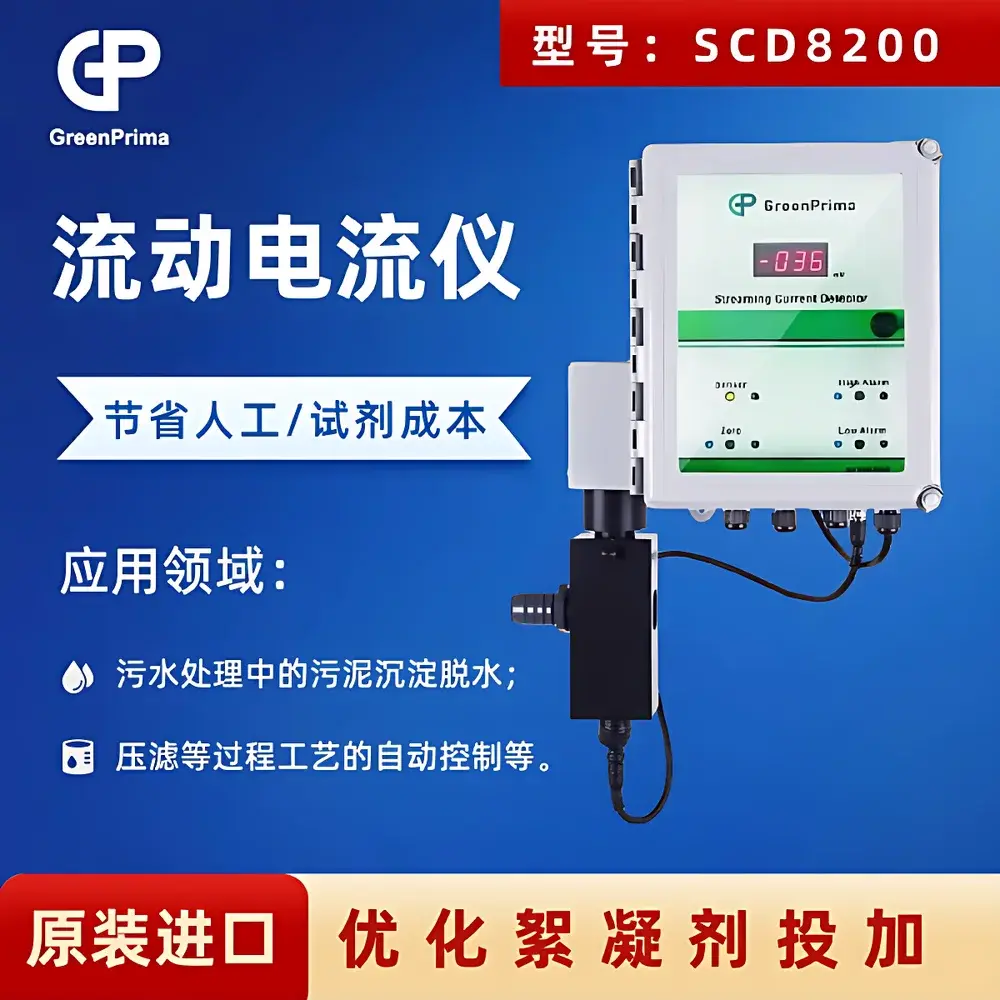
GreenPrima SCD8200 Streaming Current Detector
| Brand | GreenPrima |
|---|---|
| Origin | Germany |
| Manufacturer Type | Manufacturer |
| Origin Category | Imported |
| Model | SCD8200 |
| Price | Upon Request |
| Power Supply | 100–240 VAC |
| Measurement Range | −1000 to +1000 mV |
| Accuracy | ±0.1% of full scale |
| Display | LED |
| Flow Rate | 1 L/min |
| Inlet Connection | 1/2" |
| Outlet Connection | 3/4" |
| Response Time | 1 s |
| Sensor Material | Delrin / 316 Stainless Steel / PTFE |
| Output Signals | 4–20 mA, −10 to +10 V, 0–10 V |
| Communication | MODBUS RTU (optional) |
| Alarm Outputs | High/Low relay contacts |
| Enclosure Rating | IP65 |
| Dimensions | 279 × 152 mm (11.0" × 6.0") |
| Weight | 9 kg |
Overview
The GreenPrima SCD8200 Streaming Current Detector is an industrial-grade, online electrokinetic monitoring instrument engineered for real-time assessment of coagulant dosage efficacy in water and wastewater treatment processes. It operates on the principle of streaming current measurement—a well-established electrokinetic technique grounded in the Helmholtz-Smoluchowski theory. When a pressurized water sample flows through a precisely machined cylindrical sensor chamber, hydrodynamic shear forces displace the diffuse layer of counter-ions surrounding colloidal particles. This ion displacement generates a measurable alternating current between two embedded electrodes positioned along the flow path. The magnitude and polarity of the resulting streaming current (expressed in millivolts) correlate directly with the net surface charge density of residual colloids—providing a quantitative, process-relevant proxy for coagulation endpoint detection and charge neutralization efficiency.
Key Features
- Real-time, continuous streaming current measurement with 1-second response time—enabling dynamic feedback control of coagulant dosing pumps
- Auto-zero calibration routine executed at user-defined intervals or triggered by flow cessation, ensuring long-term baseline stability without manual intervention
- Robust sensor construction using chemically inert materials: Delrin housing, 316 stainless steel wetted components, and PTFE-sealed electrodes—optimized for aggressive chemical environments and abrasive suspended solids
- Triple analog output configuration (4–20 mA, ±10 V, 0–10 V) plus optional MODBUS RTU serial communication for seamless integration into DCS, PLC, or SCADA systems
- IP65-rated NEMA 4X enclosure with integrated status LEDs for local diagnostics—including flow presence, signal validity, and alarm condition indicators
- Wide operating voltage range (100–240 VAC, 50/60 Hz) and dual-stage relay outputs for high/low limit alarms—supporting fail-safe interlocks in critical treatment trains
Sample Compatibility & Compliance
The SCD8200 is validated for use across a broad spectrum of aqueous matrices, including raw surface water, clarified effluent, membrane pre-filtration streams, and dewatered sludge filtrate. Its design conforms to key regulatory and operational frameworks governing automated process instrumentation in water utilities: it supports audit-trail-capable data logging when interfaced with compliant SCADA platforms, aligns with ISO 5725 (accuracy and precision of measurement methods), and meets functional safety expectations outlined in IEC 61508 for SIL-1 applications. While not intrinsically certified for hazardous locations, its non-sparking sensor architecture and low-energy signal path make it suitable for Zone 2 classified areas when installed per IEC 60079-14 guidelines. The instrument’s measurement methodology is referenced in ASTM D2035 (Standard Practice for Coagulation-Flocculation Jar Tests) as a validated alternative to offline zeta potential estimation in continuous-process validation protocols.
Software & Data Management
Although the SCD8200 operates as a standalone analog transmitter, its MODBUS RTU interface enables bidirectional parameter configuration and real-time data acquisition via industry-standard HMI platforms or custom LabVIEW/Python-based supervisory software. Streaming current values, diagnostic flags (e.g., low-flow warning, sensor saturation), and relay status are mapped to discrete holding registers for trending and statistical process control (SPC). When deployed in GMP-regulated facilities—such as pharmaceutical water-for-injection (WFI) pretreatment lines—the device supports 21 CFR Part 11-compliant electronic records when paired with validated data historians that enforce user authentication, change tracking, and electronic signatures. Raw mV outputs can be linearized and temperature-compensated using external programmable logic controllers (PLCs) per site-specific calibration curves derived from jar test correlations.
Applications
- Optimization of polyaluminum chloride (PACl), ferric chloride, or cationic polymer dosing in potable water treatment plants
- Monitoring charge reversal during dual-coagulant strategies in high-turbidity or NOM-rich surface water sources
- Preventing overdosing in membrane bioreactor (MBR) and reverse osmosis (RO) feed streams—reducing fouling propensity and extending element life
- Controlling coagulant addition in sludge conditioning prior to centrifuge or belt-press dewatering—improving cake solids content and reducing polymer consumption
- Validating coagulation performance during commissioning and routine QA/QC audits under ISO 24510 and EN 12966 standards
FAQ
How does streaming current differ from zeta potential measurement?
Streaming current reflects bulk charge imbalance under dynamic flow conditions and is more robust for online use; zeta potential requires static electrophoretic mobility analysis and is typically performed offline with specialized instruments.
Can the SCD8200 be used with seawater or brackish influent?
Yes—its electrode design and wide mV range accommodate high ionic strength matrices, though calibration should be verified against jar tests due to conductivity-dependent signal attenuation.
Is field recalibration required?
No routine recalibration is needed; zero-point drift is mitigated by automatic periodic auto-zero cycles, and span verification can be performed using standardized KCl reference solutions per manufacturer protocol.
What maintenance intervals are recommended?
Sensor inspection and mechanical cleaning every 3–6 months depending on suspended solids load; O-ring replacement annually or after 5000 operating hours; no consumables or reagents required.
Does the instrument support remote firmware updates?
Firmware updates require physical access and are performed via USB-to-RS485 adapter using GreenPrima’s proprietary configuration utility—no over-the-air capability is provided for security and regulatory compliance reasons.





