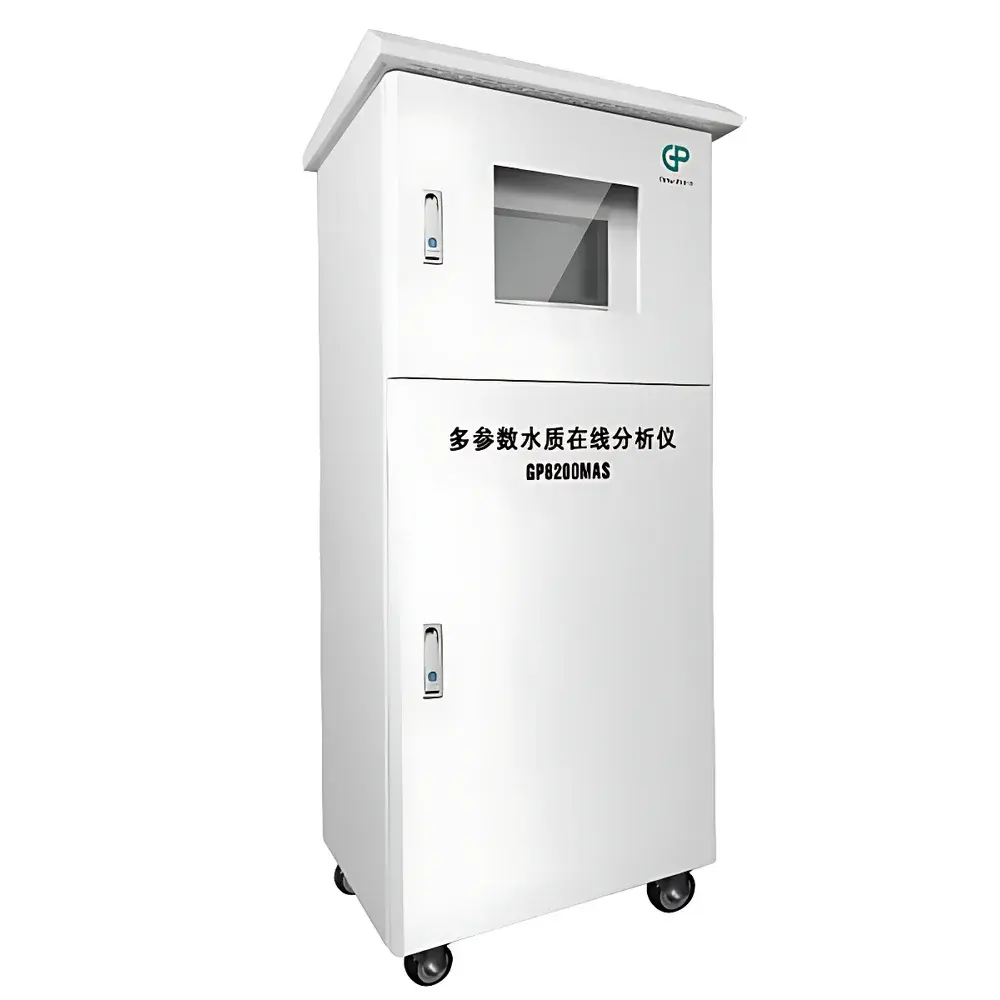
GreenPrima GP8200MAS Multi-Parameter Water Quality Analyzer for River Monitoring
| Brand | GreenPrima |
|---|---|
| Origin | Shanghai, China |
| Manufacturer Type | OEM/ODM Manufacturer |
| Country of Origin | China |
| Model | GP8200MAS |
| Price | USD 14,000 (FOB Shanghai) |
| Display | 10-inch capacitive touch LCD (Chinese UI) |
| Enclosure Rating | IP65 |
| Dimensions | 1300 × 600 × 400 mm (customizable) |
| Power Supply | AC 200 V / 20 W or DC 24 V / 15 W (solar-compatible) |
| Output Options | 4–20 mA (up to 8 channels, optional), RS485 (Modbus RTU), Ethernet (optional), GPRS (China Mobile/Unicom/Telecom, optional), Wi-Fi (optional) |
| Relay Outputs | 8 × SPST, 5 A @ 250 VAC / 30 VDC |
| Sampling Module | Optional |
| Data Transmission | DTU-integrated cloud connectivity via GoPu Cloud Platform (web, mobile app, WeChat Mini Program, SMS alerts) |
Overview
The GreenPrima GP8200MAS is an industrial-grade, modular multi-parameter water quality analyzer engineered for continuous, real-time monitoring of surface water in riverine and watershed environments. Designed for unattended operation in outdoor and semi-industrial settings, it employs direct electrochemical and optical sensing principles—pH and ORP via glass/reference electrode pairs; free chlorine via amperometric membrane sensors; turbidity via 90° scattered light detection (ISO 7027-compliant optical path); conductivity via four-electrode conductivity cells; dissolved oxygen via Clark-type polarographic or optical luminescence sensors (configurable); and temperature via integrated NTC10K or PT1000 thermistors. Its architecture eliminates reagent dependency—ensuring zero chemical waste, no secondary contamination, and compliance with ISO 5667-22 and EPA Method 160.1 for in-situ field deployment. The system supports autonomous calibration verification through built-in reference buffers and automatic temperature compensation across full operational ranges.
Key Features
- Modular sensor architecture: Independent measurement channels per parameter—no cross-talk, no signal interference, and flexible configuration scalability
- Reagent-free operation: Electrochemical and optical sensing eliminates consumables, reducing TCO and enabling >12-month maintenance intervals
- Intelligent auto-compensation: Real-time pH, temperature, and ionic strength correction applied to chlorine, DO, and conductivity readings per ASTM D1293 and ISO 5814
- Industrial HMI: 10-inch resistive-capacitive touchscreen with localized Chinese interface; supports multi-user access levels and audit-trail-enabled configuration logging
- Ruggedized enclosure: IP65-rated stainless-steel and UV-stabilized polycarbonate housing; tested per IEC 60529 for dust/water ingress resistance and IEC 60068-2-6 for vibration resilience
- Flexible power & comms: Dual-input capability (AC mains or solar + battery backup); native RS485 Modbus RTU; optional 4–20 mA analog outputs (8-channel), Ethernet TCP/IP, and tri-carrier GPRS (CMCC/Unicom/CT) with TLS 1.2 encrypted data tunnels
Sample Compatibility & Compliance
The GP8200MAS is validated for natural freshwater matrices including rivers, canals, reservoir inflows, and urban runoff channels. It meets CE marking requirements under the EMC Directive 2014/30/EU and Low Voltage Directive 2014/35/EU. Sensor modules comply with ISO 7888 (conductivity), ISO 5667-2 (sampling practice), and EN 27027 (turbidity). Data integrity adheres to GLP-aligned practices: all measurements include embedded timestamps, sensor health diagnostics (impedance check, membrane integrity flag), and non-volatile storage of raw ADC values. Optional DTU integration enables 21 CFR Part 11–compliant electronic signatures and audit trails when deployed in municipal drinking water source surveillance per China’s HJ/T 91–2019 and EU WFD Annex V protocols.
Software & Data Management
The analyzer interfaces natively with the GoPu Cloud Platform—a secure, ISO/IEC 27001-certified SaaS environment hosted on Alibaba Cloud (Shanghai region). Data ingestion supports MQTT and HTTP(S) APIs with configurable sampling intervals (1 min to 24 h). Historical datasets are retained for ≥18 months with version-controlled metadata (sensor ID, firmware revision, calibration history). Web dashboard features trend visualization, threshold-based alerting (email/SMS/WeChat push), comparative multi-site overlays, and export to CSV/PDF/Excel. Mobile applications (iOS/Android) provide offline cache sync and geotagged field verification logs. All remote commands—including zero/span adjustments and relay actuation—are logged with operator ID and timestamp for regulatory traceability.
Applications
- River basin management: Real-time tracking of eutrophication indicators (DO, conductivity, turbidity) upstream/downstream of discharge points
- Ecological early warning: Detection of sudden pH shifts or chlorine residuals indicating illegal industrial effluent intrusion
- Flood response monitoring: Rapid-deployment units for post-event water safety assessment (e.g., post-typhoon runoff analysis)
- Smart city infrastructure: Integration into municipal IoT networks via Modbus TCP or NB-IoT gateways for centralized SCADA dashboards
- Research-grade validation: Paired with laboratory benchtop analyzers (e.g., Hach DR3900, Thermo Orion Star A329) for method correlation studies under ISO 5725
FAQ
Is the GP8200MAS certified for regulatory reporting in China?
Yes—units shipped to PRC customers include CMA-accredited factory calibration certificates aligned with JJG 119–2021 (pH), JJG 376–2007 (conductivity), and HJ 505–2009 (COD surrogate via conductivity/turbidity correlation).
Can sensor modules be replaced in-field without system recalibration?
Yes—each module carries embedded EEPROM storing individual calibration coefficients and serial traceability; hot-swap replacement triggers automatic coefficient loading upon detection.
What cybersecurity measures protect cloud data transmission?
DTU firmware implements AES-128 encryption for payload, TLS 1.2 for transport, and device-authenticated MQTT sessions using X.509 certificates issued by GoPu’s private CA.
Does the system support predictive maintenance alerts?
Yes—the onboard diagnostic engine monitors sensor drift rate, signal noise variance, and electrode impedance trends; thresholds trigger proactive service notifications via platform dashboard and email.
Is third-party SCADA integration supported beyond Modbus?
Yes—OPC UA server add-on (optional) enables native integration with Siemens Desigo, Schneider EcoStruxure, and Honeywell Experion DCS environments via published information models.