
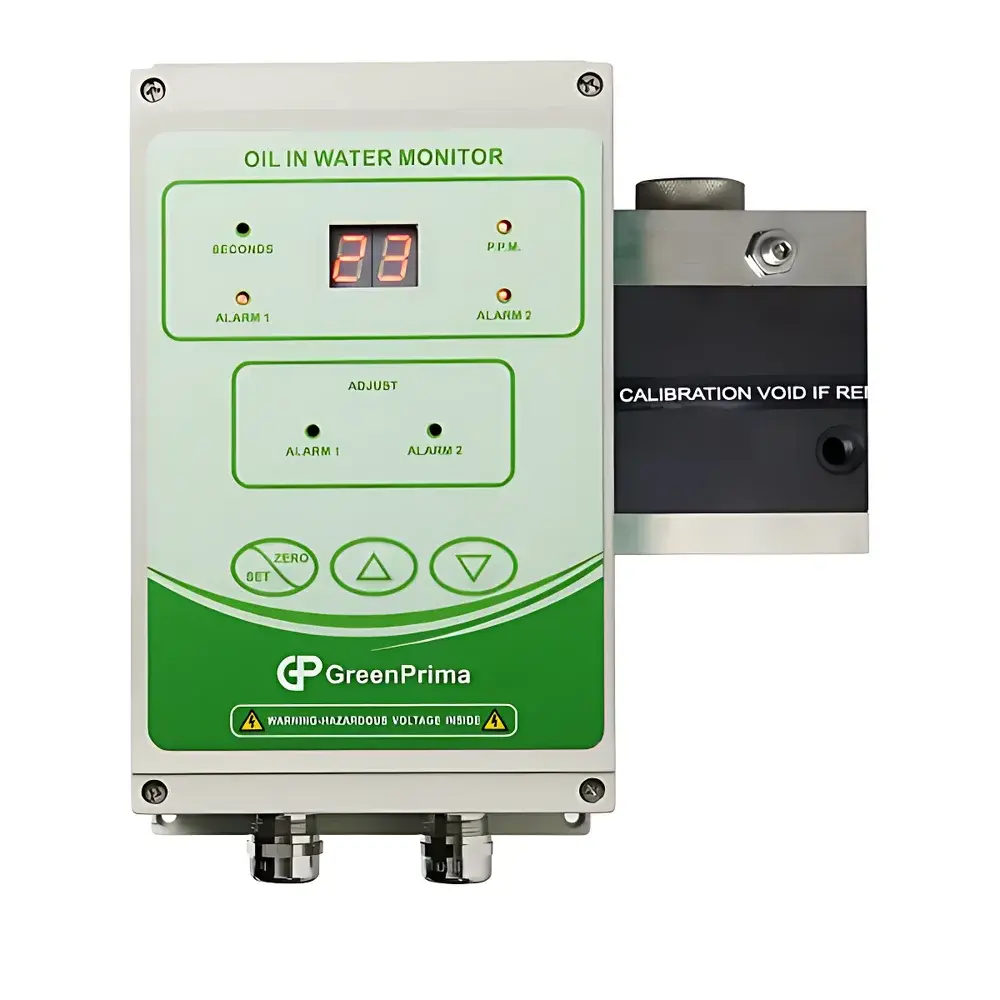
GreenPrima PROCO N7000 Online Oil-in-Water Analyzer for Groundwater Discharge Monitoring
| Brand | GreenPrima |
|---|---|
| Origin | UK |
| Manufacturer Type | Manufacturer |
| Origin Category | Imported |
| Model | PROCO N7000 |
| Instrument Type | Online |
| Measurement Principle | Fluorescence-based Optical Detection (Non-extractive, Immersion-style Sensor) |
| Measurement Range | 0–99 ppm |
| Accuracy | ±2 ppm |
| Alarm Setpoint Range | 1–98 ppm (adjustable) |
| Alarm Delay | Alarm 1: 0–60 s |
| Alarm 2 | 10–240 s (both adjustable) |
| Display | 240 × 128 pixel touchscreen |
| Analog Outputs | 0/4–20 mA (min. load 820 Ω), 0–5 V / 1–5 V DC (min. load 50 kΩ) |
| Sample Temp. | 1–40 °C |
| Sample Flow Rate | 0.1–2 L/min |
| Sample Pressure | 0.1–10 bar |
| Ambient Temp. | 1–60 °C |
| Humidity | ≤90% RH at 55 °C |
| Enclosure Rating | IP55 |
| Electrical Safety | EN 61010-1 / IEC 61000-4 (Overvoltage Category II) |
| Weight | 2.25 kg |
| Dimensions (H×W×D) | 215 × 242 × 73 mm |
| Power Supply | 230 V / 115 V AC or 24 V AC |
| Max. Power Consumption | 10 VA |
Overview
The GreenPrima PROCO N7000 is a purpose-engineered online oil-in-water analyzer designed for continuous, real-time monitoring of hydrocarbon contamination in groundwater discharge streams and industrial water circuits. It employs fluorescence-based optical detection—optimized for aliphatic and aromatic hydrocarbons—including mineral oils, diesel, lubricants, and light fuel fractions—without solvent extraction or reagent consumption. Unlike traditional gravimetric or infrared methods, the PROCO N7000 utilizes an immersion-style optical probe with temperature-compensated excitation/emission filtering, enabling stable baseline performance across variable flow, pressure, and turbidity conditions typical of unfiltered groundwater effluent. Its measurement principle conforms to the physical basis of ASTM D7622 (Standard Test Method for Determination of Oil and Grease in Water by Solvent Extraction and Infrared Spectrophotometry) in functional intent—though operationally distinct—and supports regulatory compliance frameworks applicable to environmental discharge reporting under EU WFD (Water Framework Directive), US EPA NPDES permit requirements, and ISO 10523 (water quality — determination of pH), where hydrocarbon presence must be quantified below actionable thresholds.
Key Features
- Automatic self-diagnostic routine with drift compensation algorithm—performed prior to each measurement cycle to maintain long-term stability without manual recalibration.
- Configurable measurement intervals from 1 minute to 24 hours, enabling adaptive sampling aligned with discharge event frequency or regulatory inspection cadence.
- Integrated 240 × 128 pixel resistive touchscreen interface with multilingual menu navigation (English, German, French, Spanish) and real-time trend visualization.
- Dual independent alarm channels with fully programmable setpoints (1–98 ppm), delay timers (Alarm 1: 0–60 s; Alarm 2: 10–240 s), and dry-contact relay outputs rated at 8 A @ 240 V AC.
- Flexible analog output configuration: selectable 0/4–20 mA (min. 820 Ω load) or voltage outputs (0–5 V / 1–5 V DC, min. 50 kΩ load) compatible with PLCs, SCADA systems, and DCS architectures.
- IP55-rated enclosure with external terminal block for alarm relays, start/stop triggers, and analog signals—designed for semi-outdoor deployment near pump stations, sump pits, or outfall manholes.
- No consumables, no reagents, no sample filtration required—reducing total cost of ownership and minimizing maintenance intervention frequency.
Sample Compatibility & Compliance
The PROCO N7000 is validated for use with raw groundwater, treated effluent, cooling water, boiler condensate (when cooled to ≤40 °C), and industrial wastewater containing suspended solids up to 50 ppm (by weight). It demonstrates robustness against common interferents including humic substances, chlorinated disinfectants (<5 mg/L Cl₂), and moderate iron/manganese concentrations (<2 mg/L). While not certified to ISO/IEC 17025 for accredited testing, its performance characteristics align with method validation criteria outlined in ISO 5667-3 (water quality — sampling — guidance on preservation and handling of water samples) and support GLP-aligned operational records when paired with timestamped data logging. Device firmware includes audit-trail-capable event logging (power cycles, alarm triggers, configuration changes) meeting foundational expectations of EPA 40 CFR Part 136 and EU Regulation (EC) No 1907/2006 (REACH) reporting workflows.
Software & Data Management
Data acquisition is supported via optional USB 2.0 interface (USB-A host port), enabling direct export of CSV-formatted time-series records—including concentration values, temperature readings, alarm status flags, and diagnostic codes—to field laptops or portable drives. The embedded firmware supports Modbus RTU over RS-485 (optional module) for integration into legacy industrial networks. All configuration parameters—including calibration offset (factory-set only), alarm thresholds, and communication settings—are password-protected and stored in non-volatile memory with write-cycle endurance exceeding 100,000 operations. Firmware updates are performed offline using signed binary files, preserving integrity verification per IEC 62443-3-3 Annex A security guidelines.
Applications
- Continuous monitoring of groundwater discharge points at brownfield remediation sites and landfill leachate collection systems.
- Early-warning detection of heat exchanger tube breaches in power plant closed-loop cooling circuits.
- Compliance verification for NPDES-permitted facilities discharging stormwater runoff or process water to municipal sewers.
- Real-time surveillance of lube oil carryover in marine engine jacket water systems.
- Verification of oil/water separator efficiency in refinery wastewater treatment trains prior to final discharge.
FAQ
Does the PROCO N7000 require periodic factory calibration?
No. The instrument uses a factory-characterized optical path with built-in reference channel compensation. Field verification against traceable standard solutions (e.g., hexadecane in isopropanol, NIST-traceable) is recommended annually or after mechanical shock exposure.
Can it operate under sub-zero ambient conditions?
The specified operating range is 1–60 °C ambient. For installations below 1 °C, an insulated housing with thermostatically controlled heating (not supplied) is required to prevent condensation and thermal stress on the optical window.
Is the sensor suitable for seawater applications?
Not without pre-treatment. High salinity (>35 g/kg) and biofouling potential necessitate a dedicated antifouling sleeve and inline dilution—neither included as standard. Contact GreenPrima Applications Engineering for site-specific seawater adaptation kits.
What is the minimum detectable oil concentration?
The lower limit of quantification (LLOQ) is 1 ppm under nominal flow (1 L/min) and temperature (20 °C) conditions, verified per ISO 11843-2:2000 (capability of detection).
How is sample integrity maintained during low-flow conditions?
An internal flow-sensing circuit disables measurement if flow drops below 0.1 L/min for >30 seconds, preventing stagnant-sample artifacts and triggering a “low-flow” warning state via relay and display.
Related Products







