
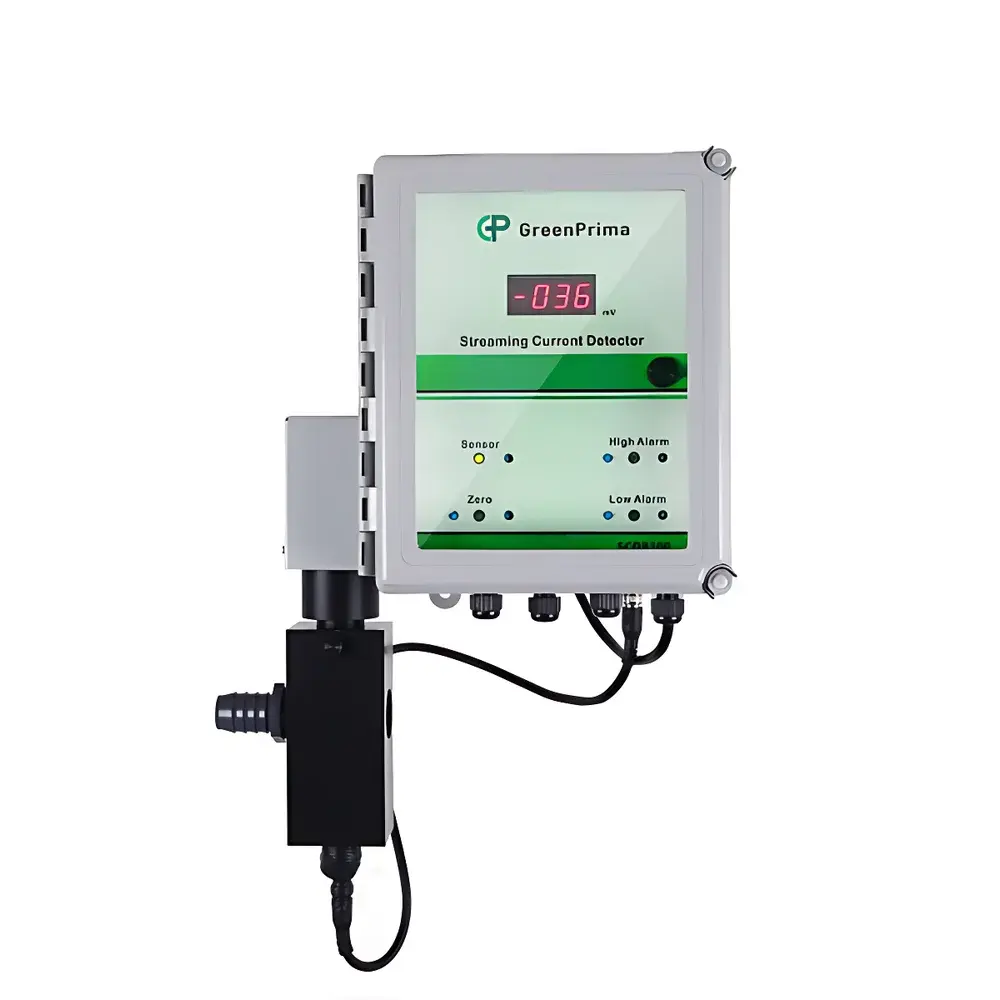
GreenPrima SCD-8200 Streaming Current Detector
| Brand | GreenPrima |
|---|---|
| Origin | United Kingdom |
| Manufacturer Type | Manufacturer |
| Origin Category | Imported |
| Model | SCD-8200 |
| Price | Upon Request |
| Power Supply | 100–240 VAC |
| Measurement Range | −1000 to +1000 mV |
| Accuracy | ±0.1% of full scale |
| Response Time | 1 second |
| Flow Rate | 1 L/min |
| Inlet Connection | 1/2" barbed |
| Outlet Connection | 3/4" barbed |
| Enclosure Rating | IP65, NEMA 4X non-metallic |
| Output Signals | 4–20 mA, −10 to +10 V, 0–10 V |
| Communication | Optional MODBUS RTU |
| Alarm Outputs | High/Low relay |
| Sensor Materials | Delrin, 316 stainless steel, PTFE |
| Diagnostic LED | Integrated on sensor head |
| Weight | 9 kg |
Overview
The GreenPrima SCD-8200 Streaming Current Detector is an industrial-grade online electrokinetic analyzer engineered for real-time measurement of streaming current—a direct indicator of net colloidal and ionic charge in aqueous process streams. Based on the principle of streaming potential generation under controlled laminar shear, the SCD-8200 employs a motor-driven piston within a precision-machined flow cell to induce reproducible hydrodynamic stress across suspended particles. This mechanical shearing action liberates counter-ions from the Stern and diffuse layers surrounding colloids, enabling their migration under applied electric field gradients. The resulting alternating current—measured between two embedded electrodes—is linearly proportional to the surface charge density of the dispersed phase. Unlike turbidity or zeta potential proxies, streaming current provides a direct, process-relevant metric of coagulant demand and charge neutralization efficiency—making the SCD-8200 a foundational instrument for closed-loop coagulant dosing control in potable water, wastewater, and industrial process water applications.
Key Features
- True online streaming current measurement with sub-second response time (≤1 s), enabling dynamic feedback control of coagulant dosing pumps
- Self-contained, zero-point auto-calibration routine executed during scheduled maintenance windows—no manual reference electrode or buffer solutions required
- NEMA 4X non-metallic enclosure with IP65-rated ingress protection, rated for permanent outdoor installation in humid, corrosive, or temperature-variable environments
- Flow cell constructed from chemically inert materials: Delrin body, 316 stainless steel wetted components, and PTFE seals—ensuring long-term stability in chlorinated, ozonated, or high-TDS feedwaters
- Triple-output analog interface (4–20 mA, ±10 V, 0–10 V) plus optional MODBUS RTU serial communication for integration into DCS, SCADA, or PLC-based automation systems
- Integrated diagnostic LED on sensor head providing immediate visual status indication (e.g., flow presence, signal integrity, calibration mode)
- Fixed-flow design (1 L/min) with standardized barbed fittings (1/2″ inlet, 3/4″ outlet) minimizing pressure drop and eliminating need for external flow regulators or rotameters
Sample Compatibility & Compliance
The SCD-8200 is validated for continuous operation in raw surface water, clarified effluent, membrane pre-filtration streams, and sludge dewatering filtrate—covering pH ranges from 5.0 to 9.5 and suspended solids concentrations up to 200 mg/L. Its measurement principle remains robust across variable alkalinity, hardness, and NOM content typical of municipal and industrial influents. The instrument complies with IEC 61326-1 (EMC for industrial environments), IEC 61000-4 series immunity standards, and meets CE marking requirements for electromagnetic compatibility and low-voltage directive conformity. While not certified per FDA 21 CFR Part 11, its analog output architecture and deterministic signal processing support audit-ready data logging when paired with compliant SCADA historians. Design and validation documentation align with ISO/IEC 17025 principles for measurement traceability, and operational protocols are compatible with GLP and GMP-aligned water treatment quality management systems.
Software & Data Management
The SCD-8200 operates as a standalone analog transmitter without embedded firmware or cloud connectivity—ensuring deterministic timing, cybersecurity resilience, and minimal maintenance overhead. All configuration (span, zero offset, alarm thresholds, output scaling) is performed locally via DIP switches and calibrated potentiometers. For centralized monitoring, the 4–20 mA output is directly wired to programmable logic controllers or distributed control systems equipped with analog input modules. When integrated with MODBUS RTU (optional), register mapping supports read-only access to live streaming current value, sensor status flags, and internal diagnostics. Data integrity is preserved through galvanic isolation of analog outputs and transient voltage suppression on power and signal lines. No proprietary software or vendor-specific drivers are required—enabling seamless interoperability with Emerson DeltaV, Siemens PCS7, Honeywell Experion, and Rockwell Automation ControlLogix platforms.
Applications
- Municipal drinking water treatment plants: Real-time optimization of polyaluminum chloride (PACl), ferric chloride, or cationic polymer dosing during rapid mix and flocculation stages
- Wastewater tertiary treatment: Monitoring charge reversal points during coagulant overdosing to prevent floc re-stabilization and filter breakthrough
- Industrial process water reuse: Controlling coagulant addition prior to ultrafiltration or reverse osmosis to reduce fouling potential and extend membrane life
- Sludge conditioning for dewatering: Quantifying optimal cationic polymer dose for centrifuge or belt press feed streams—reducing polymer consumption by 20–40% annually
- Power plant cooling water systems: Detecting colloidal instability during corrosion inhibitor or biocide dosing cycles to prevent deposition-related heat exchanger fouling
- Food & beverage production: Ensuring consistent clarification performance in juice, beer, or dairy whey processing where residual turbidity impacts product shelf life
FAQ
How does streaming current differ from zeta potential?
Streaming current measures the macroscopic net charge transport generated under defined hydraulic shear—directly correlating with coagulant demand in turbulent flow environments. Zeta potential, while related, is a calculated interfacial parameter derived from electrophoretic mobility under low-shear conditions and is less representative of full-scale process dynamics.
Can the SCD-8200 be installed in pressurized main distribution lines?
No—it requires gravity-fed or pumped sidestream sampling at atmospheric or near-atmospheric pressure. A dedicated 1 L/min bypass loop with appropriate isolation valves and backpressure regulation is recommended for mainline integration.
What maintenance intervals are required?
Sensor cleaning every 3–6 months depending on feedwater quality; annual verification of zero point and span using factory-provided calibration check procedure; no consumables or replacement electrodes required over nominal 10-year service life.
Is the instrument suitable for seawater or brackish water applications?
Yes—its electrode geometry and material selection accommodate high ionic strength environments; however, extended exposure to >30,000 µS/cm conductivity may require more frequent sensor inspection due to accelerated passivation of stainless steel surfaces.







