
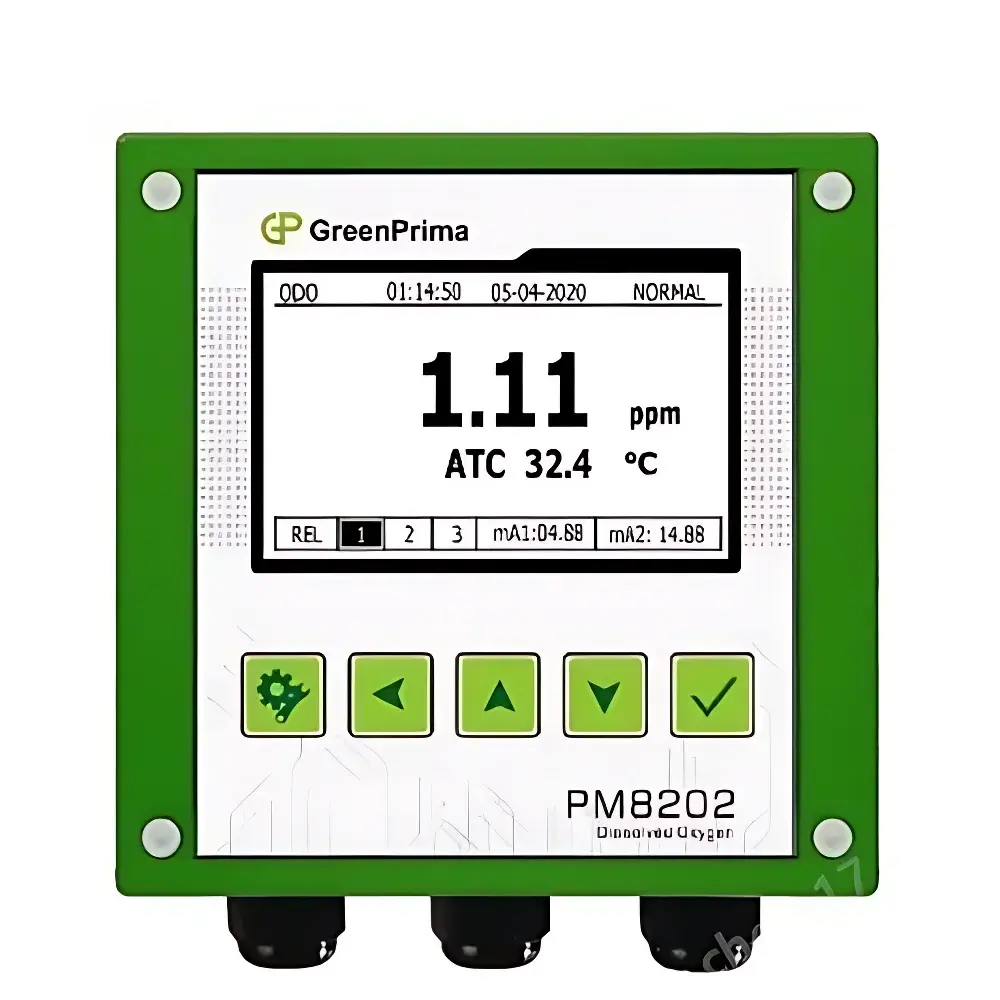
GreenPrima PM 820 D Fluorescence-Based Online Dissolved Oxygen Analyzer
| Brand | GreenPrima |
|---|---|
| Origin | United Kingdom |
| Manufacturer Type | Original Equipment Manufacturer (OEM) |
| Origin Category | Imported |
| Model | PM 820 D |
| Instrument Type | Online |
| Measurement Principle | Fluorescence Quenching |
| Measurement Range | 0.00–20.00 ppm |
| Accuracy | ±0.01 ppm |
| Resolution | 0.01 ppm |
| Temperature Compensation | -10–130 °C (NTC30K/PT1000, manual or automatic) |
| Operating Temperature | -10–70.0 °C |
| Storage Temperature | -20–70.0 °C |
| Display | Backlit large-dot-matrix LCD |
| Language | English & Chinese |
| Data Storage | 600,000 records |
| Power Supply | 90–260 VAC, 50/60 Hz or optional 24 VDC |
| Output | Dual isolated 4–20 mA (max. loop resistance 500 Ω, accuracy 0.1% F.S.), RS485 Modbus RTU |
| Cleaning Output | Adjustable interval (0.1–1000 h), duration (1–1000 s) |
| Alarm Output | Two independent Hi/Lo relay outputs (5 A / 250 VAC / 30 VDC) |
| Enclosure Rating | IP65 |
| Mounting | Wall-mounted, pipe-mounted, or panel-mounted |
| Dimensions | 144 × 144 × 108 mm |
| Panel Cutout | 138 × 138 mm |
| Weight | 0.87 kg |
Overview
The GreenPrima PM 820 D is an online dissolved oxygen (DO) analyzer engineered for continuous, high-stability monitoring in demanding water quality applications. It employs optical fluorescence quenching technology—based on the Stern–Volmer principle—to quantify dissolved molecular oxygen concentration without electrochemical consumption or membrane diffusion limitations. Unlike Clark-type amperometric sensors, the PM 820 D’s solid-state optical sensor (Bsens410) contains no electrolyte, no gas-permeable membrane, and consumes zero oxygen during measurement. This eliminates flow dependency, polarization time, and drift associated with traditional electrochemical cells. The system comprises a rugged controller unit and a replaceable 316L stainless steel probe, enabling reliable deployment in low-flow or stagnant environments—including wastewater treatment basins, aquaculture recirculation systems, surface water monitoring stations, and industrial cooling towers.
Key Features
- Fluorescence-based detection ensures zero oxygen consumption and insensitivity to flow velocity or pressure fluctuations.
- Membrane- and electrolyte-free design delivers near-zero maintenance requirements—no routine membrane replacement, electrolyte refills, or polarization conditioning.
- Stable optical signal with negligible long-term drift; calibration intervals extended significantly versus conventional DO sensors—typically only required during commissioning or after sensor replacement.
- Digital sensor architecture with embedded temperature compensation (NTC30K or PT1000 selectable) and automatic thermal correction across -10–130 °C.
- Large backlit dot-matrix LCD with intuitive bilingual (English/Chinese) menu navigation and real-time display of DO concentration, temperature, and system status.
- Dual isolated 4–20 mA analog outputs configurable for DO value and/or temperature; RS485 interface compliant with Modbus RTU protocol for seamless integration into SCADA, DCS, or PLC networks.
- Optional air-pulse self-cleaning module programmable for cleaning frequency (0.1–1000 hours) and duration (1–1000 seconds), critical for fouling-prone installations such as effluent channels or fish farm intakes.
- Robust IP65-rated enclosure with 316L stainless steel sensing element; suitable for wall, pipe, or panel mounting in indoor or sheltered outdoor environments.
- Two programmable relay outputs with adjustable hysteresis for alarm signaling (e.g., low DO threshold in aquaculture or high DO deviation in activated sludge processes).
Sample Compatibility & Compliance
The PM 820 D is validated for use in a broad spectrum of aqueous matrices: municipal and industrial wastewater, raw and treated surface water, groundwater, seawater (with salinity compensation), and recirculating aquaculture system (RAS) water. Its optical method inherently avoids interference from hydrogen sulfide, chlorine, heavy metals, or cyanide—common contaminants that poison electrochemical DO electrodes. While not certified to ISO 5814 or ASTM D888 directly (as those standards reference wet-chemistry and membrane-based methods), the instrument’s performance aligns with the functional requirements of EN 25814, US EPA Method 360.1 (for field-deployable DO), and WHO Guidelines for Safe Water Quality. Data integrity complies with GLP principles through timestamped storage of 600,000 measurement records, password-protected configuration access, and non-volatile memory retention during power loss.
Software & Data Management
The controller firmware supports full local data logging without external hardware: all measurements (DO, temperature, timestamps) are stored internally at user-defined intervals. Export is possible via USB or Modbus polling. Configuration parameters—including calibration constants, alarm thresholds, cleaning schedules, and communication settings—are secured behind multi-level password protection to prevent unauthorized modification. The Modbus register map provides direct read/write access to all operational variables, enabling traceable parameter changes and audit-ready configuration logs—supporting internal QA/QC protocols and regulatory readiness under ISO/IEC 17025 or water utility asset management frameworks.
Applications
- Continuous DO monitoring in activated sludge aeration basins and oxidation ditches to optimize blower energy consumption and biological treatment efficiency.
- Real-time dissolved oxygen control in intensive aquaculture and hatchery operations, where sub-ppm deviations impact fish metabolism and survival rates.
- Regulatory compliance monitoring at wastewater discharge points per national environmental permits (e.g., UK Environment Agency, EU Urban Wastewater Treatment Directive).
- Early warning detection of hypoxic conditions in reservoirs, rivers, and estuaries for ecological assessment and climate resilience planning.
- Process validation in pharmaceutical water-for-injection (WFI) distribution loops, where non-invasive, non-consumptive DO measurement supports USP and FDA 21 CFR Part 11 data integrity expectations.
FAQ
Does the PM 820 D require zero or span calibration in the field?
No—fluorescence quenching provides inherent stability. Factory calibration is traceable to NIST-certified standards; field verification using air-saturated water or Winkler titration is recommended annually or after sensor replacement.
Can the sensor operate in seawater or high-salinity environments?
Yes—the Bsens410 probe is compatible with salinities up to 45 ppt; salinity compensation must be enabled and configured via the controller interface.
Is the 4–20 mA output intrinsically safe for hazardous area installation?
No—the standard output is not IS-certified; for Zone 1/2 or Class I Div 1 environments, an externally mounted intrinsic safety barrier must be used per IEC 60079-11.
What is the expected service life of the fluorescent sensing layer?
Under normal operating conditions (≤50 °C, non-abrasive media), the optical coating maintains performance for ≥24 months; accelerated aging occurs above 70 °C or under UV exposure.
How does the air-pulse cleaning function integrate with process automation?
The cleaning trigger can be synchronized to a PLC timer or initiated manually via Modbus command; event logs record each cleaning cycle with timestamp and duration for maintenance tracking.







