
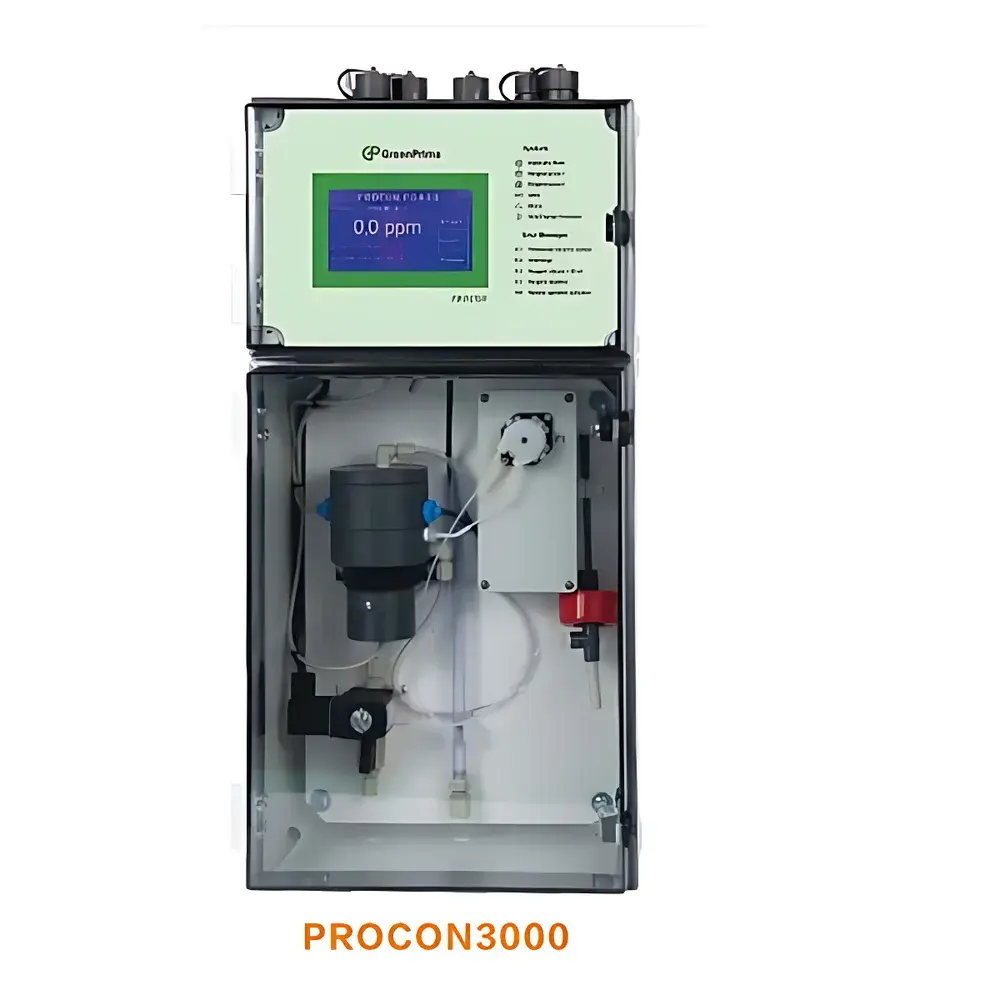
GreenPrima PROCON3000 Residual & Total Chlorine Analyzer
| Brand | GreenPrima |
|---|---|
| Origin | United Kingdom |
| Manufacturer Type | Original Equipment Manufacturer (OEM) |
| Product Category | Imported Instrument |
| Model | PROCON3000 |
| Pricing | Available Upon Request |
Overview
The GreenPrima PROCON3000 Residual & Total Chlorine Analyzer is a fully automated, benchtop or wall-mountable photometric analyzer engineered for continuous, unattended monitoring of free residual chlorine and total chlorine in aqueous matrices. It operates on the standardized N,N-diethyl-p-phenylenediamine (DPD) colorimetric method—compliant with ISO 7393-2, APHA Standard Methods 4500-Cl G, and ASTM D1253—where chlorine oxidizes DPD to form a stable magenta-colored quinoneimine dye, quantified via fixed-wavelength (515 nm) absorbance measurement. The system integrates precise peristaltic metering, pneumatically actuated solenoid valves, temperature-stabilized optical detection, and microprocessor-controlled sequence logic to deliver high reproducibility in real-world water treatment environments.
Key Features
- Fully autonomous operation: automatic sample aspiration, reagent dosing, reaction timing, photometric measurement, and system flushing—all governed by an embedded ARM-based controller with real-time clock and non-volatile memory.
- Intuitive 240 × 128 pixel resistive touchscreen interface with multilingual menu navigation (English, German, French, Spanish), enabling configuration without external software.
- Dual-mode capability: switch between residual chlorine (using DPD Reagent A + B) and total chlorine (using DPD Reagent A + C) via software-selectable assay protocols—no hardware modification required.
- Zero-point auto-compensation and drift correction algorithms minimize manual intervention; calibration stability maintained over ≥90 days under routine use conditions.
- Configurable analysis interval from 1 minute to 99 minutes; external start/stop trigger input (dry contact, 18 V DC, ~4 mA) supports integration into SCADA or PLC-controlled water networks.
- Three programmable SPDT relays: independent outputs for alarm (e.g., out-of-range), limit violation (e.g., low/high setpoint), and analysis cycle status—each rated 230 V AC / 3 A, electrically isolated.
- Robust analog output: galvanically isolated 0/4–20 mA current loop (max. load 500 Ω), configurable for linear scaling across the full 0.02–2.00 ppm Cl₂ range with user-defined zero/span points.
- Wide operating envelope: functional at ambient temperatures from 5 °C to 45 °C and sample pressures between 0.1–10 bar; power supply accepts universal 110–230 V AC (50/60 Hz); typical power draw <16 VA.
Sample Compatibility & Compliance
The PROCON3000 is validated for use with potable water, cooling tower make-up water, swimming pool circulation systems, and wastewater disinfection effluents. Sample requirements include clarity (filtered to ≤5 µm), pH 4.0–8.0, absence of strong oxidants other than chlorine (e.g., ozone, chlorine dioxide), and no suspended solids that may foul the flow cell. Reagents CL1001 (DPD powder), CL1002 (buffer for residual chlorine), and CL1003 (iodide catalyst for total chlorine) are supplied in sealed 250 mL vials, with shelf life of 6 months when stored at 5–25 °C. All wetted materials—including tubing, valves, and cuvette—are chemically resistant to chlorine solutions and meet FDA-compliant polymer standards (USP Class VI). The instrument design adheres to IEC 61000-6-2 (immunity) and IEC 61000-6-3 (emissions), and supports GLP/GMP data integrity through optional USB logging (FAT32-formatted drive, timestamped CSV export).
Software & Data Management
Internal firmware provides full audit trail functionality: every measurement event (timestamp, raw absorbance, calculated concentration, reagent batch ID, system diagnostic flags) is logged in non-volatile memory. Optional USB data export enables traceable offline review compliant with 21 CFR Part 11 requirements when paired with secure access controls and electronic signature workflows. No proprietary drivers or cloud dependencies are required—the device functions as a standalone field instrument with local parameter retention across power cycles. Firmware updates are performed via USB stick using signed binary packages verified via SHA-256 checksum.
Applications
- Real-time compliance monitoring at municipal drinking water distribution points per WHO Guidelines and EU Drinking Water Directive (98/83/EC).
- Automated dosing feedback control in chlorine contact tanks and clearwells.
- Preventive maintenance support for HVAC cooling water systems to mitigate microbial growth (Legionella spp.) while avoiding corrosion from overdosing.
- Regulatory reporting for recreational water facilities under CDC Model Aquatic Health Code (MAHC) Section 5.003.
- QA/QC verification in bottled water production lines prior to final filtration and bottling.
FAQ
What is the difference between residual and total chlorine measurement on the PROCON3000?
Residual chlorine measures only free available chlorine (HOCl/OCl⁻) using DPD Reagents A + B. Total chlorine includes combined chlorine (chloramines) and is measured after adding potassium iodide (Reagent C) to liberate bound chlorine—both modes use identical hardware and optics.
Does the analyzer require daily calibration?
No. The PROCON3000 employs factory-calibrated optical path geometry and self-zeroing reference cycles; periodic verification (e.g., weekly) with NIST-traceable chlorine standard solutions is recommended for audit readiness.
Can it operate in high-humidity or outdoor enclosures?
Yes—provided ambient temperature remains within 5–45 °C and condensation is prevented. An IP65-rated optional enclosure kit is available for semi-outdoor deployment.
Is remote diagnostics supported?
Local diagnostics only: all error codes (e.g., “Valve Timeout”, “Low Signal”, “Reagent Exhaust”) are displayed on-screen with contextual troubleshooting prompts. No Ethernet or cellular connectivity is built-in.
How often must reagents be replaced?
At typical 10-minute cycle intervals, one 250 mL reagent vial supports approximately 925 analyses (~65 days of continuous operation). Reagent expiration is tracked via date-coded labeling—not firmware.
Related Products





