
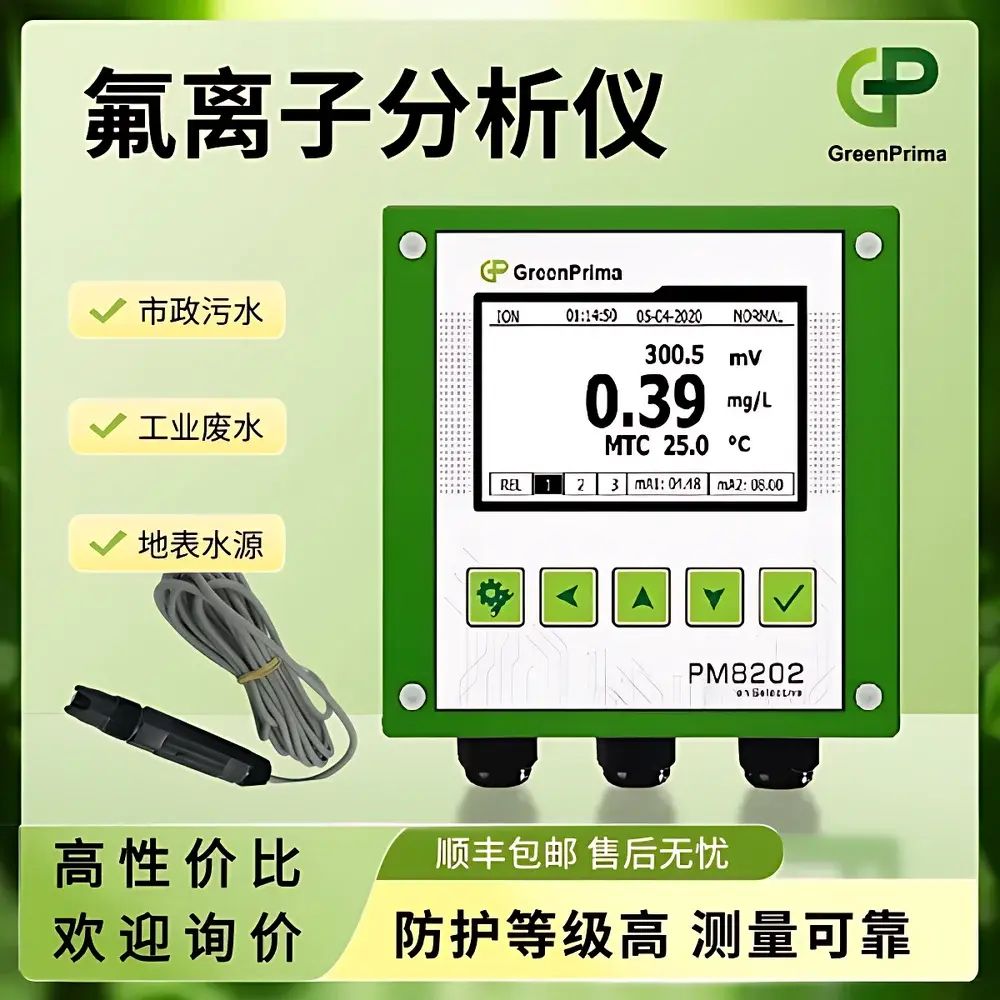
GreenPrima PM8202I Fluoride Ion Analyzer for Potable Water Monitoring
| Brand | GreenPrima |
|---|---|
| Origin | United Kingdom |
| Manufacturer Type | Original Equipment Manufacturer (OEM) |
| Product Category | Imported Instrument |
| Model | PM 8202I |
| Pricing | Available Upon Request |
| Measurement Range | 0.00–20,000 ppm F⁻ |
| Resolution | 0.01 / 0.1 / 1 ppm (user-selectable) |
| Accuracy | ±0.01 / ±0.1 / ±1 ppm (dependent on range) |
| Temperature Compensation | -10 to 130 °C (manual or automatic |
| Operating Temperature | -10 to 70.0 °C |
| Storage Temperature | -20 to 70.0 °C |
| Display | Backlit large-dot-matrix LCD |
| Language Support | English & Chinese |
| Data Storage Capacity | 600,000 records |
| Power Supply | 90–260 VAC, 50/60 Hz or optional 24 VDC |
| Analog Outputs | Two isolated 4–20 mA outputs (max. loop resistance 500 Ω, accuracy ±0.1% FS, configurable for fluoride concentration or temperature) |
| Digital Communication | RS485 Modbus RTU |
| Enclosure Rating | IP67-rated sealed housing |
| Electrode Compatibility | BSENS710 Fluoride ISE, BSENS720 Chloride ISE, BSENS730 Ammonia ISE |
| Calibration | Manual or automated multi-point calibration with password-protected access |
Overview
The GreenPrima PM8202I Fluoride Ion Analyzer is a dedicated, multi-parameter online monitoring system engineered for continuous, real-time quantification of fluoride ion (F⁻) concentration in potable water distribution networks, wastewater treatment effluents, and industrial process streams. Unlike generic conductivity or pH meters, the PM8202I employs potentiometric measurement via a solid-state, lanthanum fluoride (LaF₃)-based ion-selective electrode (ISE), conforming to ISO 10304-1 and ASTM D1179 principles for fluoride determination in aqueous matrices. The instrument operates on the Nernst equation principle, where electrode potential shifts linearly with the logarithm of fluoride activity—enabling direct, interference-compensated quantification across five decades of concentration (0.00–20,000 ppm). Its modular architecture integrates seamlessly with existing SCADA infrastructure through dual 4–20 mA analog channels and native Modbus RTU over RS485, supporting centralized data aggregation without protocol gateways.
Key Features
- IP67-rated hermetically sealed enclosure—resistant to dust ingress, water immersion up to 1 m for 30 minutes, and ambient humidity fluctuations typical in pump stations and chlorination rooms.
- User-configurable resolution (0.01 / 0.1 / 1 ppm) and auto-ranging measurement logic optimized for regulatory compliance thresholds (e.g., WHO guideline value of 1.5 mg/L and EPA MCL of 4.0 mg/L).
- Integrated temperature compensation using either NTC30k thermistors or PT1000 platinum resistance sensors—ensuring electrochemical stability across operational ranges from -10 °C to 130 °C.
- Dual isolated 4–20 mA outputs with full-scale programmability: one channel assigned to fluoride concentration, the second to temperature or alarm status—each traceable to NIST-traceable calibration records.
- Password-protected configuration interface prevents unauthorized parameter modification—supporting audit-ready operation under GLP and ISO/IEC 17025 laboratory quality systems.
- Onboard non-volatile memory stores 600,000 timestamped readings (F⁻ concentration, temperature, calibration logs, relay events), synchronized via internal real-time clock with battery backup.
Sample Compatibility & Compliance
The PM8202I is validated for use with clarified, low-turbidity aqueous samples meeting standard drinking water criteria (e.g., turbidity < 1 NTU, total suspended solids < 10 mg/L). It accommodates variable flow conditions via optional inline flow cells or submersible probe housings compatible with BS EN 14899:2017 mounting specifications. When deployed with BSENS710 fluoride electrodes, the system complies with ISO 10304-1:2012 for ion chromatography cross-validation and supports method verification per US EPA Method 300.0. All firmware and calibration protocols adhere to FDA 21 CFR Part 11 requirements for electronic record integrity, including user authentication, audit trail generation, and immutable data logging.
Software & Data Management
Data export is supported via USB mass storage mode (CSV format) or serial dump through Modbus register mapping (holding registers 40001–40100). No proprietary software is required—third-party SCADA platforms (e.g., Ignition, Siemens Desigo, Schneider EcoStruxure) can directly poll concentration, temperature, electrode slope (%), and offset (mV) values. Calibration history—including date, standard concentrations used, measured mV response, and Nernstian slope deviation—is retained with ISO 17025-compliant metadata (operator ID, instrument ID, environmental conditions). Remote diagnostics are enabled via optional Ethernet/WiFi gateway modules (sold separately).
Applications
- Real-time fluoride dosing control at municipal water treatment plants—ensuring consistent compliance with national fluoridation mandates (e.g., UK DWI, US CDC, Australian NHMRC).
- Effluent monitoring at semiconductor fabrication facilities where HF rinse water requires precise sub-ppm fluoride tracking prior to neutralization.
- Process water quality assurance in pharmaceutical manufacturing (Category A purified water systems per EU GMP Annex 1), where fluoride serves as a corrosion indicator in stainless-steel loop integrity testing.
- Regulatory reporting for environmental permits requiring quarterly fluoride discharge summaries—automated data archiving eliminates manual transcription errors.
FAQ
Does the PM8202I require daily maintenance?
No—routine maintenance intervals are defined by electrode lifetime (typically 6–12 months under continuous operation) and calibration frequency (recommended every 24–72 hours depending on sample matrix stability). No consumables beyond calibration standards are required.
Can it measure fluoride in seawater or high-salinity brines?
Not without matrix-specific validation. High ionic strength (>50,000 µS/cm) and elevated Ca²⁺/Al³⁺ concentrations cause significant activity coefficient deviations and electrode poisoning. Use only after conducting interference testing per ISO 10304-1 Annex C.
Is the system compliant with drinking water safety regulations in the EU and USA?
Yes—the measurement methodology aligns with EN ISO 10304-1 and EPA Method 300.0, and the device’s data integrity controls satisfy EU WFD Article 7 reporting requirements and US Safe Drinking Water Act enforcement guidelines.
How is electrode drift compensated during long-term deployment?
The instrument performs automatic slope monitoring at each calibration cycle and triggers user alerts when Nernstian response falls below 92% of theoretical (59.16 mV/decade at 25 °C). Drift correction is applied algorithmically using stored calibration coefficients—not via software interpolation.
Related Products







