
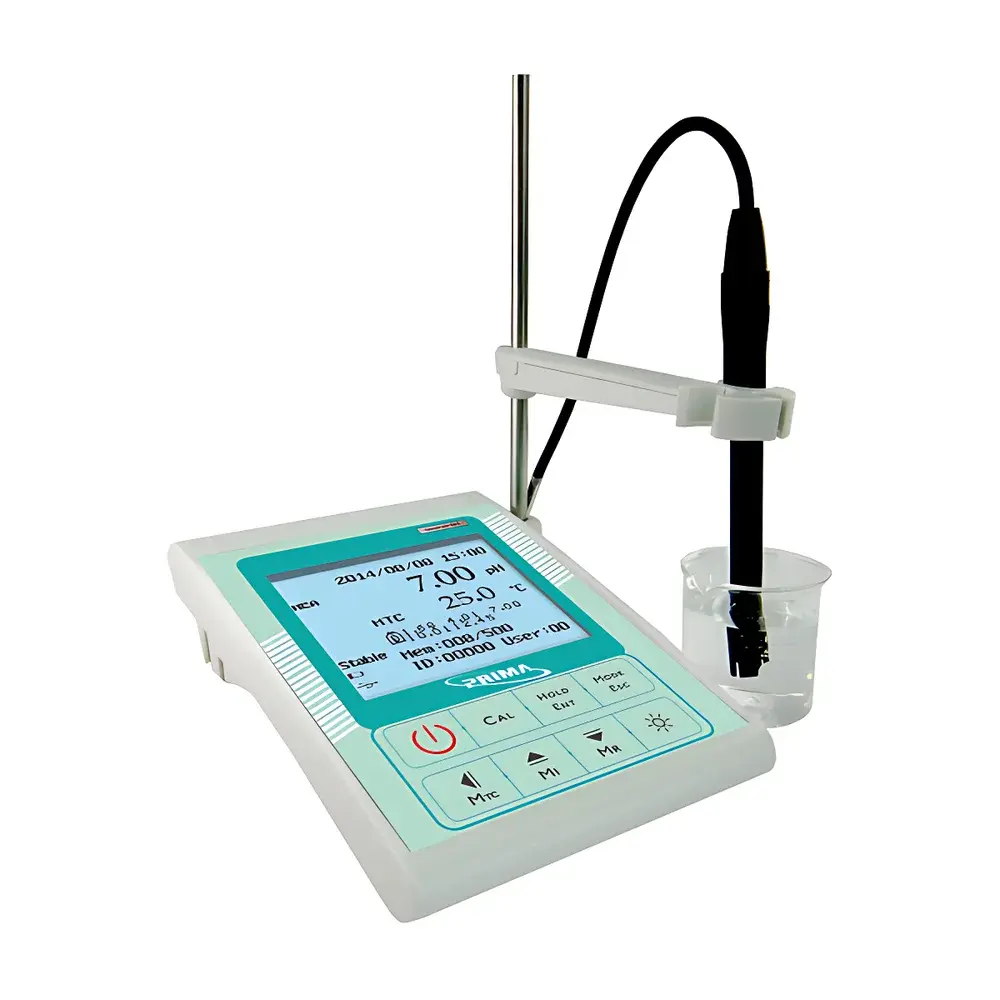
PRIMA innoLab 20I Benchtop Ion Concentration Analyzer
| Brand | PRIMA (UK) |
|---|---|
| Origin | Taiwan |
| Model | innoLab 20I |
| Ion Measurement Range | 0.000–9999 mg/L |
| pH Range | −2.000–20.000 |
| mV Range | −2000.0–2000.0 |
| Temperature Range | −10.0–120.0 °C |
| pH Accuracy | ±0.2% F.S. ±3 LSD |
| mV Accuracy | ±0.1% F.S. ±3 LSD |
| Ion Accuracy | ±0.5% F.S. ±3 LSD |
| Calibration Points | up to 7-point ISE calibration |
| Memory Capacity | 1000 data sets (pH: 500, mV: 250, ION: 250) |
| Display | Backlit dot-matrix LCD |
| Interface | USB 2.0 |
| Power Supply | 100–240 VAC |
| Dimensions | 150 × 194 × 56 mm |
| Weight | 1.0 kg |
| Electrode Interface | BNC |
| Temperature Compensation | Automatic/Manual |
| ISE Compatibility | All standard liquid- and gel-filled ISEs (NH₄⁺, F⁻, Cl⁻, CN⁻, Na⁺, NO₃⁻, K⁺, Ca²⁺, Cu²⁺, Pb²⁺, Ag⁺, etc.) |
Overview
The PRIMA innoLab 20I is a benchtop ion concentration analyzer engineered for precise, trace-level quantification of monovalent and multivalent ions in aqueous environmental, industrial, and laboratory samples. Based on potentiometric measurement principles using ion-selective electrodes (ISEs), the instrument operates under the Nernst equation framework—generating millivolt signals proportional to the logarithm of target ion activity. Unlike optical or electrochemical amperometric methods, ISE-based detection offers direct, reagent-free, real-time concentration readouts across a wide dynamic range (0.000–9999 mg/L), with resolution down to 0.001 mg/L for low-concentration applications. Designed for compliance-critical water quality monitoring—including drinking water, wastewater effluent, surface water, and industrial process streams—the innoLab 20I supports regulatory workflows aligned with ISO 10523 (pH determination), ISO 10304-1 (ion chromatography validation reference), and ASTM D6919 (chloride and nitrate by ISE). Its robust architecture integrates temperature-compensated signal conditioning, high-impedance input circuitry (>10¹² Ω), and low-noise analog-to-digital conversion to ensure long-term measurement stability and inter-laboratory reproducibility.
Key Features
- Seven-point customizable ISE calibration protocol with slope and offset verification per channel—enabling rigorous method validation and traceability.
- Triple-stage reading stabilization algorithm: user-selectable response thresholds (fast/standard/precise) to accommodate variable sample kinetics and electrode equilibration times.
- Comprehensive calibration management: date-stamped calibration logs, adjustable reminder intervals (0–60 days), and visual slope diagnostics for each calibration point.
- Backlit dot-matrix LCD with configurable contrast and auto-off backlight control—optimized for both low-light field labs and bright ambient environments.
- Full parameter programmability: user-defined serial number (4-digit), operator ID (2-digit), date format (YY/MM/DD, MM/DD/YY, DD/MM/YY), and 12/24-hour clock mode.
- Four-digit password protection for configuration menus—supporting role-based access control in GLP/GMP-regulated facilities.
- USB 2.0 interface with PRIMA SmartLink software for bidirectional data transfer, remote instrument control, and audit-trail-enabled report generation compliant with FDA 21 CFR Part 11 requirements.
Sample Compatibility & Compliance
The innoLab 20I interfaces seamlessly with a broad portfolio of commercially available ISEs—including epoxy-, PVC-, and Teflon-bodied sensors with BNC connectors (1 m standard cable; optional up to 10 m). It accommodates gel-filled, solid-state, and gas-sensing electrodes (e.g., NH₃, S²⁻) across pH-compatible matrices (e.g., F⁻: pH 4–8; CN⁻: pH 11–13; Ag⁺: pH 1–9). Each electrode type is validated for specified temperature ranges (5–50 °C typical) and matrix tolerances—ensuring reliable performance in complex matrices such as chlorinated drinking water, alkaline leachates, or saline estuarine samples. The instrument’s automatic temperature compensation (ATC) uses integrated Pt1000 sensor input or manual entry, correcting for thermal drift in Nernstian response. Regulatory alignment includes support for ISO 5667-3 (sampling preservation), US EPA Method 300.0 (anions), and WHO Guidelines for Drinking-water Quality (2022), particularly for fluoride, chloride, nitrate, and cyanide monitoring.
Software & Data Management
PRIMA SmartLink software provides secure, structured data handling for laboratories operating under quality management systems. Data exports are generated in CSV and PDF formats with embedded metadata: timestamp, operator ID, electrode ID, calibration history, temperature, and raw mV values. Audit trails record all configuration changes—including password resets, calibration events, and memory clears—with user attribution and time stamps. The software supports batch export, trend plotting, statistical summaries (mean, SD, CV%), and customizable report templates suitable for internal QA reviews or external accreditation submissions (e.g., ISO/IEC 17025). All communications employ encrypted handshake protocols, and local database storage ensures offline operation without cloud dependency—critical for secure government or utility lab environments.
Applications
- Drinking water compliance testing: fluoride (0.5–1.5 mg/L), nitrate (<10 mg/L NO₃–N), chloride (<250 mg/L), and cyanide (<0.07 mg/L) per WHO and EU Directive 2020/2184.
- Wastewater treatment plant monitoring: ammonium (NH₄⁺) in nitrification/denitrification basins, sodium in reverse osmosis reject streams, and sulfide in anaerobic digesters.
- Industrial process control: chloride ingress detection in cooling tower water, cyanide recovery in electroplating baths, and calcium hardness in boiler feedwater.
- Environmental field labs: rapid screening of surface water for bromide (emerging disinfection byproduct precursor) and lead in legacy pipe corrosion studies.
- Educational laboratories: hands-on instruction in potentiometry, Nernst equation derivation, selectivity coefficient determination (log Kpot), and ISE calibration best practices.
FAQ
What ion-selective electrodes are compatible with the innoLab 20I?
All standard BNC-interface ISEs—including PRIMA’s IS-series (e.g., IS-ClLS, IS-CNLS, IS-NaLS) and third-party electrodes from Thermo Orion, Metrohm, and Horiba—are fully supported.
Does the instrument meet FDA 21 CFR Part 11 requirements?
Yes—when used with PRIMA SmartLink software, it provides electronic signatures, audit trails, and role-based access controls required for regulated pharmaceutical and clinical environmental testing.
Can calibration data be exported for external QA review?
Yes—calibration logs, including date, slope, intercept, and standard concentrations, are exportable in CSV format with full traceability.
Is temperature compensation mandatory during ion measurement?
Automatic temperature compensation is recommended for accuracy; however, manual temperature entry is permitted when ATC probe integration is not feasible.
How is measurement uncertainty estimated for ISE readings?
Uncertainty derives from combined contributions: instrument accuracy (±0.5% F.S. ±3 LSD), electrode selectivity (log Kpot), ionic strength effects, and calibration standard uncertainty—fully documented in the included ISO/IEC 17025-compliant uncertainty budget template.







