
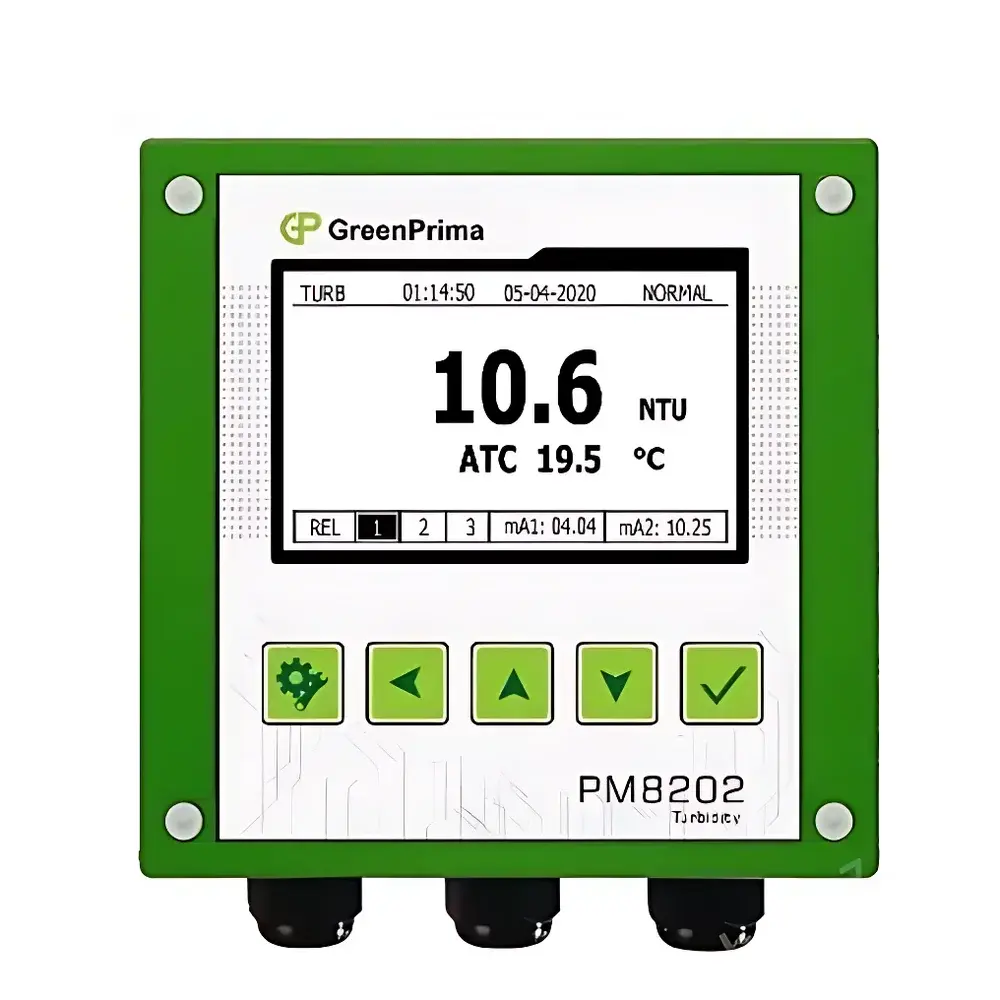
GreenPrima PM 820 2T Online Turbidimeter
| Brand | GreenPrima |
|---|---|
| Origin | United Kingdom |
| Manufacturer Type | Original Equipment Manufacturer (OEM) |
| Product Type | Online Installation |
| Model | PM 820 2T |
| Measurement Principle | Infrared 90° Nephelometric Scattering (EN ISO 7027 Compliant) |
| Temperature Compensation Range | –10 to 130 °C (manual/automatic, NTC30k or PT1000 sensor support) |
| Operating Temperature | –10 to 70.0 °C |
| Storage Temperature | –20 to 70.0 °C |
| Display | Backlit large-dot-matrix LCD |
| Language Support | English & Chinese |
| Data Storage Capacity | 600,000 records |
| Power Supply | 90–260 VAC, 50/60 Hz or optional 24 VDC |
| Analog Outputs | Two isolated 4–20 mA outputs (max. loop resistance 500 Ω, accuracy ±0.1% FS) |
| Digital Communication | RS485 Modbus RTU |
| Cleaning Output | Adjustable interval (0.1–1000 h) and duration (1–1000 s) |
| Alarm Outputs | Two independent Hi/Lo relay outputs (5 A / 250 VAC / 30 VDC, hysteresis configurable) |
| Enclosure Rating | IP65 |
| Mounting Options | Wall-mount, pipe-mount, panel-mount |
| Dimensions (H×W×D) | 144 × 144 × 108 mm |
| Panel Cutout | 138 × 138 mm |
| Weight | 0.87 kg |
Overview
The GreenPrima PM 820 2T Online Turbidimeter is an industrial-grade, continuous-monitoring instrument engineered for high-reliability turbidity and suspended solids (SS) measurement in aqueous process streams. It operates on the principle of infrared 90° nephelometric scattering—fully compliant with EN ISO 7027—ensuring traceable, standardized optical detection across diverse water matrices. Unlike broadband or visible-light systems, its monochromatic 850 nm infrared source minimizes interference from coloration, dissolved organics, and ambient light, delivering stable signal integrity under variable chromatic conditions. The integrated reference beam technology actively compensates for LED intensity drift, optical path degradation, lens fouling, and temperature-induced refractive index shifts—critical for unattended operation in wastewater treatment plants, raw water intakes, cooling towers, and food & beverage process lines. Designed as a two-component system (controller + Bsens580/Bsens580L submersible or flow-through sensor), it supports true online deployment without sample extraction or dilution.
Key Features
- Infrared 90° scattering detection at 850 nm, certified to EN ISO 7027 for metrological equivalence with laboratory-grade turbidimeters
- Dual-channel 4–20 mA analog outputs, independently assignable to turbidity, temperature, or diagnostic status, with full galvanic isolation and ±0.1% full-scale accuracy
- RS485 Modbus RTU interface for seamless integration into SCADA, DCS, or PLC-based control architectures
- IP65-rated die-cast aluminum enclosure with gasket-sealed front panel, rated for continuous operation in humid, corrosive, or dust-laden environments
- Backlit high-contrast dot-matrix LCD supporting dual-language (English/Chinese) navigation, real-time parameter display (turbidity, temperature, timestamp, relay status), and intuitive menu-driven calibration
- Configurable automatic cleaning output enabling integration with pneumatic wipers, ultrasonic transducers, or chemical flush systems—interval and duration fully programmable
- Two independent relay alarm outputs with user-defined thresholds, adjustable hysteresis, and fail-safe logic for critical limit monitoring (e.g., effluent compliance breaches)
- Built-in non-volatile memory storing up to 600,000 timestamped readings—including turbidity, temperature, and system diagnostics—for local audit trail generation
Sample Compatibility & Compliance
The PM 820 2T is validated for direct immersion or inline installation in municipal wastewater, surface water (rivers, lakes, reservoirs), potable water distribution networks, industrial process water, and recirculating cooling systems. Its sensor design accommodates particulate loadings typical of activated sludge effluents (up to 1000 NTU range, depending on selected sensor variant) while maintaining linearity and repeatability per ISO 7027 Annex B. The instrument’s firmware and data handling architecture support GLP-aligned operational practices: all calibrations, configuration changes, and alarm events are time-stamped and logged internally. While not pre-certified for FDA 21 CFR Part 11, its audit-trail-capable memory, password-protected configuration access, and immutable event logging provide foundational elements required for regulated GMP or pharmaceutical water system validation.
Software & Data Management
No proprietary PC software is required for basic commissioning; all setup—including zero/span calibration, temperature compensation mode (NTC30k or PT1000), relay hysteresis, and Modbus slave ID—is performed via the front-panel interface. For advanced data retrieval, the controller supports Modbus register mapping for real-time polling of live values and historical log blocks. Logged data can be exported in CSV format via Modbus function code 0x03 (holding registers) using standard industrial protocol tools. Configuration backups and firmware updates (where applicable) are supported through serial interface or optional USB-to-serial adapter—ensuring field-upgradability without hardware replacement. All parameter changes are subject to multi-level password protection (operator vs. engineer access), preventing unauthorized modification during routine operation.
Applications
- Real-time monitoring of final effluent turbidity in wastewater treatment plants to ensure regulatory compliance with discharge permits (e.g., EU Urban Wastewater Treatment Directive, US EPA NPDES limits)
- Early detection of filter breakthrough or media exhaustion in drinking water filtration systems
- Process optimization in membrane bioreactors (MBRs) and tertiary treatment stages where suspended solids correlate with membrane fouling risk
- Quality assurance in bottled water and beverage production lines, where turbidity serves as a surrogate for particulate contamination
- Intake monitoring for hydropower stations and irrigation canals to assess sediment loading and trigger preventive maintenance
- Continuous verification of coagulation/flocculation efficiency in chemical dosing control loops
FAQ
Does the PM 820 2T require periodic recalibration? How often?
Yes—calibration frequency depends on application severity. For stable municipal influent applications, quarterly zero/span verification is recommended; for high-fouling environments (e.g., primary clarifier effluent), monthly checks are advised. The instrument stores calibration history with timestamps.
Can the sensor be installed in pressurized pipelines?
The Bsens580L variant is rated for insertion into pressurized pipes up to 10 bar (145 psi); appropriate pressure-rated mounting adapters and isolation valves must be used per site-specific piping codes.
Is temperature compensation mandatory, and how is it implemented?
Temperature compensation is enabled by default and uses either integrated NTC30k or external PT1000 input—correcting for the known inverse relationship between water density and scattered light intensity across –10 to 130 °C.
What maintenance is required beyond sensor cleaning?
Beyond scheduled mechanical or chemical cleaning, no consumables or optical replacements are needed. LED lifetime exceeds 100,000 hours; reference photodiode stability is verified during factory calibration and tracked via internal diagnostics.
How is data integrity ensured during power interruption?
All measurements and configuration parameters are written to non-volatile flash memory prior to power-down; no data loss occurs during brownouts or unplanned outages. The real-time clock maintains time/date continuity using onboard backup capacitance.






