
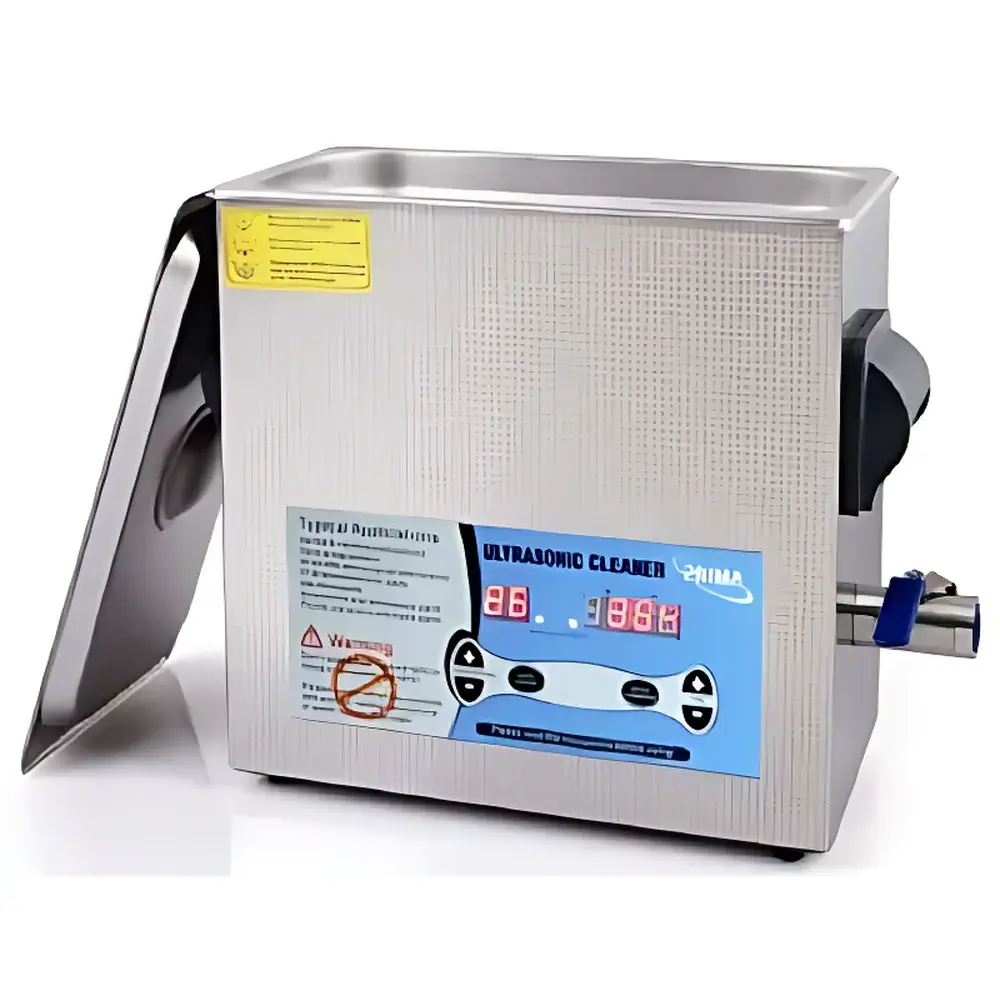
PRIMA PM1-300TD Ultrasonic Cleaner
| Brand | PRIMA (UK) |
|---|---|
| Origin | Imported |
| Model | PM1-300TD |
| Capacity | 3 L |
| Ultrasonic Frequency | 40 kHz (standard), optional 28 / 68 / 120 kHz |
| Ultrasonic Power per Transducer | 60 W |
| Total Ultrasonic Power | 120 W |
| Power Adjustment | Yes, 5-level output control |
| Temperature Control Range | 0–80 °C (digital setpoint) |
| Timer Range | 1–99 min (1-min resolution) |
| Lid | Acoustic-dampening cover included |
| Drain/Inlet | Manual valve |
| Construction | Stainless steel tank (304 grade), one-piece deep-drawn |
| Control System | Industrial-grade microcontroller with soft-start PCB |
| Compliance | CE-marked, conforms to BS EN 61000-6-3 (EMC) and BS EN 61000-6-2 (immunity) |
Overview
The PRIMA PM1-300TD Ultrasonic Cleaner is a precision-engineered benchtop cleaning system designed for laboratories, quality control facilities, and R&D environments requiring reproducible, non-destructive removal of particulate, organic, and ionic contaminants from delicate components. It operates on the principle of cavitation—generated by high-frequency piezoelectric transducers bonded to the tank base—producing controlled micro-bubbles that collapse near submerged surfaces, delivering localized energy sufficient to dislodge sub-micron residues without mechanical abrasion. With a nominal operating frequency of 40 kHz (and optional multi-frequency configurations), the PM1-300TD delivers optimal balance between penetration depth and surface cleaning intensity—making it especially suitable for fine-pitch electronics, optical substrates, and microfluidic devices. Its compact 3 L tank (240 × 140 × 100 mm internal dimensions) supports batch processing of small-volume samples while maintaining thermal and acoustic uniformity across the cleaning volume.
Key Features
- Digital microcontroller-based operation with real-time display of set temperature (0–80 °C), elapsed time (1–99 min), and selected power level
- Five-step ultrasonic power adjustment (100% down to 20%) enabling optimization for sensitive substrates such as coated optics or thin-film sensors
- Acoustically damped hinged lid minimizing airborne noise emission and preventing solvent evaporation during heated cycles
- One-piece 304 stainless steel tank formed via deep drawing—resistant to corrosion from aqueous and mild alkaline cleaning solutions
- Soft-start transducer drive circuitry reducing thermal stress on piezoceramics and extending service life beyond 999,999 operational hours
- Power-loss memory function retaining last-used parameters after interruption—critical for GLP-compliant workflow continuity
- Manual drain valve located at tank base for rapid solution exchange; inlet port accommodates external feed lines for recirculation setups
Sample Compatibility & Compliance
The PM1-300TD is validated for use with standard laboratory-grade aqueous detergents (e.g., Alconox®, Tergazyme®), ethanol/water mixtures, and low-concentration alkaline solutions. It is not rated for halogenated solvents or strong acids. The unit complies with CE marking requirements under the EU Machinery Directive 2006/42/EC and Electromagnetic Compatibility Directive 2014/30/EU. Tank geometry and transducer placement meet ISO 13850:2015 recommendations for uniform cavitation distribution in small-volume ultrasonic systems. While not certified to ISO 17025, its repeatable performance supports method validation per ASTM D2602 (Standard Test Method for Ultrasonic Cleaning Performance) and internal SOPs aligned with USP (Cleaning Validation of Laboratory Equipment).
Software & Data Management
The PM1-300TD operates as a standalone instrument with no embedded software or network interface. All operational parameters are configured locally via push-button controls and displayed on a 3-digit LED screen. No data logging, USB export, or remote monitoring capabilities are included—consistent with IEC 61000-4-11 immunity requirements for lab-grade utility equipment. For regulated environments requiring audit trails, users may integrate external timers or temperature loggers compliant with FDA 21 CFR Part 11 when paired with documented SOPs. Firmware is factory-programmed and non-upgradable—ensuring configuration stability across installations.
Applications
- Cleaning of silicon wafers, photomasks, and MEMS devices prior to lithography or metrology
- Removal of flux residues from printed circuit boards (PCBs) and SMT assemblies without damaging solder joints
- Preparation of optical lenses, prisms, and laser crystals for coating or interferometric inspection
- Decontamination of surgical instruments and dental tools in research-grade sterilization workflows
- Routine maintenance of HPLC injection valves, syringe filters, and capillary electrophoresis tubing
- Supporting ASTM F2275 (Standard Practice for Ultrasonic Cleaning of Medical Devices) verification protocols
FAQ
Is the PM1-300TD suitable for cleaning aluminum or magnesium parts?
Yes—provided neutral or mildly alkaline aqueous solutions are used and exposure time is limited to ≤10 minutes at ≤60 °C to prevent pitting or intergranular attack.
Can I use acetone or isopropanol in this unit?
No. Organic solvents with flash points below 60 °C are prohibited due to ignition risk from transducer heating and lack of explosion-proof certification.
What is the warranty coverage and service support structure?
PRIMA provides a 24-month limited warranty covering transducer and control board defects. Field service is available through authorized regional distributors with calibrated test equipment for cavitation mapping and power verification.
Does the unit include a degassing cycle?
No dedicated degas mode is implemented; however, the 40 kHz frequency and 5-minute initial operation at 30% power effectively remove dissolved air from fresh solutions before critical cleaning steps.
How is temperature accuracy verified during calibration?
Users should validate setpoint accuracy using a traceable NIST-calibrated PT100 probe immersed at tank center; deviation must remain within ±2 °C across the 20–80 °C range per internal QA checklist.



