
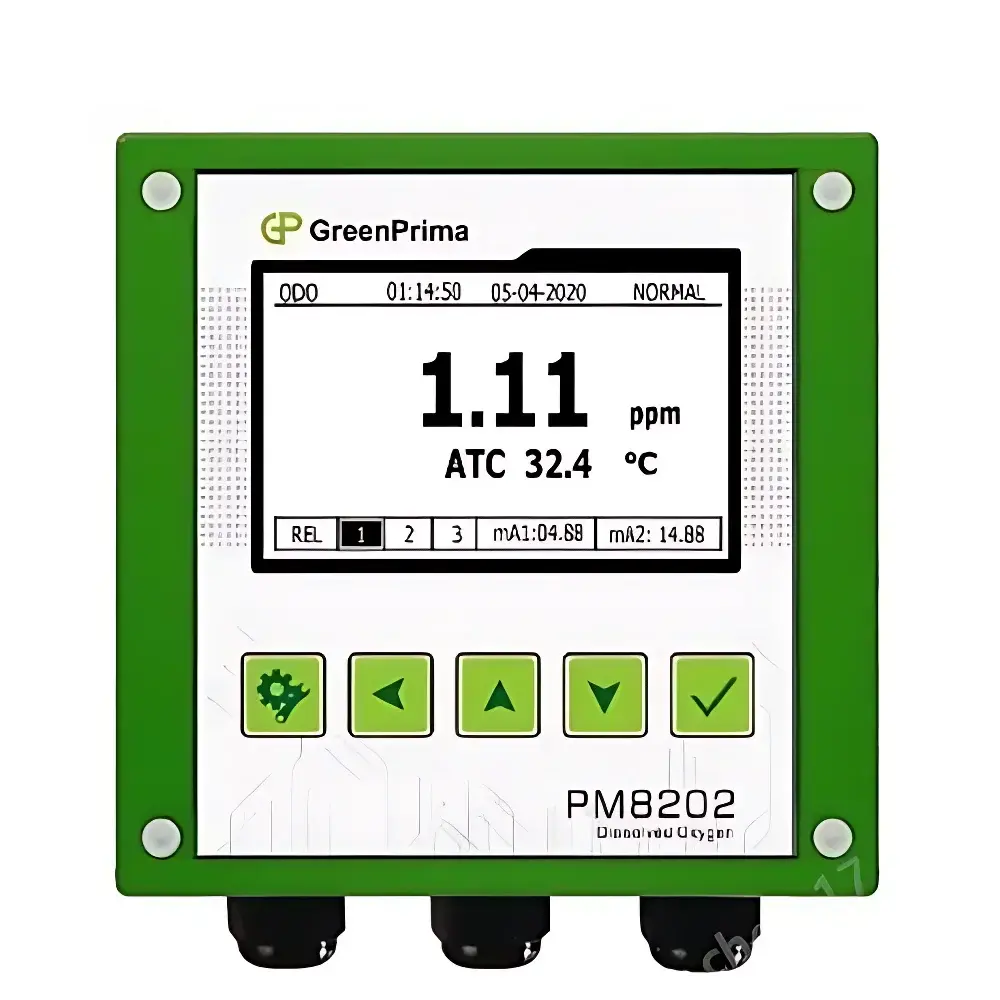
GreenPrima PM 8202O Fluorescence-Based Online Dissolved Oxygen Analyzer
| Brand | GreenPrima |
|---|---|
| Origin | United Kingdom |
| Manufacturer Type | Original Equipment Manufacturer (OEM) |
| Origin Category | Imported |
| Model | PM 8202O |
| Instrument Type | Online |
| Measurement Principle | Fluorescence Quenching |
| Measurement Range | 0.00–20.00 ppm |
| Accuracy | ±0.01 ppm |
| Resolution | 0.01 ppm |
| Temperature Compensation | –10 to 130 °C (manual/automatic |
| Operating Temperature | –10 to 70.0 °C |
| Storage Temperature | –20 to 70.0 °C |
| Display | Backlit large-dot-matrix LCD |
| Language | English & Chinese |
| Data Storage | 600,000 records |
| Power Supply | 90–260 VAC, 50/60 Hz or optional 24 VDC |
| Output | Dual isolated 4–20 mA (max. loop resistance 500 Ω, accuracy 0.1% FS), configurable for DO and temperature |
| Communication | RS485 Modbus RTU |
| Cleaning Output | Adjustable interval (0.1–1000 h) and duration (1–1000 s) |
| Alarm Outputs | Two independent Hi/Lo relay outputs (5 A / 250 VAC / 30 VDC, with hysteresis) |
| Enclosure Rating | IP65 |
| Mounting Options | Wall-mount, pipe-mount, panel-mount |
| Dimensions (W×H×D) | 144 × 144 × 108 mm |
| Cutout Size | 138 × 138 mm |
| Weight | 0.87 kg |
| Electrode Material | 316L stainless steel |
| Optional Feature | Air-driven self-cleaning module |
Overview
The GreenPrima PM 8202O is an online dissolved oxygen (DO) analyzer engineered for continuous, high-stability monitoring in aquaculture systems, wastewater treatment plants, surface water networks, and industrial process streams. It employs optical fluorescence quenching technology—based on the Stern–Volmer principle—to quantify dissolved molecular oxygen concentration without electrochemical consumption. Unlike Clark-type amperometric sensors, the PM 8202O uses a solid-state, immobilized ruthenium-based luminophore embedded in a gas-permeable polymer matrix. When excited by blue LED light (typically ~470 nm), the fluorophore emits red-shifted phosphorescence (~600 nm); the presence of dissolved O2 quenches both the intensity and lifetime of this emission. The instrument precisely measures the phase shift or decay time of the phosphorescent signal—a parameter linearly correlated with partial pressure of oxygen—and converts it into concentration units (ppm) using factory-calibrated algorithms. This non-consumptive, membrane-free architecture eliminates oxygen depletion at the sensing interface, removes flow-dependency, and ensures stable operation even under low-flow or stagnant conditions typical in recirculating aquaculture systems (RAS) and pond monitoring.
Key Features
- Fluorescence-based measurement principle compliant with ISO 5814:2012 and ASTM D888–12 for optical DO determination
- Zero-maintenance sensor design: no membranes, electrolytes, or cathode/anode replacements required over operational lifetime
- True flow-independent operation—no minimum velocity specification; validated for use in static tanks, slow-moving channels, and submerged cage arrays
- No signal drift across extended deployment periods; factory calibration remains stable for ≥12 months under normal operating conditions
- Digital Bsens410 smart sensor with integrated temperature compensation (NTC30K or PT1000 selectable), enabling automatic correction from –10 to 130 °C
- Robust 316L stainless-steel sensor body rated for long-term immersion in saline, brackish, and chlorinated waters
- Configurable air-pulse self-cleaning module (optional) mitigates biofouling and sediment accumulation in turbid or organic-rich environments
- Backlit high-contrast dot-matrix LCD display supporting dual-language (English/Chinese) interface and real-time graphical trend visualization
- Dual isolated 4–20 mA analog outputs assignable to DO concentration and/or temperature, with full-scale accuracy of 0.1% FS
- RS485 Modbus RTU interface for integration into SCADA, DCS, or centralized environmental data acquisition platforms
Sample Compatibility & Compliance
The PM 8202O is validated for direct immersion or flow-cell installation in freshwater, seawater, brackish water, effluent streams, and nutrient-rich aquaculture media—including high-salinity RAS loops (up to 35 ppt) and aerated fish hatchery basins. Its optical sensing element exhibits minimal interference from common water constituents such as chloride, hydrogen sulfide, carbon dioxide, and redox-active metals (e.g., Fe2+, Mn2+). The system meets CE marking requirements per Directive 2014/30/EU (EMC) and 2014/35/EU (LVD), and complies with IEC 61326–1 for industrial measurement equipment. For regulated applications involving GLP/GMP-aligned environmental reporting, the device supports audit-ready data logging (600,000 timestamped records) with user-accessible export via USB or Modbus register polling. While not FDA 21 CFR Part 11-certified out-of-the-box, its password-protected configuration interface, change-log functionality, and deterministic output behavior enable validation pathways for quality-critical aquaculture health monitoring programs.
Software & Data Management
Data integrity is maintained through synchronized internal clock stamping and cyclic redundancy check (CRC)-protected storage. All logged entries include DO value, temperature reading, sensor status flags (e.g., fouling alert, low-light warning), and operator-initiated event markers. Configuration changes—including calibration offsets, alarm thresholds, cleaning schedules, and communication parameters—are recorded with user ID (if enabled) and timestamp. The embedded firmware supports remote firmware updates via Modbus register write sequences, minimizing site visits. Export formats include CSV-compatible plain text files readable by Excel, LabVIEW, or Python-based analytics pipelines. Optional cloud gateway modules (sold separately) allow secure MQTT-based telemetry to AWS IoT Core or Azure IoT Hub, facilitating predictive maintenance modeling based on long-term sensor stability metrics.
Applications
- Real-time DO supervision in recirculating aquaculture systems (RAS), including biofilter effluent, sump tanks, and raceway inlets
- Automated feed control integration—triggering aeration or oxygen injection when DO falls below species-specific thresholds (e.g., <5.0 ppm for salmonids)
- Regulatory compliance monitoring for discharge permits (e.g., EPA NPDES) and watershed management programs
- Process optimization in activated sludge basins, oxidation ditches, and membrane bioreactors (MBRs)
- Long-term ecological studies of diurnal DO cycling in lakes, reservoirs, and estuarine zones
- Validation of hypolimnetic oxygenation systems and sediment capping interventions
FAQ
Does the PM 8202O require periodic recalibration?
No—fluorescence lifetime measurement is inherently stable. Factory calibration remains valid for ≥12 months under standard operating conditions. Field verification using saturated air or water standards is recommended quarterly for QA/QC documentation.
Can the sensor operate in seawater without corrosion?
Yes—the 316L stainless-steel housing and inert polymer optical window provide excellent resistance to chloride-induced pitting and crevice corrosion up to 35 ppt salinity.
Is temperature compensation automatic?
Yes—integrated NTC30K or PT1000 thermistor enables real-time compensation across –10 to 130 °C; selection is configurable during setup.
What maintenance is required for the air self-cleaning option?
Only periodic inspection of the air filter and regulator; no consumables or scheduled part replacement needed. Cleaning frequency adapts dynamically to local fouling rates via programmable duty cycles.
How is data security managed during remote access?
Modbus RTU operates over isolated RS485 with no inherent encryption; we recommend deploying the analyzer behind firewalled industrial routers or using TLS-enabled cloud gateways for internet-connected deployments.







