
GreenPrima PM8200I Online Water Hardness Analyzer
| Brand | GreenPrima |
|---|---|
| Origin | United Kingdom |
| Manufacturer Type | Original Equipment Manufacturer (OEM) |
| Product Category | Imported Instrument |
| Model | PM8200I |
| Measurement Range | 0.00–20,000 ppm as CaCO₃ |
| Resolution | 0.01 / 0.1 / 1 ppm |
| Accuracy | ±0.01 / ±0.1 / ±1 ppm (depending on range) |
| Temperature Compensation | –10 to 130 °C (manual/automatic |
| Operating Temperature | 0 to 70.0 °C |
| Storage Temperature | –20 to 70.0 °C |
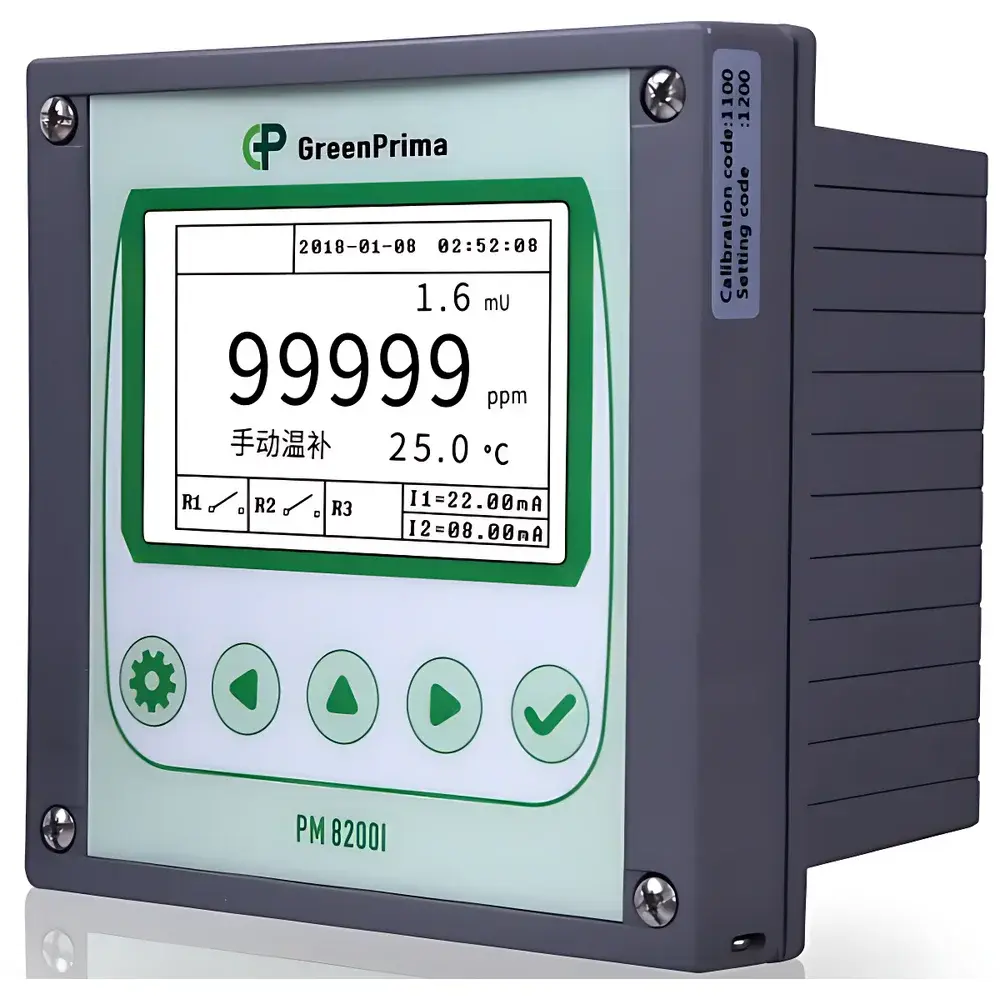
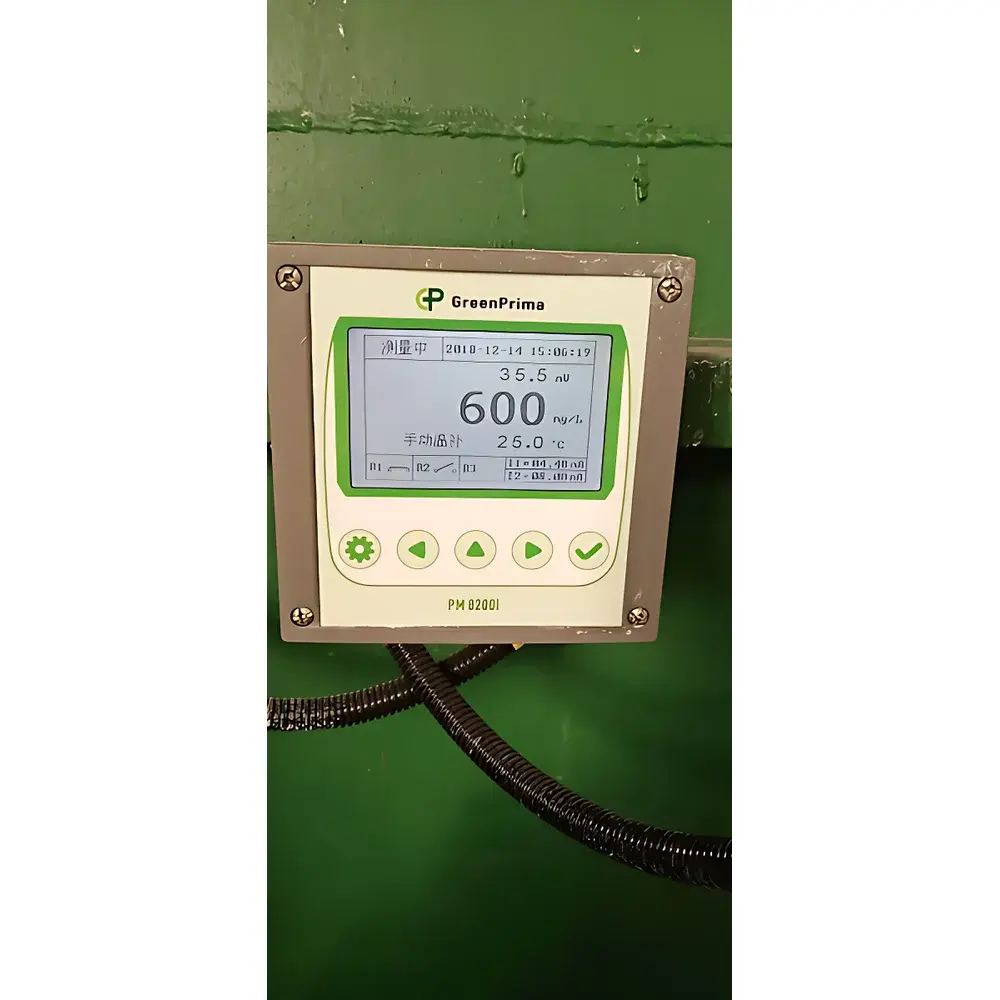
| Display | Backlit large-dot-matrix LCD with pH, temperature, time, and relay status |
| Data Storage | 600,000 records with query function |
| Output | Two isolated 4–20 mA outputs (max. loop resistance 500 Ω, accuracy 0.1% FS) |
| Communication | RS485 interface, MODBUS RTU protocol compliant |
| Relay Output | One multifunctional relay (for cleaning cycle control, periodic alarm, fault alarm) |
| Cleaning Control | Adjustable interval (0.1–1000 h) and duration (1–1000 s) |
| Power Supply | 90–260 VAC, 50/60 Hz or optional 24 VDC |
| Enclosure Rating | IP65 (fully sealed, dust-tight, water-resistant) |
| Mounting Options | Wall-mount, pole-mount, panel-mount |
| Dimensions | 144 × 144 × 106 mm |
| Panel Cutout | 138 × 138 mm |
| Weight | 0.86 kg |
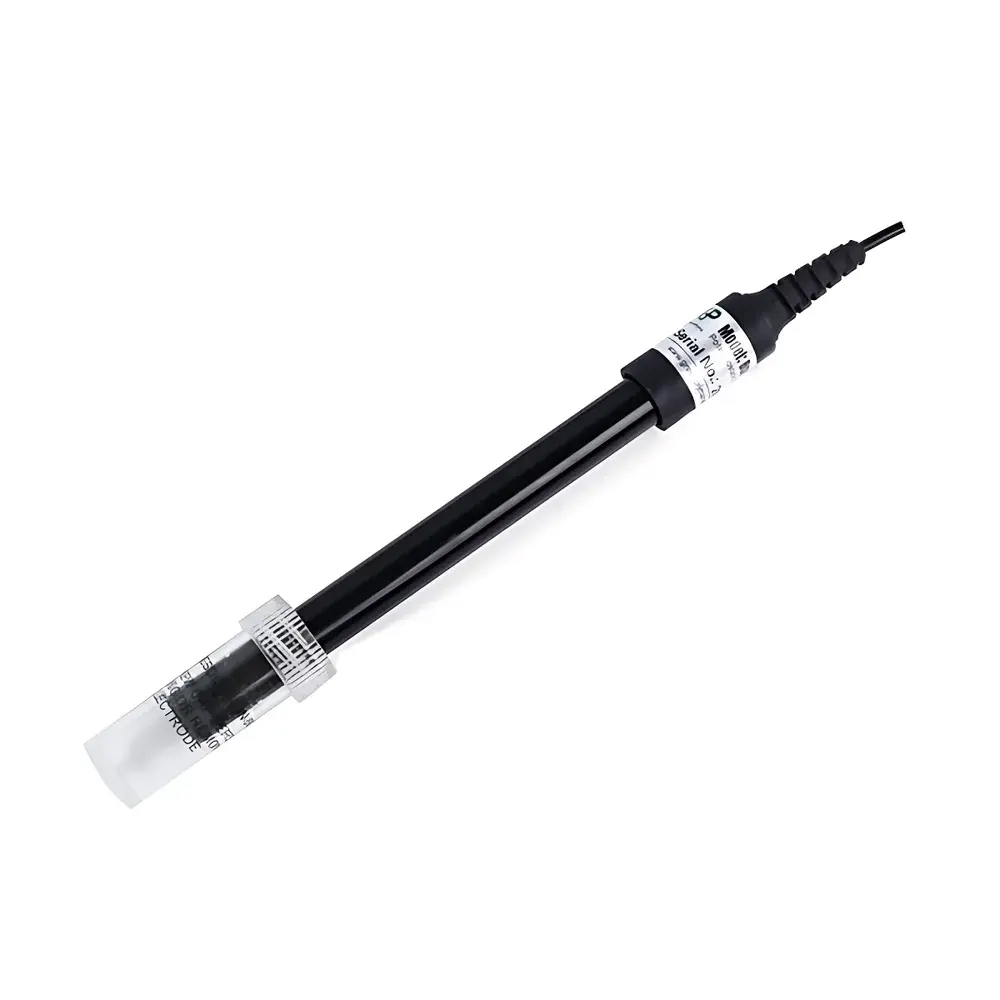
| Sensor Model | Bsens740 |
| Sensor Range | 0–40,000 mg/L as CaCO₃ |
| Sensor Resolution | 0.01 mg/L |
| Sensor Accuracy | ±3% FS |
| Sensor Material | Polyphenylsulfone (PPS) |
| Sensor Operating Temp. | –5 to 70.0 °C |
| Max. Pressure Rating | 3.5 bar |
| Sensor Connection | PG13.5 fixed thread |
| Cable Length | 5 m |
| Language Interface | Switchable English/Chinese menu |
| Auto-backlight Timeout | 3 min (configurable) |
| Contrast Adjustment | User-adjustable |
Overview
The GreenPrima PM8200I Online Water Hardness Analyzer is an industrial-grade, continuous-monitoring instrument engineered for precise, real-time measurement of total water hardness—expressed as calcium carbonate (CaCO₃) equivalent—in high-purity and process-critical water streams. It operates on the principle of selective complexometric titration via a solid-state ion-selective sensor (Bsens740), which delivers stable electrochemical response to divalent cations—primarily Ca²⁺ and Mg²⁺—in aqueous solution. Unlike colorimetric or photometric methods, this potentiometric approach eliminates reagent consumption, optical drift, and turbidity interference, making it especially suitable for unattended operation in boiler feedwater, pharmaceutical purified water (PW), clean steam condensate, and HVAC makeup systems where long-term calibration stability and minimal maintenance are essential.
Key Features
- High-reliability sensor architecture using chemically inert polyphenylsulfone (PPS) housing and optimized electrode geometry for consistent response across wide temperature (–5 to 70 °C) and pressure (up to 3.5 bar) ranges;
- Dual isolated 4–20 mA analog outputs with full-scale programmability and 0.1% FS accuracy—configured independently for hardness value and temperature or diagnostic status;
- RS485 serial interface compliant with MODBUS RTU protocol, enabling seamless integration into SCADA, DCS, and PLC-based monitoring infrastructures without proprietary gateways;
- IP65-rated die-cast aluminum and polycarbonate enclosure with gasket-sealed front bezel—certified for deployment in humid mechanical rooms, boiler houses, and outdoor utility enclosures;
- Large backlit dot-matrix LCD display supporting simultaneous visualization of hardness value, temperature, system time, relay states, and real-time trend indicators;
- Onboard data logger storing up to 600,000 timestamped records—including hardness, temperature, and event flags—with chronological search, export-ready CSV retrieval via serial command set;
- Configurable multifunction relay supporting three operational modes: scheduled cleaning activation, threshold-based alarm (high/low), and hardware fault signaling (e.g., sensor timeout, communication loss);
- Intelligent auto-sleep logic: backlight deactivates after 3-minute inactivity; contrast level and timeout duration fully adjustable via menu navigation.
Sample Compatibility & Compliance
The PM8200I is validated for use in low-conductivity (<10 µS/cm), low-TDS, and low-alkalinity water matrices typical of high-pressure boiler feedwater, pharmaceutical water-for-injection (WFI) loops, semiconductor ultrapure rinse water, and closed-loop HVAC systems. Its sensor design minimizes fouling from silica scaling or iron oxide precipitation through hydrophobic surface treatment and pulsed cleaning synchronization. The analyzer conforms to IEC 61326-1 (EMC for industrial environments), EN 61000-6-2/6-4, and meets functional safety requirements per IEC 61508 SIL1 for non-safety-critical monitoring applications. While not intrinsically safe, it is compatible with Zone 2 hazardous area installations when housed in appropriate barrier-protected cabinets. Calibration traceability aligns with ISO/IEC 17025-accredited reference standards (e.g., NIST-traceable CaCO₃ solutions).
Software & Data Management
No proprietary PC software is required for basic configuration or data extraction. All setup—including measurement range selection, temperature compensation mode (NTC10K or PT1000), relay logic, cleaning schedule, and MODBUS slave ID—is performed locally via intuitive bilingual (English/Chinese) menu navigation. For enterprise-level integration, GreenPrima provides a documented ASCII command set and MODBUS register map (available in datasheet Rev. 3.2+), supporting read/write access to all operational parameters and logged data blocks. When connected to a central historian or LIMS, the device supports timestamped data streaming at user-defined intervals (1 sec to 1 hr). Audit trails—including parameter changes, calibration events, and relay activations—are embedded within the stored dataset and retrievable via MODBUS Function Code 03 (Read Holding Registers). The system does not implement FDA 21 CFR Part 11 electronic signature controls but supports GLP/GMP-aligned manual logbook practices through exported CSV timestamps and operator-annotated calibration records.
Applications
- Real-time hardness surveillance in high-pressure drum boilers and once-through supercritical units to prevent scale formation on economizers and superheater tubes;
- Continuous verification of softener effluent quality in pharmaceutical manufacturing facilities complying with USP and EU Annex 1 requirements;
- Feedwater hardness trending in combined-cycle power plants to optimize ion exchange resin regeneration cycles and reduce chemical usage;
- Monitoring of reverse osmosis (RO) permeate and mixed-bed polishers in microelectronics fabs where hardness >50 ppb risks wafer defect propagation;
- Automated alarm triggering for cooling tower blowdown control based on dynamic hardness accumulation thresholds;
- Validation support for ASME B31.1 piping system water flush acceptance criteria in new construction projects.
FAQ
What hardness units does the PM8200I report by default?
The instrument reports total hardness exclusively in parts per million (ppm) as CaCO₃ equivalent—consistent with ASTM D1126 and ISO 6059 standards.
Can the Bsens740 sensor be calibrated in situ without removal?
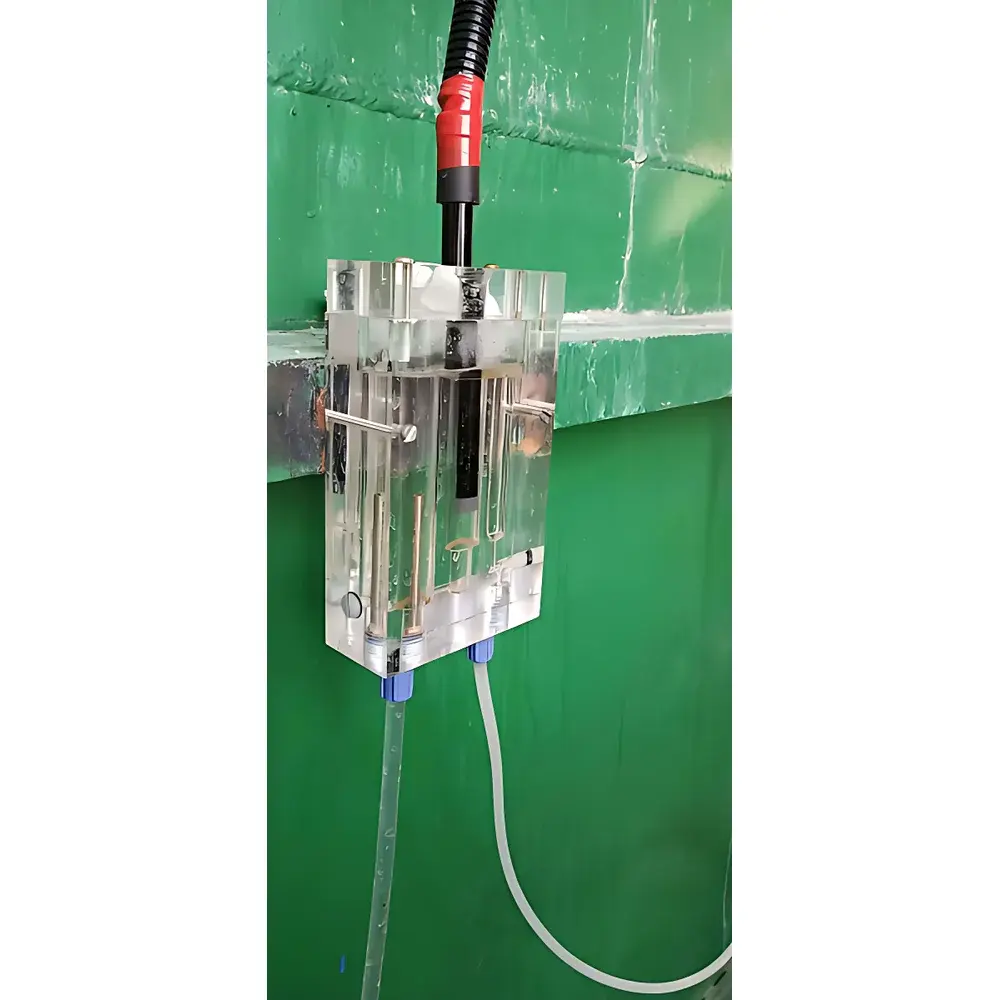
Yes—zero and span calibration can be performed live using certified standard solutions (e.g., 100 ppm and 1000 ppm CaCO₃) while the sensor remains installed in-line or immersed in a bypass cell.
Is temperature compensation mandatory for accurate readings?
Yes—hardness measurement is inherently temperature-dependent due to ionic activity shifts; automatic compensation using integrated NTC10K or PT1000 is strongly recommended for measurements above 30 °C.
Does the PM8200I support Modbus TCP/IP or only RS485?
The standard configuration includes RS485 physical layer only; Modbus TCP/IP requires an external RS485-to-Ethernet gateway configured as a transparent bridge.
How often should the sensor be cleaned in high-fouling applications?
Cleaning frequency must be determined empirically; initial recommendation is every 24–72 hours in boiler feedwater with >10 ppm silica, adjustable via the relay-controlled solenoid valve interface.
Is firmware upgrade possible in the field?
Firmware updates are supported via ASCII command upload over RS485 using GreenPrima’s documented bootloader protocol; no hardware modification is required.







