
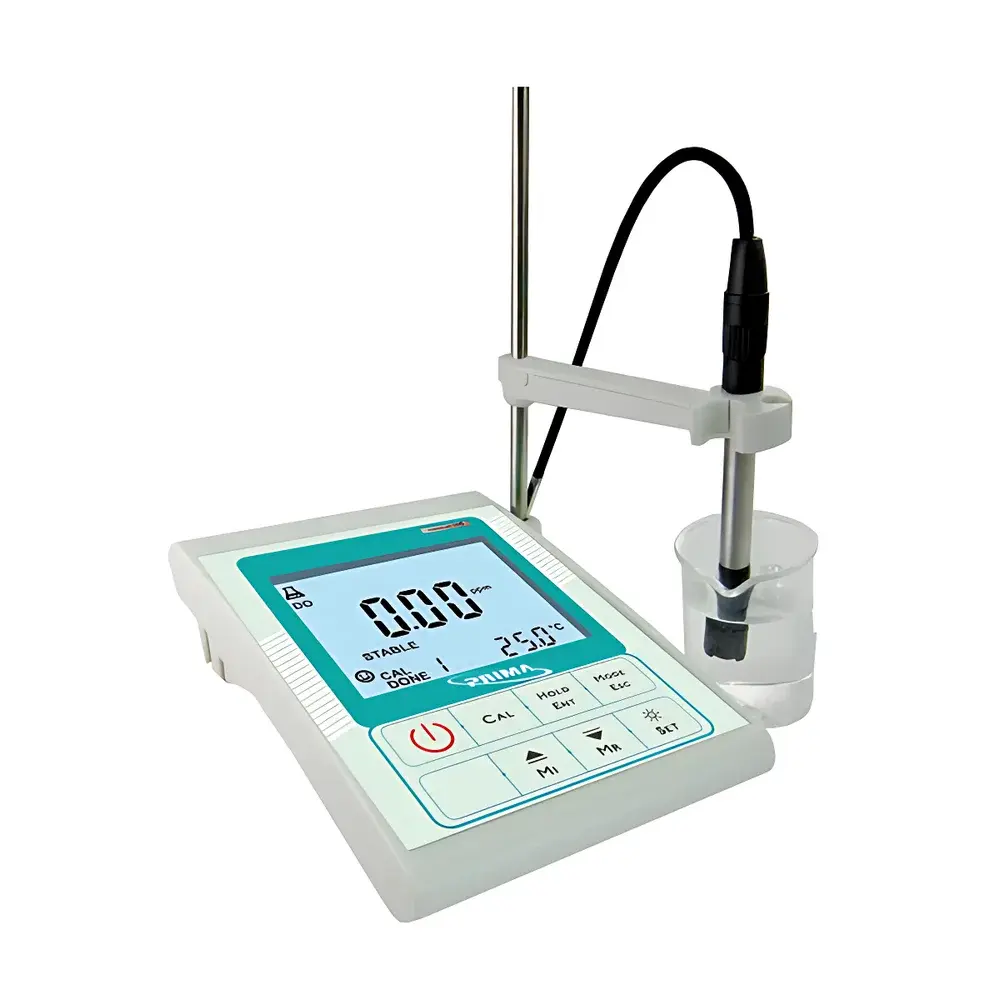
PRIMA innoLab 20D Benchtop Dissolved Oxygen Analyzer
| Brand | PRIMA |
|---|---|
| Origin | Taiwan |
| Model | innoLab 20D |
| Instrument Type | Benchtop Dissolved Oxygen Analyzer |
| Measurement Range | 0.00–40.00 mg/L (ppm) and 0.0–400.0% saturation |
| Temperature Range | −5.0–120.0°C (23.0–248.0°F) |
| Resolution | 0.01 mg/L, 0.1%, 0.1°C/0.1°F |
| Accuracy | ±1.5% F.S. (DO), ±0.3°C (temperature) |
| Calibration | Manual 1-point or 2-point (air-saturated water / zero-oxygen solution) |
| Salinity Compensation | 0.0–45.0 ppt (manual input) |
| Atmospheric Pressure Compensation | 450–800 mmHg (0.600–1.100 bar) |
| Depth Compensation | 0.0–10.0 m (hydrostatic pressure correction) |
| Data Storage | 100 measurement records |
| Interface | USB (virtual COM port) |
| Power Supply | 100–240 VAC adapter |
| Battery | Built-in rechargeable Li-ion (for portable operation within benchtop form factor) |
| Enclosure Rating | IP54 |
| Dimensions | 150 × 194 × 56 mm |
| Weight | 1.0 kg |
Overview
The PRIMA innoLab 20D is a precision-engineered benchtop dissolved oxygen (DO) analyzer designed for reliable, traceable, and field-validated measurements in both laboratory and semi-field environments. It operates on the electrochemical principle—supporting interchangeable galvanic (fuel-cell) and Clark-type polarographic DO sensors—to deliver stable, low-drift readings across diverse aqueous matrices. Unlike handheld-only instruments, the innoLab 20D maintains a fixed-bench architecture with integrated AC power operation while retaining mobility via its internal rechargeable lithium-ion battery—enabling uninterrupted use during instrument relocation, multi-site calibration verification, or temporary deployment in teaching labs or wastewater process control rooms. Its dual-mode output (mg/L and % saturation) and comprehensive environmental compensation algorithms ensure metrological rigor under variable salinity, ambient pressure, temperature, and hydrostatic head conditions—critical for compliance with ASTM D888, ISO 5814, and EN 25814 standards governing dissolved oxygen determination in natural waters, effluents, and aquaculture systems.
Key Features
- Electrochemical sensing platform compatible with standardized galvanic and Clark-type DO electrodes—ensuring interchangeability with NIST-traceable reference sensors.
- Simultaneous dual-unit display (mg/L and % saturation) with user-selectable default mode and automatic unit conversion based on calibration context.
- Multi-parameter environmental compensation: manual salinity entry (0.0–45.0 ppt), real-time atmospheric pressure input (450–800 mmHg), and configurable depth-based hydrostatic pressure correction (0.0–10.0 m).
- Intelligent electrode diagnostics: real-time display of offset (mV) and slope (%/day) during calibration—providing immediate assessment of membrane integrity, electrolyte stability, and cathode activity.
- High-contrast 120° viewing-angle LCD with adjustable LED backlight—optimized for readability under variable ambient lighting in laboratories, hatcheries, or municipal treatment control rooms.
- USB virtual COM port interface compliant with standard CDC ACM protocols—enabling direct data streaming to LIMS, Excel, or custom SCADA clients without proprietary drivers.
- Built-in rechargeable lithium-ion battery (operational autonomy >8 hours at typical sampling intervals)—eliminating dependency on continuous AC supply during audits or mobile validation exercises.
Sample Compatibility & Compliance
The innoLab 20D is validated for use with freshwater, seawater, brackish effluents, activated sludge supernatants, and recirculating aquaculture system (RAS) water. Its pressure-compensated algorithm meets the functional requirements of ISO 5814:2012 (electrochemical determination of dissolved oxygen) and aligns with the procedural expectations of EPA Method 360.1 and ASTM D888-22 (Standard Test Methods for Dissolved Oxygen in Water). While not certified for GLP/GMP production environments, its audit-ready calibration logs, timestamped memory storage, and parameter-lock capability support adherence to internal QA/QC protocols and third-party accreditation frameworks such as ISO/IEC 17025. The IP54-rated enclosure provides protection against dust ingress and water splashing—suitable for wet-lab countertops and near-process basins where incidental exposure occurs.
Software & Data Management
Data acquisition is facilitated via native USB CDC serial communication—requiring no additional software installation on Windows, macOS, or Linux hosts. Each stored record includes DO value, temperature, salinity, pressure setting, calibration status, and UTC timestamp. The 100-entry non-volatile memory retains entries across power cycles and supports sequential recall with forward/backward navigation. For regulatory traceability, users may export CSV-formatted logs directly via terminal emulation (e.g., PuTTY, Tera Term) or integrate into Python- or LabVIEW-based data pipelines using standard pySerial libraries. No cloud connectivity or firmware-over-the-air updates are implemented—ensuring data sovereignty and minimizing cybersecurity attack surface in regulated facilities.
Applications
- Wastewater treatment plant process monitoring: aeration basin DO profiling, nitrification/denitrification control, and final effluent compliance verification per local discharge permits.
- Aquaculture and aquarium management: real-time DO trending in RAS tanks, hatchery larval rearing units, and coral propagation systems where hypoxia thresholds must be maintained below 4.0 mg/L.
- Environmental field laboratories: calibration cross-checks between portable and benchtop platforms prior to EPA-approved ambient water sampling campaigns.
- Academic instruction: hands-on demonstration of Henry’s Law, temperature–solubility relationships, and sensor polarization kinetics in undergraduate analytical chemistry and environmental engineering curricula.
- Industrial cooling water system surveillance: detection of biofilm-induced oxygen depletion and correlation with corrosion potential measurements.
FAQ
Does the innoLab 20D support automatic temperature compensation (ATC) during measurement?
Yes—ATC is enabled by default using the integrated Pt1000 RTD sensor; manual override is available if external probe calibration is required.
Can I use third-party DO electrodes with this analyzer?
Only electrodes conforming to standard BNC analog output specifications and matching the selected electrochemical mode (galvanic or polarographic) are functionally compatible; PRIMA does not guarantee performance or warranty coverage with non-certified transducers.
Is the USB interface compatible with modern operating systems?
Yes—the device enumerates as a CDC ACM-class serial device and requires no vendor-specific drivers on Windows 10/11, macOS 12+, or current Linux kernels.
What is the recommended calibration frequency for routine QC use?
Daily single-point air-saturation calibration is advised for critical applications; two-point (zero + air-sat) calibration should be performed weekly or after electrode membrane replacement.
Does the instrument log calibration events separately from measurement data?
No—calibration parameters (offset, slope, date/time) are embedded within the memory record only when a measurement is taken immediately post-calibration; standalone calibration logs are not stored.







