
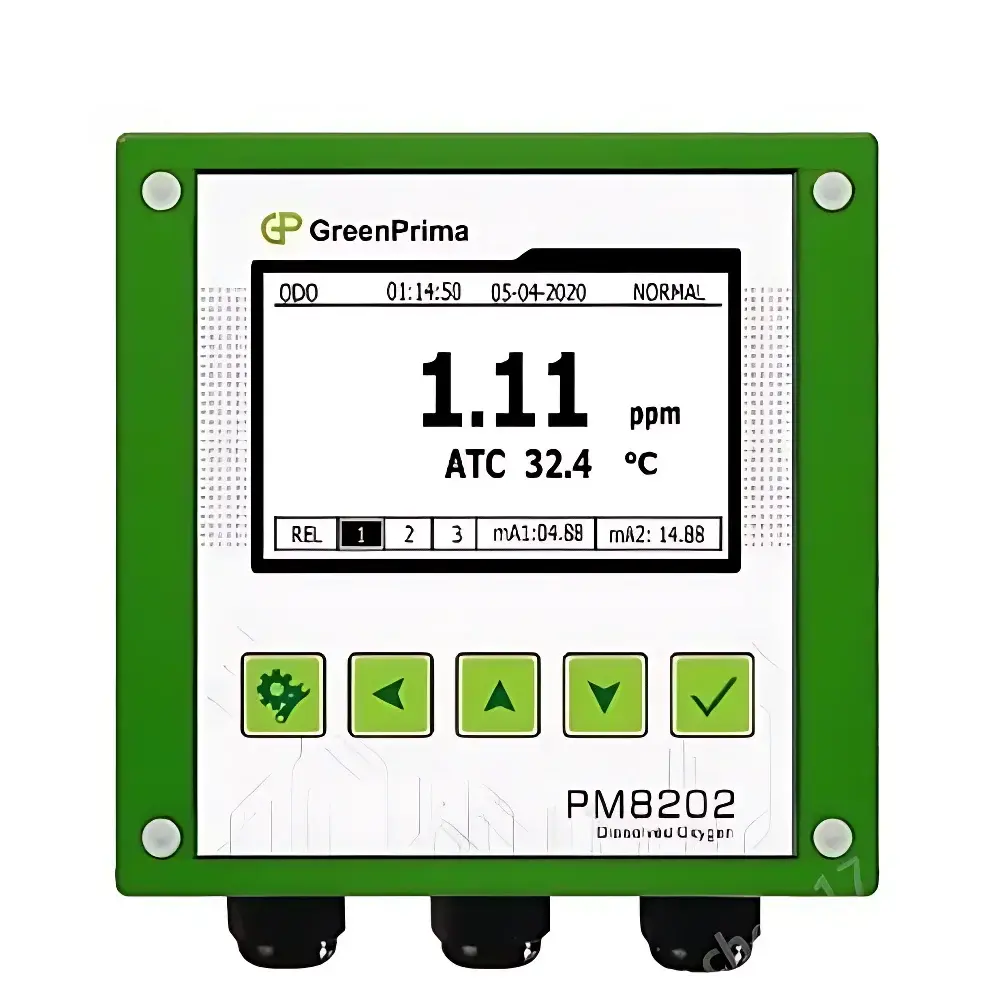
GreenPrima PM8202O Fluorescence-Based Online Dissolved Oxygen Analyzer
| Brand | GreenPrima |
|---|---|
| Origin | United Kingdom |
| Manufacturer Type | Original Equipment Manufacturer (OEM) |
| Product Category | Imported Instrument |
| Model | PM8202O |
| Instrument Type | Online Analyzer |
| Measurement Principle | Fluorescence Quenching |
| Measurement Range | 0.00–20.00 ppm |
| Resolution | 0.01 ppm |
| Accuracy | ±0.01 ppm |
| Temperature Compensation | –10 to 130 °C (NTC30K or PT1000 selectable) |
| Operating Temperature | –10 to 70.0 °C |
| Storage Temperature | –20 to 70.0 °C |
| Display | Backlit Graphic LCD |
| Language Interface | English & Chinese |
| Data Storage Capacity | 600,000 records |
| Power Supply | 90–260 VAC, 50/60 Hz or 24 VDC (optional) |
| Output | Two isolated 4–20 mA outputs (max. loop resistance 500 Ω, accuracy 0.1% FS) |
| Cleaning Function | Optional air-pulse self-cleaning (interval: 0.1–1000 h |
| duration | 1–1000 s) |
| Alarm Outputs | Two independent Hi/Lo relay outputs (5 A / 250 VAC / 30 VDC) |
| Enclosure Rating | IP65 |
| Mounting Options | Wall-mount, pipe-mount, panel-mount |
| Dimensions (W×H×D) | 144 × 144 × 108 mm |
| Panel Cutout | 138 × 138 mm |
| Weight | 0.87 kg |
| Electrode Material | 316L stainless steel |
Overview
The GreenPrima PM8202O is an online dissolved oxygen (DO) analyzer engineered for continuous, high-fidelity monitoring in demanding water quality applications. It operates on the principle of fluorescence quenching—where molecular oxygen modulates the intensity and lifetime of fluorescent emission from a proprietary ruthenium-based luminophore immobilized on the sensor surface. Unlike electrochemical Clark-type sensors, this optical method eliminates the need for oxygen-permeable membranes, electrolyte solutions, or cathodic polarization, thereby removing sources of drift, fouling, and consumable dependency. The absence of oxygen consumption during measurement ensures accurate readings even under stagnant or low-flow conditions—critical for wastewater effluent channels, aquaculture recirculation systems, and remote surface water monitoring stations. The system comprises a robust wall-mountable transmitter (PM8202O controller) and the Bsens410 optical DO sensor, designed for seamless integration into SCADA, DCS, or PLC-based infrastructure via standard industrial protocols.
Key Features
- Fluorescence-based detection with no membrane, electrolyte, or oxygen consumption—enabling true zero-maintenance operation over extended deployment cycles
- Digital sensor architecture with embedded temperature compensation (NTC30K or PT1000 configurable), ensuring stable output across –10 to 130 °C
- High-resolution measurement (0.01 ppm) and metrological accuracy (±0.01 ppm) validated per ISO 5814:2012 for optical DO determination
- Two fully isolated 4–20 mA analog outputs, each programmable for DO concentration or temperature—compliant with IEC 61000-6-2/6-4 for electromagnetic immunity
- RS485 Modbus RTU interface supporting multi-drop network configuration (up to 32 nodes) with configurable baud rates (9.6–115.2 kbps)
- Optional air-pulse self-cleaning mechanism mitigates biofilm accumulation on the sensing window without chemical agents or mechanical wipers
- Backlit graphic LCD with dual-language (English/Chinese) menu navigation and real-time trend visualization
- Onboard data logging capacity of 600,000 timestamped records, supporting audit-ready traceability in GLP/GMP environments
- IP65-rated enclosure with 316L stainless steel sensor body—suitable for outdoor installation and corrosive ambient conditions
- User-accessible password protection (three-tier privilege levels) prevents unauthorized parameter modification or calibration reset
Sample Compatibility & Compliance
The PM8202O is validated for use across heterogeneous aqueous matrices including municipal and industrial wastewater, river and reservoir surface water, aquaculture ponds, cooling tower circuits, and bioreactor influent/effluent streams. Its optical design renders it insensitive to hydrogen sulfide, chlorine residuals, and redox-active ions that commonly interfere with amperometric DO sensors. The analyzer conforms to key international standards governing environmental instrumentation: ISO 5814:2012 (water quality — determination of dissolved oxygen — optical sensor method), EN 25813:1994 (water quality — determination of dissolved oxygen — electrochemical methods, referenced for performance benchmarking), and ASTM D888-22 (standard test methods for dissolved oxygen in water). For regulated facilities, its data integrity framework—including time-stamped logs, user authentication, and non-volatile memory—supports alignment with FDA 21 CFR Part 11 requirements when deployed with appropriate IT governance controls.
Software & Data Management
Data acquisition and configuration are managed through the embedded firmware interface, eliminating dependency on proprietary PC software. All operational parameters—including measurement range scaling, alarm thresholds with adjustable hysteresis, cleaning schedule (0.1–1000 h interval; 1–1000 s duration), and communication settings—are configurable via intuitive menu navigation. Logged data can be exported via USB flash drive (not included) in CSV format for third-party analysis tools such as MATLAB, Python Pandas, or LIMS platforms. The dual 4–20 mA outputs support direct connection to analog input modules in Siemens S7, Rockwell ControlLogix, or Schneider Modicon controllers. Modbus register mapping follows standard conventions (e.g., Holding Register 40001 = DO value in ppm × 100; 40003 = temperature in °C × 10), facilitating rapid integration without custom driver development.
Applications
- Real-time DO monitoring in activated sludge basins and secondary clarifiers to optimize aeration energy use and prevent nitrification failure
- Continuous surveillance of dissolved oxygen saturation in fish hatcheries and shrimp farms—supporting automated feed control and hypoxia alerting
- Regulatory compliance reporting for NPDES discharge permits requiring hourly DO records at outfall points
- Long-term ecological assessment of eutrophication dynamics in lakes and estuaries using solar-powered telemetry-integrated deployments
- Process validation in pharmaceutical water-for-injection (WFI) distribution loops where oxygen ingress must remain below pharmacopeial limits (USP <1231>)
- Corrosion management in closed-loop cooling systems by correlating DO transients with iron dissolution rates measured via inline ICP-OES
FAQ
Does the PM8202O require periodic calibration?
No. The fluorescence quenching principle provides inherent stability; factory calibration remains valid throughout the sensor’s service life. Field verification against a certified Winkler titration standard is recommended annually for QA/QC documentation.
Can the sensor operate in seawater or brackish environments?
Yes. The 316L stainless steel housing and optical window coating resist chloride-induced pitting. Salinity compensation is not required, as fluorescence lifetime is unaffected by ionic strength within 0–50 g/L NaCl.
Is temperature compensation automatic?
Yes. Integrated NTC30K or PT1000 thermistor options provide continuous, real-time thermal correction aligned with ISO 5814 Annex B algorithms.
What maintenance intervals are specified for the air-pulse cleaning system?
Cleaning frequency is fully user-configurable. Typical settings range from 2–6 hours in high-fouling wastewater applications to 72–168 hours in clean surface water monitoring.
How is data security ensured during remote access scenarios?
The device lacks Wi-Fi or Ethernet connectivity by design. All data exchange occurs via isolated serial or analog interfaces—eliminating network attack vectors while preserving regulatory compliance in air-gapped critical infrastructure.
Related Products







