
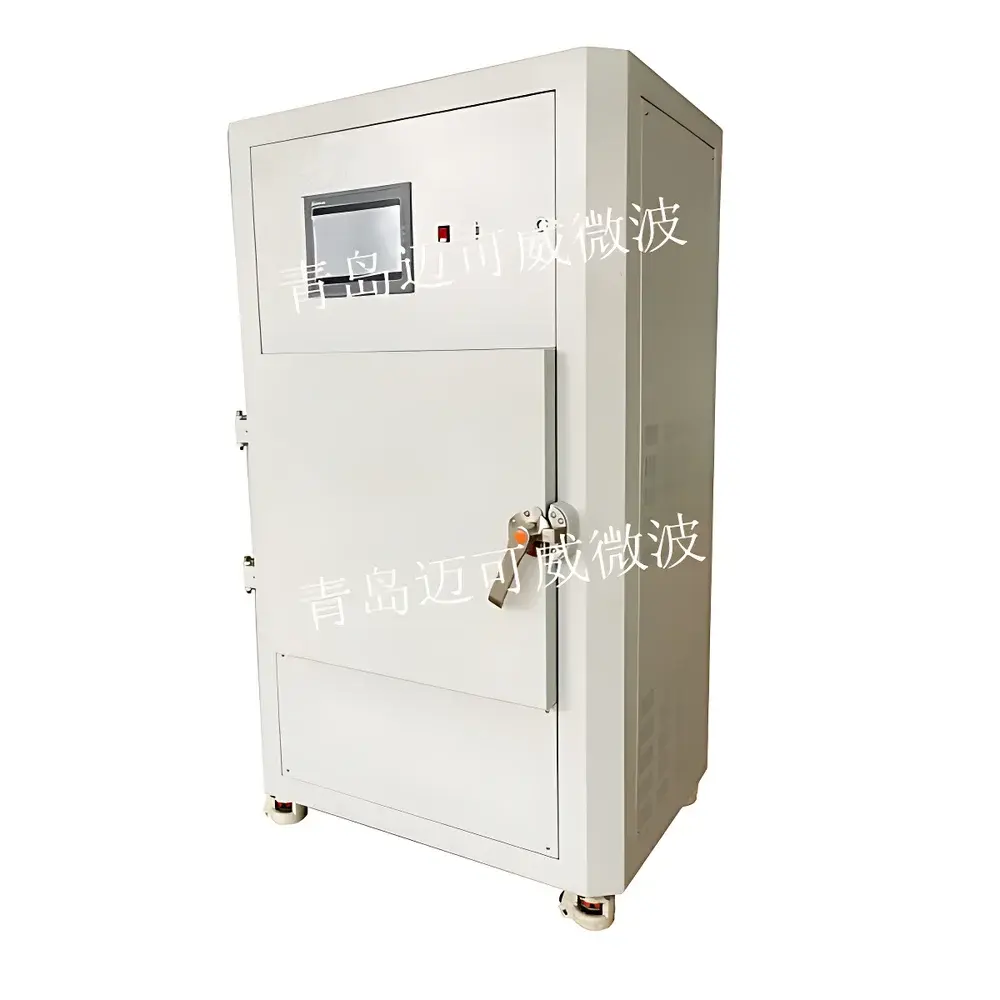
HEXING BIOCHEMICAL HXH-L10 High-Capacity Microwave-Assisted Dry-Ashing System for Radioactive Sample Preparation
| Key | Brand: HEXING BIOCHEMICAL |
|---|---|
| Model | HXH-L10 |
| Origin | Shandong, China |
| Power Range | 0–3.2 kW (adjustable) |
| Frequency | 2450 MHz |
| Cavity Volume | 56 L |
| Crucible Capacity | 10 L (quartz, standard |
| Temperature Range | 0–1200 °C (thermocouple-sensed) |
| Cavity Construction | Fully sealed, stainless steel welded monoblock with micro-positive pressure design |
| Insulation | Integrated high-efficiency thermal insulation |
| Gas Atmosphere | Adjustable air inlet |
| Exhaust | Venturi-based negative-pressure exhaust system |
| Safety Compliance | GB 4706.21–2008, GB 5959.6–2008 |
| Regulatory Alignment | GB/T 14883.1–2016, GB 5749–2006, GB 16145–1995 |
| Dimensions (W×D×H) | 975 × 750 × 1680 mm |
| Control System | PLC with color touchscreen interface, multi-stage programmable protocols, real-time temperature/time curve logging, USB data export |
Overview
The HEXING BIOCHEMICAL HXH-L10 is a high-capacity, integrated microwave-assisted dry-ashing system engineered specifically for radiochemical sample preparation in environmental and nuclear laboratories. It combines sequential drying, carbonization, and ashing into a single, closed-loop process—eliminating manual transfer between discrete instruments and minimizing radioactive material loss through volatilization or handling. Unlike conventional muffle furnaces or sequential hotplate-based methods, the HXH-L10 employs dielectric heating at 2450 MHz to deliver rapid, volumetric energy penetration directly into biological matrices—including cereals, leafy vegetables, aquatic tissue, meat, soil slurries, and airborne particulate filters. This non-contact, internal heating mechanism enables accelerated thermal decomposition while preserving radionuclide integrity—particularly critical for low-yield isotopes such as 90Sr, 137Cs, 210Po, and transuranics subject to thermal mobility above 400 °C. The system operates under controlled micro-positive pressure and supports configurable gas atmospheres (air, oxygen-enriched, or nitrogen-purged), enabling method adaptation per nuclide-specific oxidation requirements defined in ISO 11704, ASTM D7282, and IAEA Technical Reports Series No. 439.
Key Features
- Patented microwave ashing architecture (ZL201721881531.1), integrating drying, carbonization, and final ashing in one sealed quartz cavity—reducing procedural steps and operator exposure.
- 56-liter stainless steel monoblock cavity with full thermal insulation and micro-positive pressure sealing to prevent cross-contamination and ensure consistent thermal uniformity across large-volume loads (up to 10 L quartz crucible).
- Quartz crucible system with ultra-low intrinsic radioactivity (“nuclear background”), minimizing spectral interference during subsequent gamma spectrometry or alpha/beta counting.
- Venturi-driven negative-pressure exhaust with optional catalytic smoke abatement—designed for centralized ducting and compliant with occupational odor thresholds per OSHA 1910.1200 and EU Directive 2004/37/EC.
- PLC-controlled multi-segment thermal profiling: precise ramp-hold-cool sequences with real-time thermocouple feedback (0–1200 °C), enabling isothermal stabilization at nuclide-specific optimal temperatures (e.g., 450 °C for 137Cs retention, 550 °C for 90Sr recovery).
- Comprehensive safety architecture: interlocked access door, surface temperature monitoring (<50 °C), microwave leakage <5 mW/cm² (per GB 4706.21), explosion-resistant chamber design, and corrosion-resistant internal surfaces.
Sample Compatibility & Compliance
The HXH-L10 accommodates heterogeneous biological and environmental matrices without pre-grinding or homogenization—validated for intact cereal grains, whole fish fillets, bundled grass samples, sediment cores, and HEPA-filtered air particulates. Its closed quartz cavity minimizes volatile loss of iodine-131, tritium-labeled organics, and volatile actinide species during carbonization. The system meets analytical prerequisites outlined in GB/T 14883.1–2016 (General Principles for Radioactivity Testing in Foods), GB 5749–2006 (Drinking Water Standards), and GB 16145–1995 (Gamma Spectrometry of Biological Samples). Structural and operational compliance extends to GB 4706.21–2008 (Microwave Appliance Safety) and GB 5959.6–2008 (Industrial Microwave Heating Equipment Safety). For GLP/GMP environments, audit-ready operation logs—including time-stamped temperature profiles, power modulation history, and door-open events—are exportable via USB and support 21 CFR Part 11–compatible electronic signature integration when paired with validated LIMS interfaces.
Software & Data Management
The embedded PLC controller features a 7-inch color touchscreen with intuitive icon-based navigation. Preloaded protocols include standardized workflows for common matrices (e.g., “Leafy Vegetable Ashing – IAEA Protocol”, “Marine Tissue – Sr-90 Optimized”). Each protocol stores up to 10 user-defined thermal segments (ramp rate, target temp, dwell time, atmosphere setting). Real-time graphs display temperature vs. time, microwave power output, and cavity pressure—all synchronized and timestamped. Data export supports CSV format for post-processing in MATLAB, OriginLab, or laboratory information management systems (LIMS). All operational parameters—including firmware version, calibration date, and last safety self-test result—are stored in non-volatile memory and accessible via maintenance menu. Audit trails record operator ID (via optional RFID badge reader), start/stop timestamps, parameter modifications, and fault codes—enabling traceability per ISO/IEC 17025:2017 clause 7.9.
Applications
- High-throughput environmental surveillance: simultaneous ashing of ≥20 food composite samples per cycle for national radionuclide monitoring programs.
- Nuclear facility effluent analysis: rapid volume reduction of liquid scintillation cocktails, resin columns, and filter papers prior to alpha spectrometry.
- Emergency response labs: accelerated processing of field-collected vegetation, milk, and drinking water concentrates during radiological incident assessment.
- Research institutes conducting comparative studies on radionuclide retention kinetics across thermal profiles and matrix types.
- Reference material producers requiring reproducible ash yields (RSD <2.5%) across batch sizes up to 8 kg wet weight.
FAQ
Does the HXH-L10 comply with international radiation safety standards for lab use?
Yes—the system adheres to IEC 61000-6-3 (EMC emissions), IEC 61000-6-4 (industrial immunity), and incorporates shielding verified to limit microwave leakage below 5 mW/cm² at 5 cm distance, consistent with ICNIRP 2020 guidelines.
Can the system be integrated into an existing LIMS or ELN infrastructure?
Native USB data export supports CSV ingestion; optional RS-485 or Ethernet module enables Modbus TCP communication for direct LIMS polling of run metadata and thermal logs.
What maintenance intervals are recommended for the quartz crucible and exhaust catalyst?
Quartz crucibles require visual inspection after every 50 cycles and replacement after 200 cycles or visible devitrification; catalytic smoke filters should be replaced every 12 months or after 1000 operating hours, whichever occurs first.
Is method validation documentation available for regulatory submissions?
HEXING BIOCHEMICAL provides IQ/OQ documentation templates, performance qualification test scripts aligned with ASTM D7282 Annex A1, and a Certificate of Conformance with traceable NIST-calibrated thermocouple verification records.
How does the micro-positive pressure design improve analytical accuracy compared to open-air ashing?
It suppresses convective loss of volatile radionuclides (e.g., 129I, 106Ru) and prevents ambient dust ingress—yielding ash residues with ≤0.8% mass variability (n=12) versus ≥3.2% in conventional furnace ashing per interlaboratory study NRC-2021-ASH-087.



