
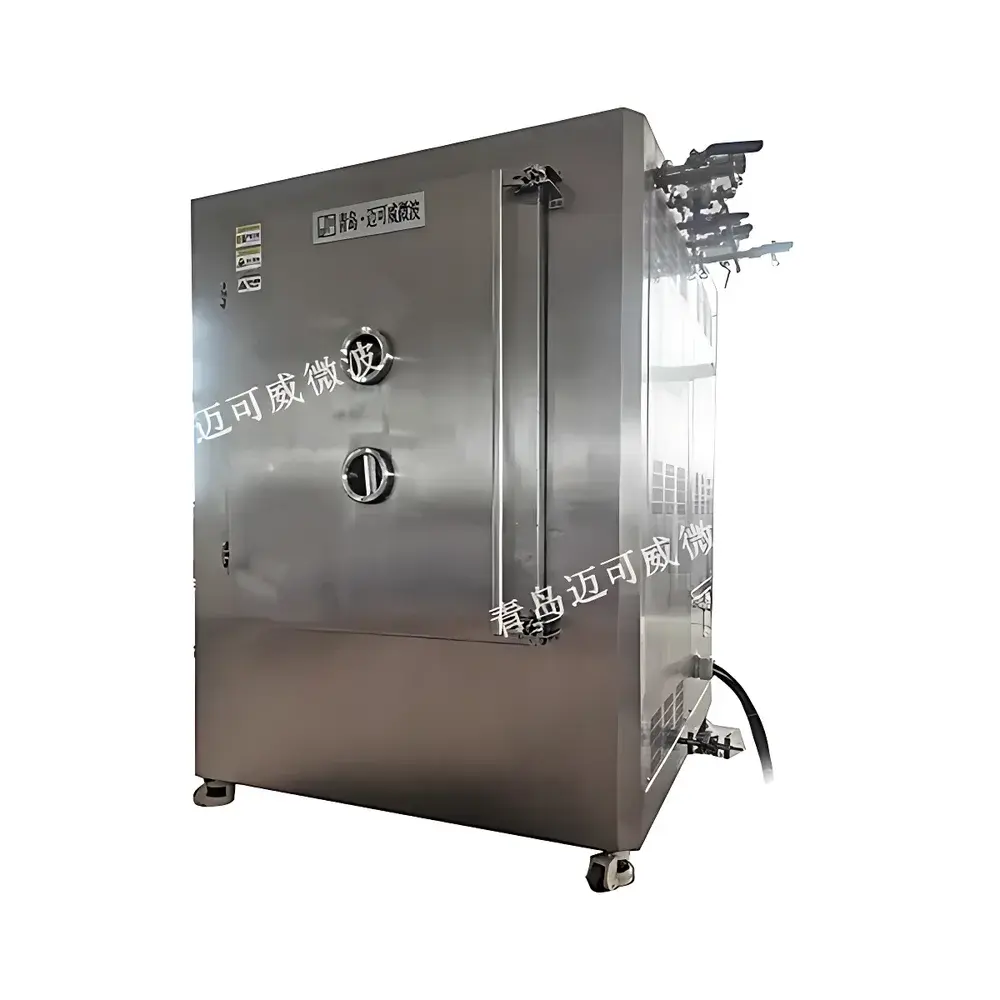
MakeWave MGZ-G Series Benchtop Microwave Vacuum Low-Temperature Dryer
| Brand | MakeWave |
|---|---|
| Origin | Shandong, China |
| Manufacturer Type | Direct Manufacturer |
| Country of Origin | China |
| Model | MGZ-G Series |
| Pricing | Upon Request |
| Vacuum Limit | –0.099 MPa |
| Operating Temperature Range | Ambient to 100 °C |
| Microwave Frequency | 2450 MHz |
| Power Range | 2–20 kW (adjustable, industrial-grade variable-frequency source) |
| Chamber Material | AISI 304 stainless steel, fully welded vacuum-tight construction |
| Chamber Volume | 25–1000 L (customizable) |
| Safety Compliance | GB 5959.6–2008, ISO 9001 certified |
| Microwave Leakage | <5 mW/cm² (measured per IEC 61000-4-3 and GB 5959.6) |
Overview
The MakeWave MGZ-G Series Benchtop Microwave Vacuum Low-Temperature Dryer is an engineered solution for gentle, high-fidelity dehydration under controlled low-pressure and low-thermal-stress conditions. It operates on the principle of volumetric microwave energy absorption within a sealed vacuum chamber—enabling rapid phase transition of moisture at significantly reduced boiling points. Unlike conventional conductive heating methods (e.g., shelf-based hot-air or steam ovens), this system delivers uniform internal energy deposition directly into the dielectric material, minimizing surface overheating, oxidation, and thermolabile compound degradation. Designed for reproducible process development and small-to-medium batch production, it serves as a critical tool in R&D laboratories and pilot-scale manufacturing environments across food science, fine chemical synthesis, and pharmaceutical solid dosage form development—particularly where retention of volatile actives, color stability, enzymatic integrity, or crystalline polymorph control is essential.
Key Features
- Integrated vacuum-microwave platform with full-chamber sealing (ultimate vacuum: –0.099 MPa), ensuring consistent pressure control during dynamic drying cycles.
- Industrial-grade 2450 MHz variable-frequency microwave generator (2–20 kW output), delivering stable power modulation and extended duty-cycle reliability.
- AISI 304 stainless steel cavity, fully welded and leak-tested, incorporating multi-port broadband waveguide feed for homogeneous field distribution and minimized standing-wave hotspots.
- Motor-driven rotating tray system with optional multi-tier stacking configuration—optimized for heterogeneous loads including powders, granules, gels, and irregular solids.
- Infrared non-contact temperature monitoring with closed-loop power regulation, enabling real-time thermal feedback and precise endpoint control.
- Front-access observation window with integrated LED illumination and optional remote HD video monitoring for visual process validation without chamber interruption.
- PLC-based control architecture with 7-inch resistive touchscreen HMI; stores up to 99 programmable protocols with timestamped parameter logging (time, power, temperature, vacuum level).
- Comprehensive safety architecture: λ/4 choke door seal, interlocked access gates, continuous microwave leakage monitoring (<5 mW/cm²), and emergency power cutoff compliant with GB 5959.6–2008.
Sample Compatibility & Compliance
The MGZ-G accommodates a broad spectrum of heat-sensitive matrices—including herbal extracts, probiotic cultures, enzyme formulations, lyophilization-preconditioned biologics, and amorphous API intermediates. Its vacuum-compatible chamber supports both static and rotational loading modes, accommodating sample geometries from thin-film coatings to 50-mm-thick slabs. All wetted surfaces are electropolished 304 SS, meeting basic requirements for GMP-aligned cleaning validation. The system conforms to ISO 9001:2015 quality management standards and adheres to national electrical safety directives for industrial microwave equipment (GB 5959.6–2008). Optional Ex d IIB T4 explosion-proof certification is available for solvent-laden or oxygen-sensitive applications requiring nitrogen purging or inert-gas backfilling.
Software & Data Management
The embedded control firmware records all operational parameters—including microwave power setpoint, actual reflected power, chamber temperature (IR-sensed), absolute vacuum pressure, rotation speed, and elapsed time—at user-defined intervals (1–60 s). Data export is supported via USB flash drive in CSV format for post-process statistical analysis (e.g., moisture loss kinetics, Arrhenius modeling). Optional Ethernet-enabled remote supervision allows integration into LabVantage or DeltaV environments. Audit trail functionality meets GLP documentation prerequisites, with operator ID tagging, protocol version control, and tamper-resistant log archiving. FDA 21 CFR Part 11 compliance is achievable through optional digital signature modules and role-based access control upgrades.
Applications
- Pharmaceutical: Low-temperature drying of peptide conjugates, mRNA-LNP intermediates, and hygroscopic excipients without deliquescence or polymorphic shift.
- Food Technology: Preservation of anthocyanins in berry pulps, retention of lycopene in tomato paste, and stabilization of Lactobacillus viability in fermented powder blends.
- Chemical R&D: Solvent removal from metal–organic frameworks (MOFs), catalyst precursor dehydration, and controlled crystallization of co-crystals under sub-ambient vapor pressure.
- Academic Research: Kinetic studies of bound-water desorption in hydrogels, comparative analysis of microwave vs. freeze-drying energy efficiency, and vacuum-assisted gelation kinetics.
FAQ
What vacuum level is required to achieve sub-40 °C drying of aqueous solutions?
At –0.095 MPa (95 kPa vacuum), water boils at approximately 35 °C; the MGZ-G achieves –0.099 MPa, enabling reliable operation down to 25–30 °C depending on solute concentration and mass transfer resistance.
Can the system handle organic solvents such as ethanol or acetone?
Yes—when equipped with Ex d IIB T4-rated components, nitrogen purge capability, and condensate trapping, the MGZ-G supports Class I, Group D solvent drying per NEC Article 500.
Is infrared temperature measurement validated against reference thermocouples?
Calibration certificates are provided for each IR sensor (emissivity-adjustable, 0.1–1.0 range); cross-validation with ASTM E2847-compliant contact probes is recommended for critical thermal endpoints.
What cooling infrastructure is required for continuous 8-hour operation?
A closed-loop chiller supplying ≤25 °C softened water at ≥3 L/min is mandatory for >10 kW configurations; air-cooled variants are limited to intermittent duty cycles.
Does the control system support automated recipe transfer between instruments?
Protocol files (.mzp) are portable across MGZ-G units of identical chamber volume and power rating; firmware version alignment is required for full parameter fidelity.



