
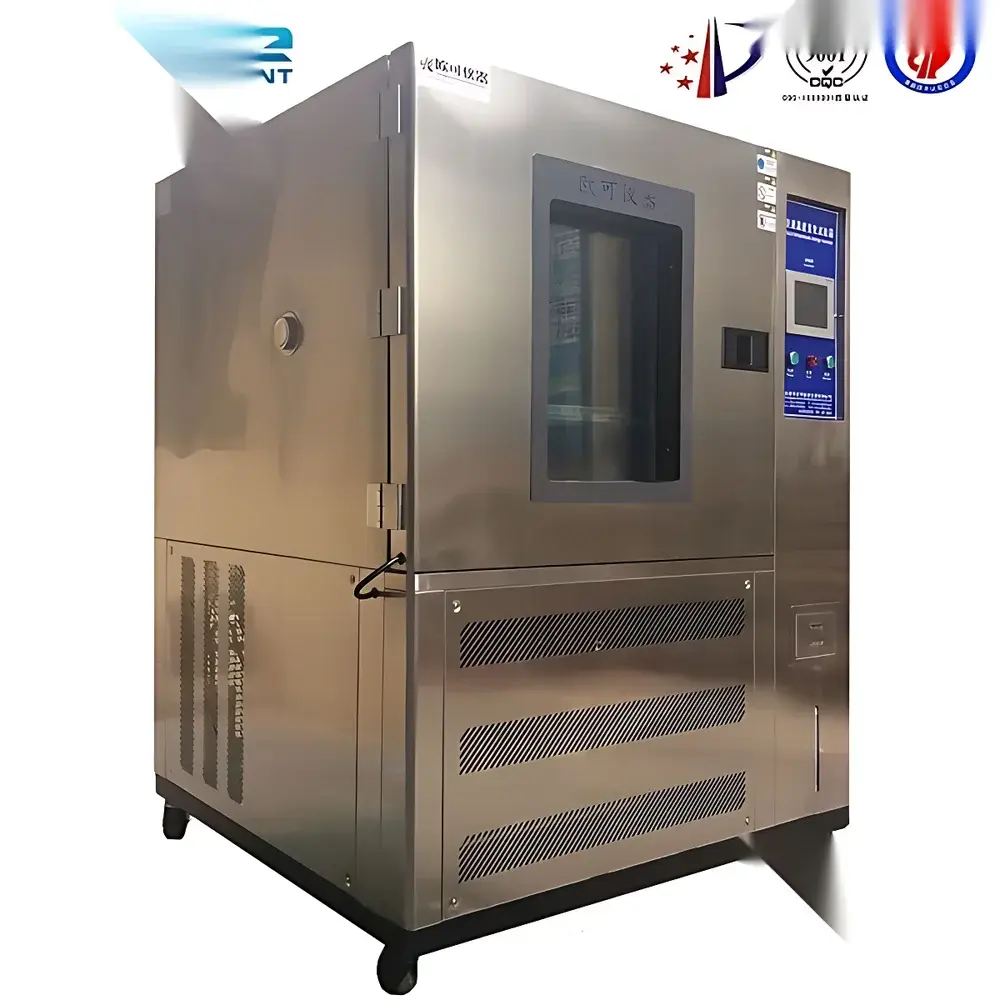
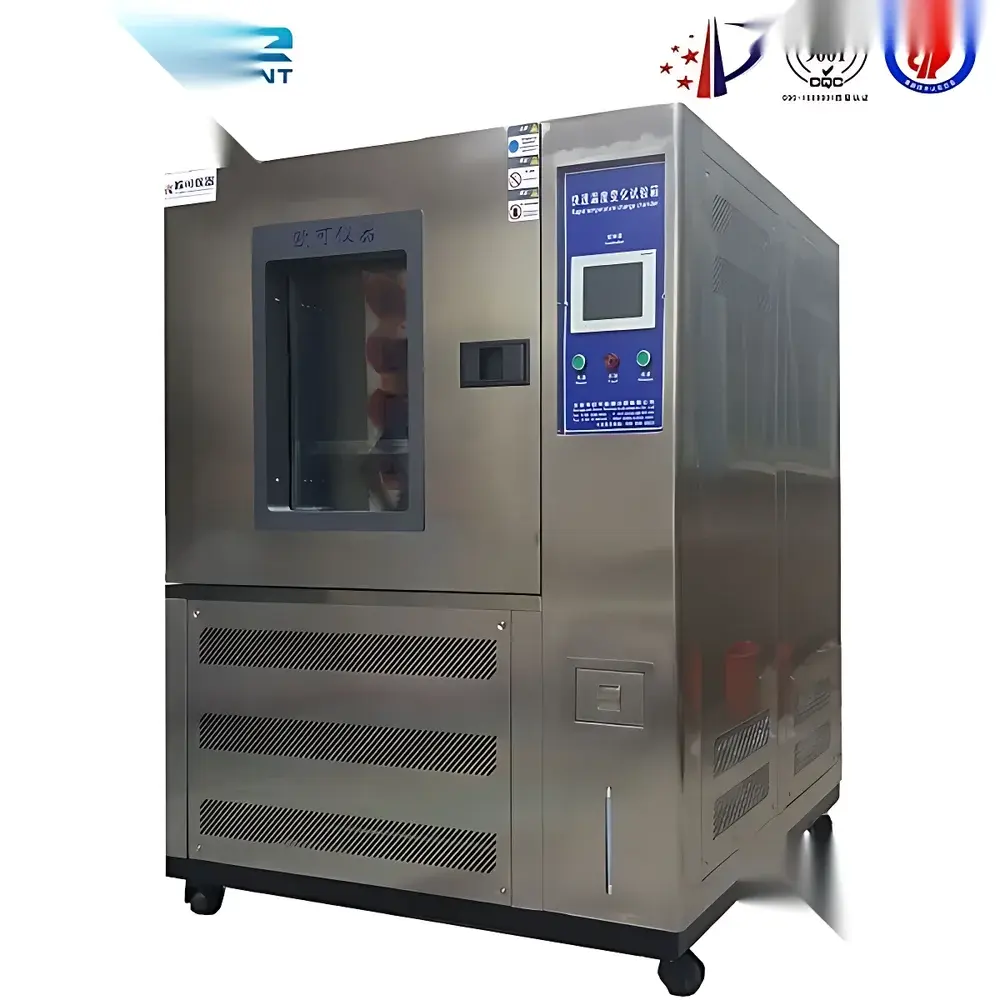
KS-TH Series Rapid Temperature Change Chamber for Smartphone Camera Module Testing
| Brand | Other Brands |
|---|---|
| Origin | Imported |
| Manufacturer Type | General Distributor |
| Price | USD 2,650 (approx.) |
| Internal Dimensions (W×H×D, mm) | 500×600×500 to 1000×1000×1000 |
| External Dimensions (W×H×D, mm) | 1750×2250×2350 to 2350×2800×3000 |
| Temperature Range | −70 °C to +150 °C |
| Humidity Range (optional) | 20–98 %RH |
| Rapid Temperature Transition Range | −45 °C to +85 °C |
| Transition Rate Options | 5–30 °C/min (A–F models, linear or non-linear programmable) |
| Temperature Uniformity | ±2.0 °C |
| Humidity Uniformity | ±3.0 %RH |
| Temperature Control Accuracy | ±0.5 °C |
| Humidity Control Accuracy | ±2.5 %RH |
| Temperature Resolution | 0.1 °C |
| Humidity Resolution | 0.1 %RH |
| Refrigeration System | Water-cooled, dual-compressor (Tecumseh/Tecumseh or Bitzer) |
| Inner Chamber Material | SUS304 stainless steel |
| Outer Chamber Material | Stainless steel or SECC cold-rolled steel with epoxy powder coating |
| Insulation | High-density polyurethane foam (CFC-free) |
| Safety Protections | Over-temperature/over-humidity cutoff, high/low refrigerant pressure switch, compressor overload protection, fuse, water shortage alarm, fault diagnostic display |
| Power Supply | AC 380 V, 3-phase 5-wire, 50/60 Hz |
| Weight | 950–2300 kg |
Overview
The KS-TH Series Rapid Temperature Change Chamber is an engineered environmental stress screening (ESS) system specifically optimized for reliability validation of smartphone camera modules and other compact optoelectronic components. It operates on a balanced temperature and humidity control (BTHC) principle, utilizing proportional-integral-derivative (PID) algorithms with solid-state relays (SSR) to dynamically match heating/cooling/humidification output against thermal and moisture load losses—enabling stable, repeatable, and long-duration cycling without drift. Designed to replicate real-world thermal shock profiles encountered during device operation, logistics, and field deployment, the chamber supports accelerated life testing (ALT), HALT/HASS pre-screening, and qualification per IEC 60068-2-1 (cold), IEC 60068-2-2 (dry heat), and IEC 60068-2-30 (damp heat cyclic) standards. Its architecture prioritizes thermal inertia minimization via high-efficiency water-cooled compressors, low-thermal-mass chamber walls, and precision airflow management—critical for achieving sub-30-second thermal settling times after rapid transitions.
Key Features
- Modular scalability across five internal volume classes (150 L to 1000 L), each configurable with six transition rate grades (5–30 °C/min), enabling test protocol alignment from MIL-STD-810G Method 503.5 to JEDEC JESD22-A104E.
- Triple-layer vacuum-coated observation window with integrated Philips energy-efficient fluorescent lighting—eliminates condensation without wipers and ensures optical clarity for real-time visual inspection of lens focus shift, IR filter adhesion, or housing warpage.
- Physically isolated humidification circuitry: steam generator piping routed separately from control boards and power distribution, mitigating electrical risk from condensate leakage and supporting ISO/IEC 17025-compliant lab safety protocols.
- LCD touchscreen controller with intuitive menu navigation, multi-segment ramp-soak programming, and built-in data logging (10,000-point memory); supports RS485 Modbus RTU and optional Ethernet/IP for integration into centralized MES or LIMS platforms.
- Structural integrity reinforced by SUS304 interior cladding and polyurethane insulation with zero ozone-depleting potential (ODP = 0), compliant with EU Regulation (EC) No 1005/2009 on fluorinated greenhouse gases.
Sample Compatibility & Compliance
The chamber accommodates camera modules up to 150 mm × 150 mm × 30 mm mounted on standardized DUT carriers or custom fixtures. Optional accessories—including glove ports with anti-static gloves, deionized water purification units, and external desiccant dryers—enable testing under electrostatic discharge (ESD)-sensitive or ultra-low-humidity conditions (<5 %RH). All models are certified to meet GB/T 2423.1–2023 (cold), GB/T 2423.2–2023 (dry heat), and GB/T 2423.34–2012 (damp heat cyclic), with traceable calibration documentation available per ISO/IEC 17025 requirements. Humidity functionality complies with IEC 60068-3-5 for humidity generation accuracy and IEC 60068-3-6 for chamber uniformity assessment.
Software & Data Management
The embedded controller provides native support for test sequence definition—including up to 99 programmable steps per cycle, dwell time synchronization between temperature and humidity ramps, and automatic pass/fail flagging based on user-defined tolerance bands. Exported CSV logs include timestamped temperature, humidity, setpoint deviation, and alarm status—structured for direct ingestion into statistical process control (SPC) tools such as Minitab or JMP. Optional PC-based software extends functionality with remote monitoring, multi-chamber fleet management, electronic signature support aligned with FDA 21 CFR Part 11 Annex 11, and audit trail generation for GLP/GMP-regulated environments.
Applications
- Thermal shock evaluation of CMOS image sensors under −45 °C to +85 °C transitions to detect solder joint fatigue, die attach delamination, or micro-lens misalignment.
- Environmental stress screening (ESS) of autofocus actuators (VCM/OIS) to validate mechanical hysteresis and positional repeatability across extreme thermal gradients.
- Humidity-induced fogging and condensation resistance testing of AR/IR coatings on cover glass, using controlled 20–98 %RH excursions at stabilized temperatures.
- Qualification of encapsulation materials (e.g., silicone gels, UV-curable resins) against moisture ingress and coefficient-of-thermal-expansion (CTE) mismatch during repeated cycling.
- Pre-compliance verification for automotive-grade camera modules targeting AEC-Q200 Grade 2 (−40 °C to +105 °C) or Grade 1 (−40 °C to +125 °C) specifications.
FAQ
Is humidity control mandatory, or can it be omitted for dry thermal cycling only?
Humidity functionality is optional and factory-deactivated by default; chambers configured without humidification retain full rapid temperature transition capability and reduced maintenance overhead.
What is the maximum allowable thermal load when testing multiple camera modules simultaneously?
Maximum steady-state thermal load is 300 W per 100 L chamber volume; exceeding this requires derating transition rates per manufacturer’s thermal load correction curves.
Does the system support non-linear ramp profiles, such as exponential or logarithmic heating/cooling segments?
Yes—via advanced segment programming mode, users may define custom rate profiles per step, including dwell-hold, linear ramp, and user-defined non-linear interpolation.
How is calibration traceability maintained for regulatory audits?
Each unit ships with NIST-traceable calibration certificates for temperature (±0.3 °C at key points) and humidity (±1.5 %RH at 50 %RH), with annual recalibration kits and third-party service partnerships available globally.
Can the chamber interface with industrial PLCs for synchronized operation within automated test lines?
Standard RS485 Modbus RTU and optional EtherNet/IP or Profibus-DP gateways enable deterministic I/O signaling for start/stop commands, status feedback, and emergency stop integration.



