
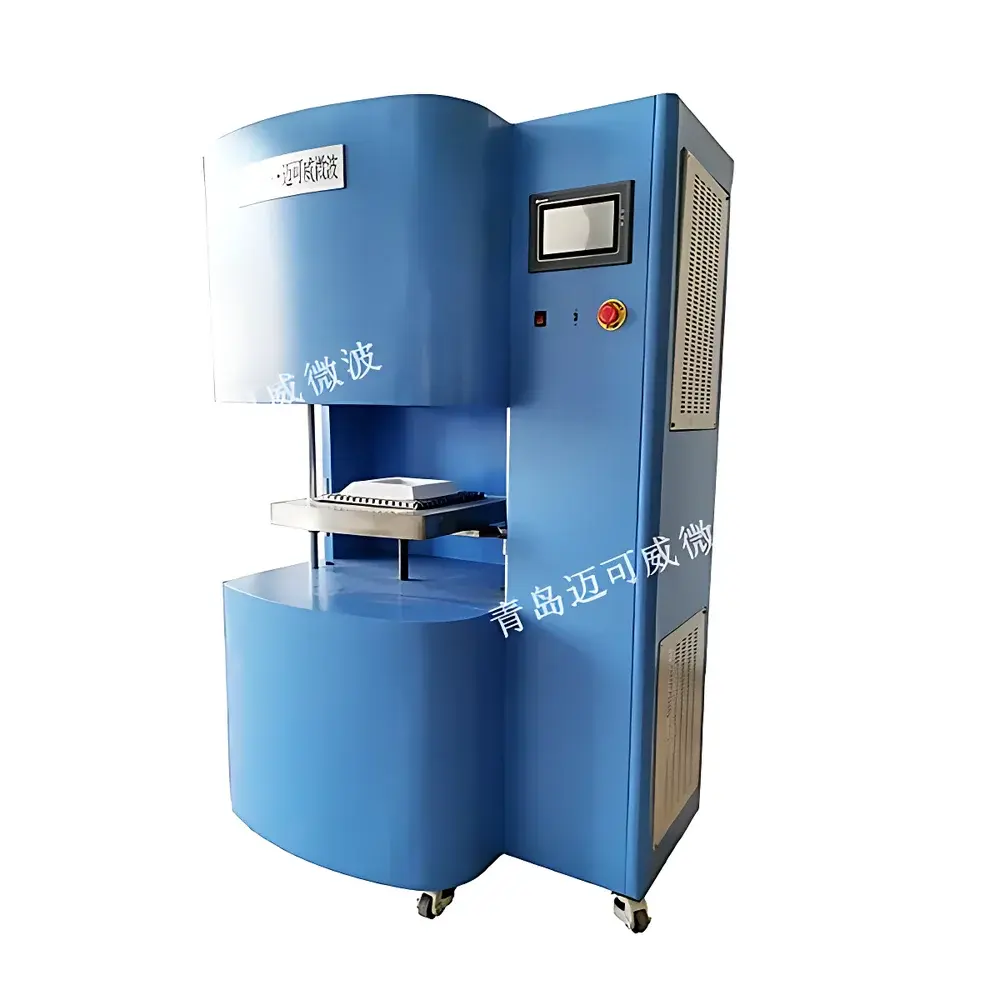
Makewave MKZ-SM8B Vertical Lift-Type Microwave High-Temperature Muffle Furnace
| Brand | Makewave |
|---|---|
| Origin | Shandong, China |
| Manufacturer Type | Direct Manufacturer |
| Product Category | Domestic |
| Model | MKZ-SM8B |
| Instrument Type | High-Temperature Microwave Furnace |
| Temperature Range | 0–1200 °C (extendable to 1400 °C with enhanced insulation) |
| Temperature Uniformity | ±1 °C |
| External Dimensions | 1000 × 800 × 1700 mm (W × D × H) |
| Chamber Volume | ~7 L (190 × 190 × 200 mm) |
| Chamber Material | Seamless Stainless Steel Welded Construction |
| Heating Method | 2450 MHz Microwave Energy (0–4000 W, Continuously Adjustable) |
| Atmosphere Control | Micro-positive Pressure Sealed Cavity with Inlet/Outlet Gas Ports |
| Loading Mechanism | Motorized Bottom-Lift Tray with Triple-Barrier Door (Thermal/Microwave/Gas-Tight) |
| Crucible Options | 150 × 150 mm Ceramic Crucibles (Mullite, Alumina, Quartz, or Silicon Carbide) |
| Control System | PLC-Based Intelligent Controller with Color Touchscreen Interface |
| Data Management | Multi-step Programmable Profiles, Real-Time Temperature/Time Curve Display, USB Data Export, Audit-Trail-Capable Logging |
Overview
The Makewave MKZ-SM8B is a vertically oriented, lift-type microwave high-temperature muffle furnace engineered for precision thermal processing under controlled atmospheric conditions. Unlike conventional resistive-heated muffle furnaces, the MKZ-SM8B utilizes 2450 MHz microwave energy to induce volumetric heating within the sample and crucible—enabling rapid, uniform temperature ramping and significantly reduced thermal inertia. This fundamental shift in heating mechanism eliminates surface-limited conduction and mitigates thermal gradients common in radiant or convection-based systems. The furnace is designed for applications requiring precise thermal decomposition, ashing, sintering, carbonization, sulfonation, and high-temperature calcination across materials science, geochemistry, pharmaceutical QA/QC, food safety testing, and environmental residue analysis. Its sealed stainless-steel cavity supports inert, reducing, oxidizing, or reactive gas atmospheres at micro-positive pressure—ensuring reproducible reaction kinetics and minimizing cross-contamination from ambient air ingress.
Key Features
- Vertical lift architecture with motorized bottom-loading tray: Enables safe, ergonomic handling of hot crucibles without lateral door opening—reducing heat loss, operator exposure, and contamination risk during loading/unloading.
- Seamless stainless-steel cavity with hermetic micro-positive pressure sealing: Maintains stable atmosphere integrity up to 1200 °C; compatible with N2, Ar, H2/N2, CO, O2, and other process gases via standardized inlet/outlet ports.
- Optimized thermal field design: Top-mounted reflective plate captures rising convective heat, promoting vertical temperature homogeneity and minimizing axial gradient—critical for consistent sintering density and phase transformation studies.
- Rapid cooldown capability: Integrated forced-air cooling path combined with automatic chamber descent allows direct high-temperature sample retrieval, cutting cycle time by up to 40% compared to static chamber furnaces.
- Ceramic fiber-insulated chamber (~7 L volume) with multiple crucible compatibility: Supports standard 150 × 150 mm crucibles in mullite, alumina, quartz, or SiC—selected based on thermal stability, chemical inertness, and maximum operating temperature requirements.
- Triple-barrier safety door system: Integrates high-temperature insulation, microwave shielding (≥80 dB attenuation at 2450 MHz), and gas-tight gasketing—meeting IEC 61000-4-3 and GB 4706.21 electromagnetic safety standards.
Sample Compatibility & Compliance
The MKZ-SM8B accommodates diverse sample forms—including powders, pellets, thin films, granules, and biological tissues—within chemically resistant ceramic crucibles. Its micro-positive pressure operation ensures minimal oxidation of sensitive samples (e.g., transition metal oxides, battery cathode precursors) and prevents volatilization loss during organic ashing per ASTM D5630 and ISO 1171. The furnace meets structural and operational requirements for GLP-compliant laboratories: temperature calibration traceable to NIST-certified reference thermocouples, programmable multi-segment thermal profiles, and timestamped data logging with user-accessible audit trails. Optional integration with mass flow controllers and exhaust scrubbers supports EPA Method 3050B and USP heavy metal residue testing workflows.
Software & Data Management
The embedded PLC controller features a 7-inch color touchscreen interface supporting intuitive profile programming, real-time graphical monitoring of temperature vs. time curves, and immediate visual feedback on microwave power delivery and chamber pressure status. Up to 32 multi-step thermal programs can be stored onboard, each with independent ramp rates, dwell times, and atmosphere switching logic. All operational data—including setpoints, actual temperatures, power output, gas flow rates (when interfaced), and alarm events—are timestamped and exportable via USB to CSV format. The system supports optional 21 CFR Part 11-compliant software modules with electronic signatures, role-based access control, and immutable log archiving for regulated environments.
Applications
- High-fidelity ashing of food, feed, and botanical matrices for elemental analysis (ICP-OES/MS).
- Sintering of advanced ceramics (e.g., ZrO2, Al2O3, SiC) with controlled grain growth and density optimization.
- Thermogravimetric coupling: Serves as a high-temperature combustion module synchronized with TGA instruments for evolved gas analysis (EGA) and kinetic modeling.
- Carbonization of polymer-derived ceramics and biochar production under nitrogen or argon.
- Residue-on-ignition (ROI) determination in pharmaceutical excipients per USP .
- High-temperature pretreatment of catalyst supports and electrode materials prior to electrochemical characterization.
FAQ
What is the maximum continuous operating temperature, and is 1400 °C achievable?
The rated operational range is 0–1200 °C. With upgraded insulation and optimized microwave coupling, short-duration exposure up to 1400 °C is possible—but requires validation using appropriate thermocouple grade (Type B) and crucible material (e.g., high-purity alumina or SiC).
Can the furnace operate under vacuum?
No. The MKZ-SM8B is designed for micro-positive pressure gas environments only. Vacuum operation would compromise microwave cavity integrity and safety interlocks.
Is microwave leakage monitored during operation?
Yes. A built-in RF leakage sensor continuously measures field strength at the door seal and triggers an immediate shutdown if >5 mW/cm² is detected—exceeding IEC 62233 safety thresholds.
How is temperature calibrated and verified?
Calibration uses dual-point verification with NIST-traceable Class 1 armored thermocouples (Type K for ≤1200 °C; Type B for extended range), performed annually or after major maintenance per ISO/IEC 17025 guidelines.
Does the system support remote monitoring or integration with LIMS?
Standard RS485 Modbus RTU and optional Ethernet TCP/IP interfaces enable integration with laboratory automation platforms and LIMS via OPC UA or custom API—subject to site-specific network security protocols.



