
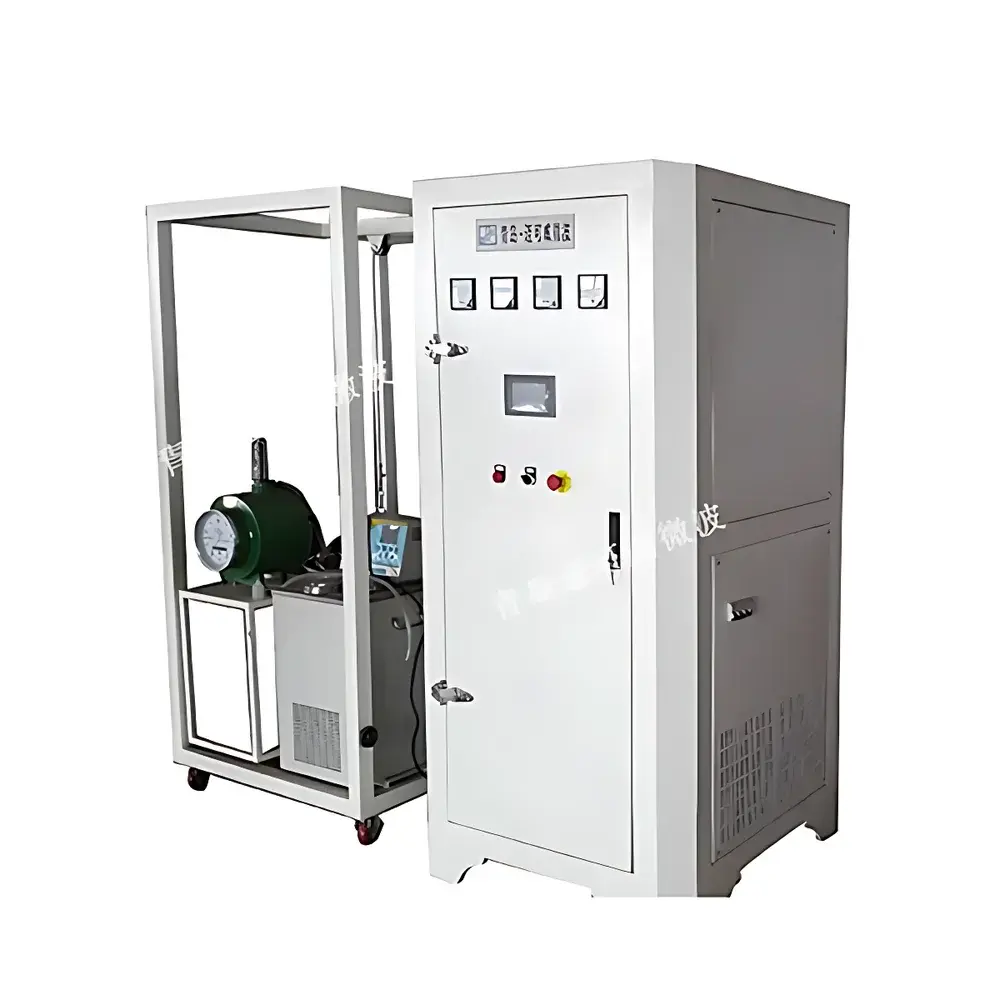
MakeWave MGF-3 Microwave Pyrolysis Reactor
| Brand | MakeWave |
|---|---|
| Origin | Shandong, China |
| Manufacturer Type | Direct Manufacturer |
| Product Category | Domestic |
| Model | MGF-3 |
| Instrument Type | High-Temperature Microwave Pyrolysis System |
| Temperature Range | 200–250 °C |
| Temperature Stability | ±1 °C |
| Cavity Material | 304 Stainless Steel |
| Heating Method | Microwave (2.4 kW) |
| System Integration | Integrated Gas Preheating, Condensation, Gas Capture, and PLC-Based Control |
Overview
The MakeWave MGF-3 Microwave Pyrolysis Reactor is a purpose-built laboratory-scale system engineered for controlled thermal decomposition of carbonaceous feedstocks—including biomass, coal, and petroleum-derived precursors—under precisely regulated microwave heating conditions. Unlike conventional resistive ovens, the MGF-3 employs single-mode or multimode microwave energy (2.4 kW nominal output) to induce rapid, volumetric, and selective heating within a sealed quartz reaction tube housed in a shielded 304 stainless steel cavity. This enables uniform internal temperature distribution and minimizes thermal lag, facilitating accurate kinetic studies of endothermic pyrolysis reactions beginning at 200 °C and extending to 250 °C. The reactor operates on the principle of dielectric heating, where polar molecules (e.g., water, lignin fragments, oxygenated organics) absorb microwave energy and convert it directly into thermal energy—resulting in faster heat-up rates, improved energy efficiency, and enhanced reproducibility in product yield distribution (biochar, bio-oil, syngas). Designed for fundamental research and process development, the MGF-3 supports ASTM D7582 (proximate analysis), ISO 18123 (biomass pyrolysis characterization), and alignment with GLP-compliant experimental workflows.
Key Features
- Microwave-specific high-temperature pyrolysis chamber with electromagnetic shielding and interlocked safety door
- Quartz tubular reactor (OD ≥ 50 mm, length ≥ 600 mm) compatible with inert gas purging and continuous feeding configurations
- Integrated gas preheating module: heats incoming protective gas (N₂, Ar) to 100–300 °C prior to entering the reaction zone, improving thermal efficiency and suppressing secondary cracking
- Cryogenic condensation system using a recirculating chiller (−20 °C to −40 °C operating range) coupled with gravity-fed cold trap and calibrated liquid collection vessel (volume capacity: 500 mL)
- Floating-buoy gas capture assembly enabling quantitative, zero-loss collection of non-condensable gases (H₂, CH₄, CO, CO₂, C₂H₄) via water displacement and wet-test meter integration
- PLC-based control system with HMI interface supporting programmable ramp-hold profiles, real-time thermocouple (Type K) monitoring, data logging at 1 s intervals, and audit-trail-capable parameter history (aligned with FDA 21 CFR Part 11 requirements when configured with electronic signature modules)
Sample Compatibility & Compliance
The MGF-3 accommodates solid feedstocks in granular, pelletized, or powdered form (particle size ≤ 5 mm), including lignocellulosic biomass (wood chips, rice husk, straw), algae, sewage sludge, waste tires, and low-rank coals. Its design conforms to IEC 61000-6-3 (EMC emission limits) and IEC 61000-6-4 (industrial immunity). All wetted surfaces contacting condensate or gas streams are constructed from 304 stainless steel or borosilicate glass—ensuring resistance to organic acids (acetic, formic), phenolics, and light hydrocarbons generated during pyrolysis. The system meets essential safety provisions of EN 61010-1 for laboratory electrical equipment and supports method validation per USP Analytical Instrument Qualification protocols.
Software & Data Management
The embedded PLC controller records time-stamped temperature, power output, gas flow rate (via wet-test meter calibration), and pressure differentials across the condenser. Exportable CSV files include full traceability metadata (operator ID, batch ID, timestamp, setpoint deviations). Optional Ethernet/RS485 communication allows integration with LIMS or SCADA platforms. Data integrity safeguards include write-protected memory, automatic backup on USB storage, and configurable alarm thresholds with event-triggered email notifications (SMTP-enabled). Audit trails comply with ALCOA+ principles (Attributable, Legible, Contemporaneous, Original, Accurate, Complete, Consistent, Enduring, Available).
Applications
- Kinetic modeling of primary and secondary pyrolysis reactions under controlled heating rates (5–50 °C/min equivalent)
- Yield optimization studies for biochar production targeting specific surface area (>300 m²/g) and fixed-carbon content
- Upgrading of bio-oil composition via in-situ catalytic cracking using supported metal oxides (e.g., Ni/Al₂O₃, ZSM-5)
- Gas composition profiling for syngas quality assessment (H₂/CO ratio, LHV calculation)
- Thermal stability evaluation of polymer composites and carbon fiber precursors
- Method development for EPA Method 8270D (semivolatile organics) and ASTM D5231 (pyrolytic GC-MS sample prep)
FAQ
What feedstock particle size is recommended for optimal microwave coupling?
Feedstock should be uniformly sized ≤ 5 mm to ensure consistent dielectric absorption and avoid arcing or hot-spot formation.
Can the MGF-3 operate under vacuum or reduced pressure?
Yes—the quartz tube and sealing system support operation down to 10 mbar absolute pressure when paired with optional vacuum pump and pressure transducer modules.
Is the system compatible with catalyst testing in situ?
Absolutely—the quartz reactor permits placement of catalyst beds upstream or downstream of the main pyrolysis zone, enabling staged reaction studies.
How is temperature calibrated and verified?
Calibration is performed using NIST-traceable Type K thermocouples; users may validate accuracy via reference material pyrolysis (e.g., cellulose onset at 315 °C ± 5 °C under N₂).
Does the system meet CE marking requirements for export to the EU?
The base configuration complies with CE directives for EMC and Low Voltage Equipment; full CE certification documentation is available upon request for harmonized standards implementation.



