
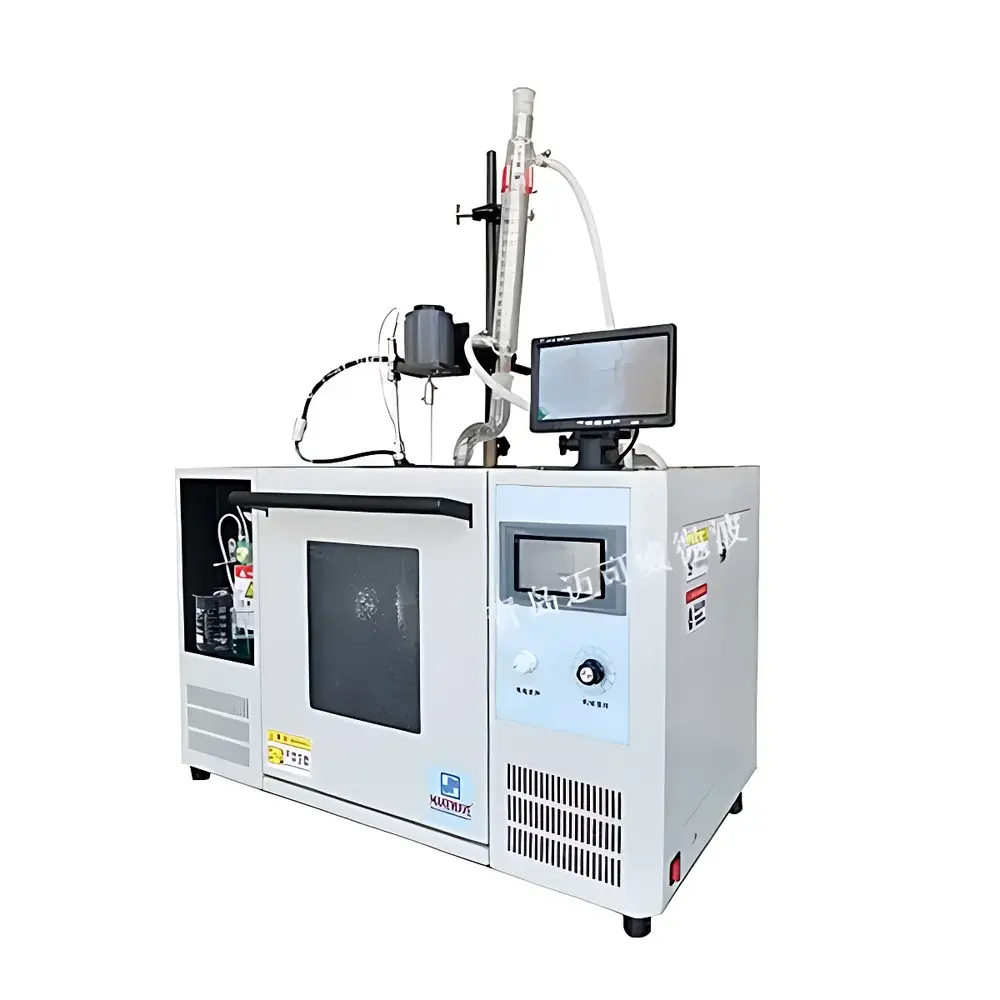
MakeWave MKX-H1C1S Open-Mode Atmospheric Microwave Chemical Synthesizer with Integrated Sampling Function
| Brand | MakeWave |
|---|---|
| Origin | Shandong, China |
| Manufacturer Type | Direct Manufacturer |
| Country of Origin | China |
| Model | MKX-H1C1S |
| Price Range | USD 7,000 – 14,000 (FOB) |
| Temperature Range | 0–300 °C |
| Temperature Control Accuracy | ±0.1 °C |
| Reaction Vessel | Borosilicate Glass Three-Neck Round-Bottom Flask |
| Maximum Reaction Volume | 500 mL |
Overview
The MakeWave MKX-H1C1S is an open-mode, atmospheric-pressure microwave chemical synthesizer engineered for precision-controlled synthetic and extraction chemistry under non-pressurized conditions. Unlike sealed-vessel microwave reactors, the MKX-H1C1S operates via continuous, non-pulsed 2450 MHz microwave irradiation (rated output: 800 W), enabling real-time process observation, manual or automated sampling, and integration with standard glassware-based reaction workflows. Its core principle relies on selective dielectric heating—microwave energy couples directly with polar molecules and ionic species in the reaction mixture, accelerating molecular rotation and kinetic energy transfer. This results in rapid, volumetric heating with reduced thermal gradients, enabling faster reaction kinetics, lower operational temperatures compared to conventional conductive heating, and access to thermodynamically disfavored or kinetically hindered pathways. Designed for laboratories requiring flexibility between synthesis, extraction, and method development, the MKX-H1C1S supports reproducible scale-up from exploratory screening to gram-scale preparative work.
Key Features
- Open-atmosphere reaction platform compatible with standard 500 mL three-neck borosilicate glass flasks—enabling simultaneous temperature monitoring, mechanical/magnetic stirring, reflux condensation, and in-situ sampling.
- Dual-mode agitation system: PTFE-coated anchor impeller driven by a variable-speed geared motor (mechanical stirring), plus PTFE-encapsulated magnetic stir bar (electromagnetic stirring), both independently adjustable for heterogeneous or viscous reaction media.
- Integrated sampling module with programmable peristaltic flow pump and solenoid valve array—supports three operational modes: time-triggered, temperature-gated, or flow-rate-regulated sampling for kinetic profiling or intermediate isolation.
- Robust 304 stainless-steel cavity (≈20 L internal volume; 275 mm cavity height) with multi-layer PTFE coating for corrosion resistance against acidic, alkaline, and high-temperature reagents; λ/4 choke structure and interlocked door ensure microwave leakage <5 mW/cm² (exceeding GB 10436 and IEC 61000-3-2 compliance thresholds).
- PLC-based control architecture with 7-inch color touchscreen HMI—displays real-time temperature, power, time, and stirring speed curves; supports up to 20 user-defined protocols with editable setpoints, ramp/hold profiles, and automatic data logging (CSV export via USB).
Sample Compatibility & Compliance
The MKX-H1C1S accommodates a broad range of sample types—including organic solvents (e.g., DMF, ethanol, acetonitrile), aqueous solutions, suspensions, and solid-liquid heterogeneous mixtures—within its open-flask configuration. It complies with ISO 9001:2015 quality management standards and meets electromagnetic compatibility (EMC) requirements per IEC 61326-1 for laboratory equipment. While not certified for GMP production environments, its data integrity features—including timestamped parameter logging, non-editable audit trails, and password-protected protocol modification—support GLP-aligned documentation practices. The system is suitable for method development under ASTM E2915 (Standard Guide for Evaluating Microwave-Assisted Chemical Reactions) and aligns with USP guidelines for analytical instrument qualification when deployed in QC/QA settings.
Software & Data Management
Control firmware implements deterministic real-time scheduling for temperature/power feedback loops using type-K thermocouple input (insertion-style, direct immersion). All operational parameters—including setpoint history, actual temperature trace, microwave power modulation, and sampling event timestamps—are stored internally and exportable as comma-separated values (CSV) for post-processing in MATLAB, Origin, or Excel. No proprietary software installation is required; data retrieval occurs via standard USB mass-storage interface. The system supports optional RS-485 Modbus RTU communication for integration into centralized lab automation networks (e.g., LIMS or SCADA), provided external gateway hardware is deployed.
Applications
The MKX-H1C1S serves diverse research and development domains: organic synthesis (e.g., Suzuki couplings, esterifications, heterocycle formation); natural product extraction (e.g., polyphenol recovery from botanical matrices); nanomaterial synthesis (e.g., metal oxide nanoparticle precipitation); pharmaceutical process scouting (API intermediate optimization); food science applications (e.g., enzymatic hydrolysis acceleration); and environmental analysis (e.g., accelerated solvent extraction of PAHs from soil). Its open-system design facilitates rapid reagent addition, pH adjustment mid-reaction, and compatibility with inert gas purging—making it particularly valuable for air-sensitive or exothermic transformations where pressure containment is unnecessary or undesirable.
FAQ
Is the MKX-H1C1S compatible with Schlenk-line or nitrogen-purged reactions?
Yes—the open three-neck flask configuration allows direct connection to inert gas manifolds via standard ground-glass joints.
Can the sampling system be interfaced with an external autosampler or HPLC injector?
Yes—via optional ¼” OD PTFE tubing and custom valve timing logic; users must supply external actuation signals (TTL or 24 V DC) for synchronization.
What cooling methods are supported for reflux condensation?
The unit includes threaded ports for standard water-cooled condensers; recirculating chillers (e.g., −10 °C to 25 °C range) are recommended for volatile solvent systems.
Does the system support validation documentation (IQ/OQ/PQ)?
Comprehensive factory test reports and calibration certificates (thermocouple, power meter) are provided; site-specific OQ protocols can be developed using built-in diagnostic routines and third-party metrology tools.
What maintenance is required for long-term reliability?
Quarterly inspection of cavity coating integrity, annual verification of door seal compression and interlock function, and biannual cleaning of exhaust fan filters are recommended per the operator manual.



