
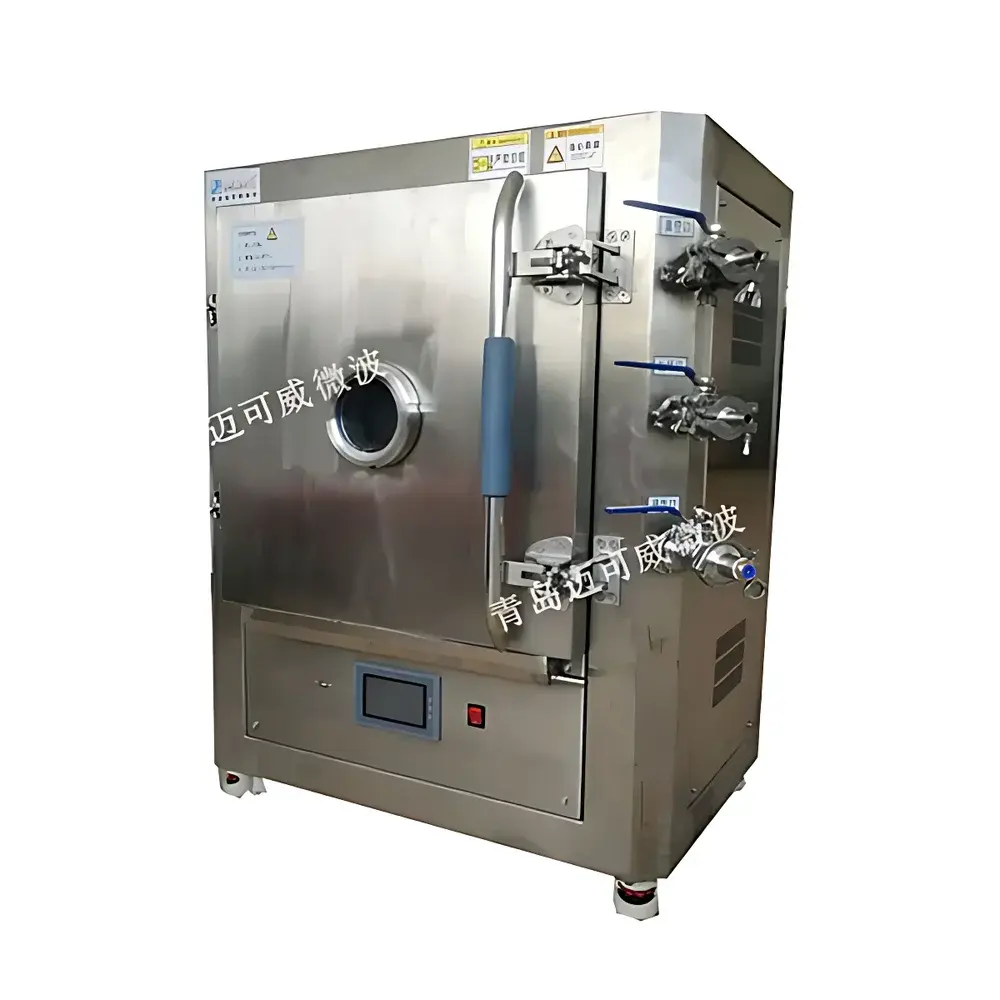
MakeWave MKZ-G2A Microwave Vacuum Low-Temperature Drying Oven
| Brand | MakeWave |
|---|---|
| Origin | Shandong, China |
| Manufacturer Type | Direct Manufacturer |
| Country of Origin | China |
| Model | MKZ-G2A |
| Instrument Type | Vacuum Drying Oven |
| Temperature Range | Ambient to 100 °C (infrared non-contact measurement) |
| Temperature Uniformity | ±1 °C |
| External Dimensions | 652 × 550 × 800 mm (W × H × D) |
| Internal Chamber Dimensions | 305 × 305 × 305 mm (W × H × D) |
| Chamber Material | AISI 304 Stainless Steel |
| Heating Method | 2450 MHz Microwave Energy |
| Microwave Power | 1600 W (industrial-grade variable-frequency generator) |
| Ultimate Vacuum | –0.099 MPa |
| Chamber Volume | 26 L |
| Power Supply | 220 VAC / 50 Hz |
| Total Power Consumption | 3000 W |
| Net Weight | 100 kg |
Overview
The MakeWave MKZ-G2A Microwave Vacuum Low-Temperature Drying Oven is an engineered solution for gentle, rapid, and solvent-efficient dehydration under controlled vacuum and microwave-assisted heating conditions. Unlike conventional conduction-based drying ovens, this system employs dielectric heating via 2450 MHz microwave energy within a fully sealed, evacuated chamber—enabling phase change at significantly reduced temperatures through vapor pressure depression. This principle supports low-thermal-stress processing of thermolabile compounds, preserving structural integrity, bioactivity, and volatile profile in sensitive matrices. Designed for laboratory-scale process development and pilot validation, the MKZ-G2A bridges the gap between benchtop feasibility studies and scalable vacuum-microwave drying protocols compliant with pharmaceutical, food, and fine chemical R&D workflows.
Key Features
- Integrated vacuum-microwave architecture: Fully welded AISI 304 stainless steel cavity with λ/4 choke-sealed door and dual-port broadband microwave coupling for uniform field distribution
- Precision temperature control: Non-contact infrared pyrometry (ambient to 100 °C), closed-loop power modulation, and real-time feedback to maintain thermal setpoints within ±1 °C
- Dynamic sample handling: Motor-driven φ260 mm PTFE-coated rotating tray system ensures consistent exposure across heterogeneous or layered samples; optional multi-tier stacking configuration available
- High-integrity vacuum environment: Ultimate vacuum down to –0.099 MPa (measured at sea-level reference); compatible with water-ring or oil-free mechanical vacuum pumps per application requirements
- Operational safety compliance: Microwave leakage <5 mW/cm² (per GB 5959.6–2008 and IEC 60519-6); quarter-wavelength choke structure on all access interfaces; interlocked door and emergency cutoff circuitry
- Intuitive human-machine interface: 7-inch industrial touchscreen with PLC-based control logic; simultaneous monitoring of time, temperature, microwave power output, rotational speed, and vacuum level
Sample Compatibility & Compliance
The MKZ-G2A accommodates solid, semi-solid, and particulate samples—including lyophilized intermediates, botanical extracts, enzyme formulations, polymer gels, and ceramic precursors—without requiring solvent displacement or pre-freezing. Its low-temperature vacuum operation aligns with USP , ISO 14644-1 cleanroom-compatible installation practices, and GLP-compliant documentation frameworks. The system’s design adheres to GB 5959.6–2008 (Safety of Industrial Microwave Heating Equipment) and supports audit-ready data logging for FDA 21 CFR Part 11–aligned environments when paired with optional timestamped event recording and user-access-controlled parameter locking.
Software & Data Management
Control firmware implements deterministic real-time scheduling for synchronized vacuum ramping, microwave power sequencing, and rotational actuation. All operational parameters—including IR temperature traces, vacuum decay curves, and power-on-time histograms—are logged internally with microsecond timestamp resolution. Exportable CSV files support post-process statistical analysis (e.g., drying rate kinetics, Arrhenius modeling). Optional Ethernet or RS485 connectivity enables integration into centralized LIMS or MES platforms. Remote video monitoring (via IP camera module) provides visual verification of sample morphology changes during dehydration without breaking vacuum.
Applications
- Pharmaceutical: Low-temperature removal of residual solvents from APIs and excipients while maintaining polymorphic stability and avoiding Maillard degradation
- Food Science: Preservation of heat-sensitive nutraceuticals (e.g., anthocyanins, polyphenols) and enzymatic activity in fruit powders and probiotic cultures
- Materials Research: Controlled dehydration of hydrogels, MOFs, and aerogel precursors to prevent capillary collapse and pore shrinkage
- Academic Labs: Teaching and research in dielectric heating theory, mass transfer under reduced pressure, and kinetic modeling of moisture diffusion in porous media
- Quality Control: Accelerated stability testing under defined vacuum/microwave stress conditions per ICH Q1 guidelines
FAQ
What vacuum level is achievable, and how is it verified?
The system achieves a base pressure of –0.099 MPa under standard atmospheric conditions (sea level); vacuum integrity is confirmed via calibrated Pirani gauge with digital readout and auto-compensated drift correction.
Can the MKZ-G2A be used for oxygen-sensitive materials?
Yes—when coupled with inert gas backfill capability (N₂ or Ar purge option), the chamber supports anaerobic drying protocols for oxidation-prone compounds such as unsaturated lipids or metal-organic frameworks.
Is infrared temperature measurement validated against contact probes?
Factory calibration includes emissivity-adjusted correlation against NIST-traceable thermocouple references across the full operating range; users may perform field verification using embedded calibration ports.
Does the system support GMP-aligned electronic records?
With optional audit trail firmware upgrade, the controller logs operator ID, parameter changes, alarm events, and runtime signatures in tamper-evident binary format compatible with 21 CFR Part 11 review workflows.
What maintenance intervals are recommended for the microwave generator?
The industrial-grade variable-frequency magnetron requires no scheduled replacement under normal use; annual inspection of waveguide flange seals, cooling fan performance, and vacuum pump oil (if applicable) is advised per preventive maintenance checklist.



