
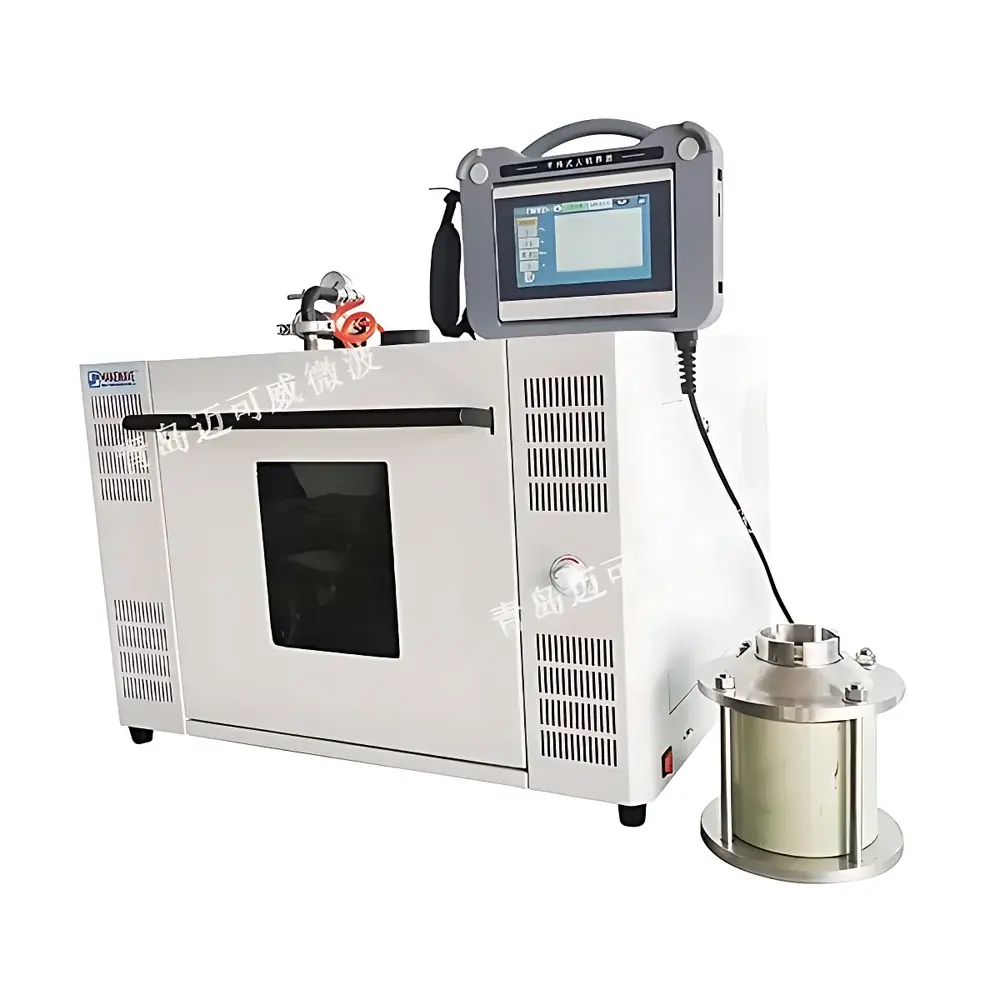
MakeWave MKX-H2G1A 40L High-Pressure Microwave Hydrothermal Synthesis System
| Brand | MakeWave |
|---|---|
| Origin | Shandong, China |
| Manufacturer Type | Direct Manufacturer |
| Country of Origin | China |
| Model | MKX-H2G1A |
| Price Range | USD 14,000 – 28,000 (FOB) |
| Temperature Range | 0–220 °C |
| Temperature Control Accuracy | ±0.1 °C |
| Reaction Volume | 40 L (cavity capacity) |
| Microwave Frequency | 2450 MHz |
| Rated Microwave Power | 1600 W (continuous, non-pulsed output) |
| Safety Leakage | <5 mW/cm² |
| Power Supply | 220 V AC / 50 Hz |
| Total Power Consumption | 3000 W |
| Net Weight | 80 kg |
| Dimensions (W×H×D) | 782 × 610 × 523 mm |
Overview
The MakeWave MKX-H2G1A is a high-capacity, fully enclosed microwave hydrothermal synthesis system engineered for reproducible, scalable materials synthesis under controlled high-temperature and high-pressure aqueous conditions. It integrates monomode-like microwave energy delivery with a robust 40 L stainless-steel reaction cavity to enable uniform volumetric heating of sealed reaction vessels—leveraging the dielectric loss properties of water and polar precursors to rapidly generate supercritical or near-critical hydrothermal environments. Unlike conventional conductive heating methods, microwave irradiation induces rapid, bulk thermal activation throughout the reaction medium, minimizing thermal gradients and enabling kinetic acceleration of nucleation, crystal growth, and phase transformation processes. This system is designed for research-scale synthesis of functional nanomaterials—including metal oxides, perovskites, MOFs, and doped ceramics—where precise control over crystallinity, particle size distribution, and stoichiometric fidelity is required.
Key Features
- 40 L industrial-grade microwave cavity constructed from seamless 304 stainless steel with multi-layer PTFE interior coating for corrosion resistance in acidic, alkaline, and high-temperature aqueous environments.
- Continuous, non-pulsed 2450 MHz microwave generation with 1600 W rated output power, ensuring stable energy delivery across extended synthesis cycles.
- Integrated fiber-optic temperature sensing with direct insertion into reaction vessels (0–220 °C range; ±0.1 °C accuracy) and real-time pressure monitoring compatible with 1000 mL Teflon-lined autoclaves.
- Programmable magnetic stirring (PTFE-coated stir bar, variable speed) for homogeneous mass transfer and suspension stability during hydrothermal crystallization.
- PLC-based control architecture with 7-inch touchscreen HMI, supporting multi-step ramp-hold programs, real-time graphical display of temperature/pressure/microwave power profiles, and USB-exportable CSV data logs.
- Dual-safety interlock door mechanism featuring λ/4 choke suppression, elastic pressure-relief translation, and automatic microwave cutoff upon door actuation—validated to meet IEC 61000-3-2 and GB 4706.21 safety standards.
Sample Compatibility & Compliance
The MKX-H2G1A accommodates standard and custom-designed sealed hydrothermal vessels (e.g., Teflon-lined stainless-steel autoclaves up to 1000 mL), as well as optional parallel reaction modules (e.g., MKX-H2G10A 10-position configuration). Its design conforms to ISO 9001:2015 quality management requirements and incorporates engineering safeguards aligned with GLP-compliant laboratory practice. While not FDA-registered, the system’s closed-loop control architecture, audit-trail-capable data logging (via optional timestamped export), and traceable parameter recording support documentation needs for internal process validation and regulatory pre-submission studies. All materials contacting the reaction zone comply with USP Class VI biocompatibility standards for fluoropolymer components.
Software & Data Management
The embedded control firmware provides deterministic sequence execution with up to 20 programmable steps per protocol, including temperature ramp rates (0.1–20 °C/min), dwell durations (1 min–99 h), and dynamic power modulation. Real-time curves for temperature, pressure, and microwave output are rendered on the HMI and stored locally with time-stamped metadata. Data export via USB flash drive yields comma-separated values (CSV) files compatible with MATLAB, OriginLab, and Python pandas workflows. Optional Ethernet connectivity enables remote status polling and alarm notification via Modbus TCP—facilitating integration into centralized lab automation infrastructures compliant with ISA-88/ISA-95 frameworks.
Applications
This system is routinely deployed in academic and industrial R&D laboratories for: synthesis of transition-metal oxide nanoparticles (e.g., TiO₂ anatase, Fe₃O₄ spinel); hydrothermal growth of layered double hydroxides (LDHs); preparation of zeolitic imidazolate frameworks (ZIFs); low-temperature crystallization of lithium-ion battery cathode precursors (e.g., NMC, LFP); and dopant-controlled synthesis of luminescent phosphors (e.g., YAG:Ce³⁺). Its ability to sustain subcritical-to-supercritical water conditions (up to 220 °C at ~20 bar estimated vapor pressure) enables access to reaction pathways inaccessible via reflux or solvothermal routes—particularly for metastable phase stabilization and defect-engineered lattice formation.
FAQ
What types of reaction vessels are compatible with the MKX-H2G1A?
Standard 1000 mL Teflon-lined stainless-steel autoclaves are supported; custom vessel geometries (e.g., cylindrical, conical) with microwave-transparent walls and integrated fiber-optic ports can be validated upon request.
Is the system suitable for corrosive reagents such as HF or concentrated HNO₃?
The cavity’s multi-layer PTFE coating provides broad chemical resistance; however, prolonged exposure to anhydrous HF or fuming nitric acid requires prior consultation with MakeWave engineering for material compatibility verification.
Can the system operate under inert or reducing atmospheres?
Yes—optional gas inlet/outlet ports allow purging with N₂, Ar, or H₂ prior to sealing; vacuum-assisted degassing (down to 10 mbar) is supported via integrated negative-pressure exhaust.
Does the controller support compliance with 21 CFR Part 11?
The base system provides electronic records but lacks built-in user authentication, electronic signatures, or audit trail archiving; these capabilities may be implemented via third-party LIMS integration or custom firmware upgrade.
What maintenance is required for long-term operational reliability?
Recommended quarterly inspection includes cavity coating integrity check, waveguide seal verification, stir motor calibration, and fiber-optic sensor recalibration using NIST-traceable reference standards.



