
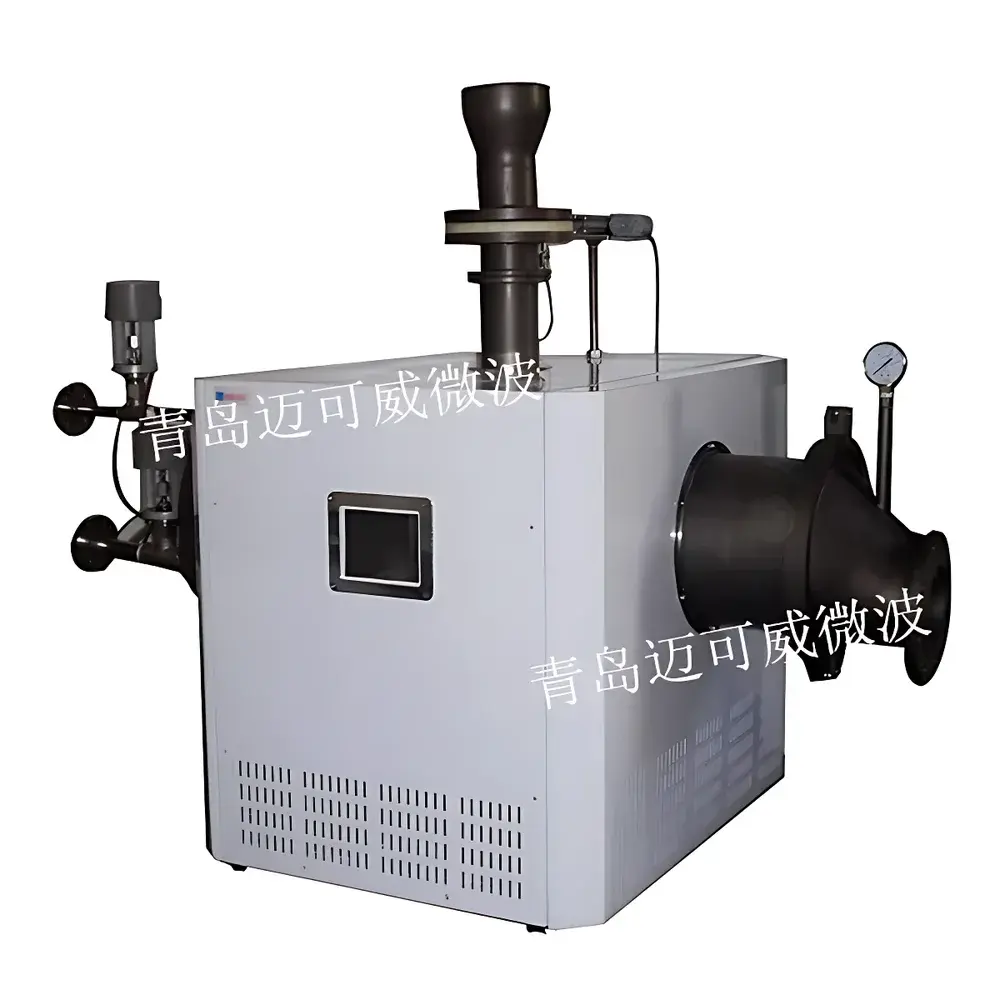
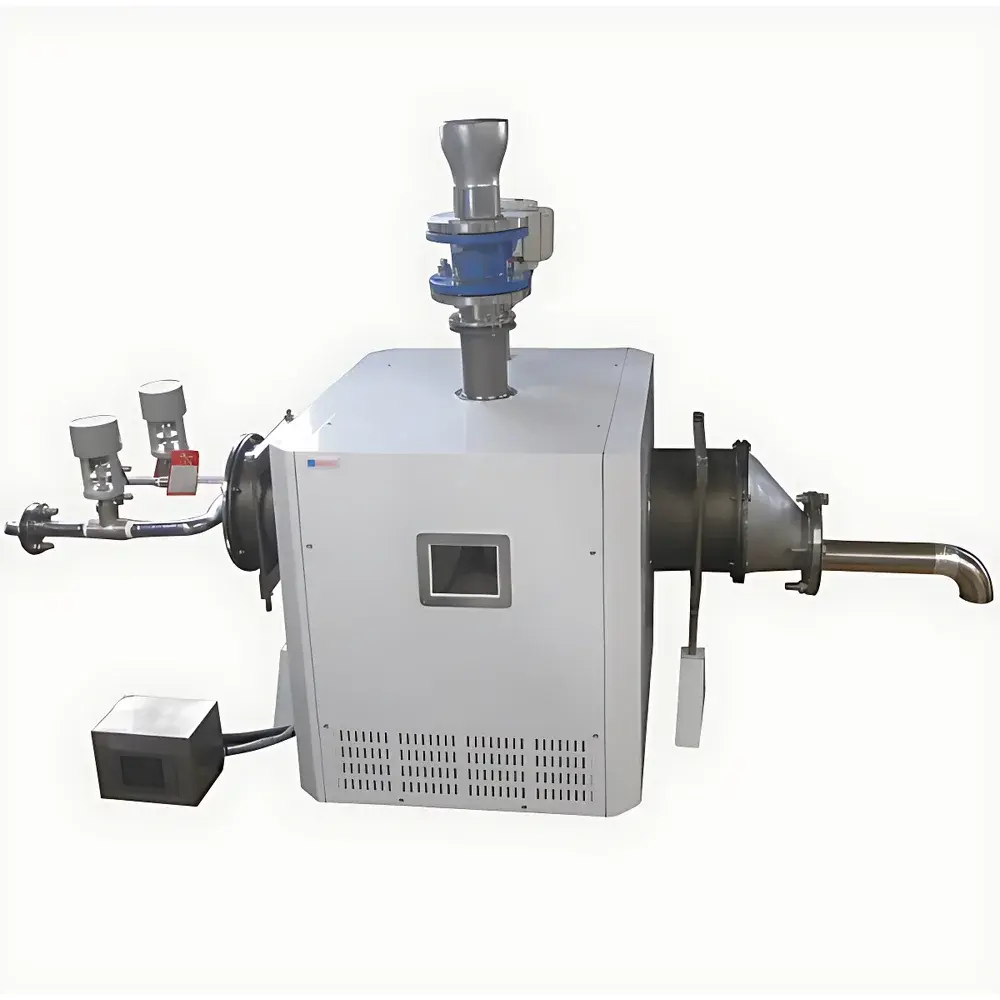
Makewave MKG-M5TB Microwave Tube-Type Atmosphere Expansion & Reduction Furnace
| Brand | Makewave |
|---|---|
| Origin | Shandong, China |
| Manufacturer Type | Direct Manufacturer |
| Country of Origin | China |
| Model | MKG-M5TB |
| Chamber Volume | Small-scale |
| Construction Material | Stainless Steel |
| Operating Pressure | Low-pressure |
| Capacity | 1 m³ |
| Vacuum Level | –0.098 Pa |
| Microwave Frequency | 2450 MHz |
| Microwave Power Output | 4 kW |
| Input Power Requirement | 3-phase, 380 V ±5%, 50 Hz |
| Total Electrical Load | ≥7.5 kVA |
| Internal Cavity Dimensions | 400 × 400 × 400 mm (W × H × D) |
| Borosilicate Glass Tube Dimensions | Horizontal section — 700 mm length × 230 mm OD |
| Microwave Leakage | <5 mW/cm² (per GB 10436-2008 / IEC 62233) |
Overview
The Makewave MKG-M5TB Microwave Tube-Type Atmosphere Expansion & Reduction Furnace is an engineered high-temperature processing system designed for controlled thermal treatment of solid materials under dynamic gas atmospheres. It integrates microwave energy coupling with continuous-flow tubular reactor architecture to enable rapid, volumetric, and selective heating—distinct from conventional conductive or radiant furnaces. The system operates on the principle of dielectric heating, where polarizable materials (e.g., carbon-based precursors, metal oxides, or catalyst supports) absorb 2450 MHz microwave radiation, inducing molecular rotation and interfacial polarization that result in efficient internal heat generation. This mechanism facilitates uniform thermal profiles across particulate or granular feedstocks, minimizes thermal gradients, and reduces process time by up to 70% compared to resistive heating equivalents. The furnace is configured for low-pressure operation (down to –0.098 Pa) and compatible with inert (N₂, Ar), reducing (H₂, CO), or oxidizing (air, O₂) atmospheres—making it suitable for applications including graphene exfoliation, metal oxide reduction, catalyst activation, and thermal decomposition under programmable gas flow regimes.
Key Features
- Modular tubular reactor core built around a triple-port borosilicate glass tube (ASTM E438 Type I, Class A), offering optical transparency for real-time visual monitoring and chemical inertness toward acidic/alkaline vapors at elevated temperatures.
- 4 kW magnetron-based microwave source with linear, stepless power regulation (0–100% full scale) via PLC-integrated solid-state controller—ensuring reproducible energy delivery across multi-stage thermal profiles.
- Hermetic gas-handling architecture featuring waveguide-terminated flanged joints, solenoid-controlled pneumatic valves, and integrated vacuum-pumping interface for precise atmosphere control and leak-tight operation (<1 × 10⁻³ mbar·L/s He leak rate).
- Automated material feeding system with load-cell-based dosing hopper, gravity-assisted transport through quartz-lined stainless steel piping, and manual retractable scraper assembly for post-run residue removal without disassembly.
- Robust safety design compliant with IEC 61000-4-3 (EMC immunity) and GB 10436-2008 (microwave leakage limits); includes interlocked observation window with RF-shielded tempered glass, forced-air magnetron cooling, and transformer self-cooling.
- PLC-driven automation platform supporting up to 99 programmable segments for time–power–temperature–gas flow coordination, with hardware-level emergency shutdown triggered by door opening, overtemperature, or pressure deviation.
Sample Compatibility & Compliance
The MKG-M5TB accommodates powdered, granular, or pelletized solids with particle sizes ranging from submicron to 5 mm diameter—including graphite derivatives, transition metal oxides, rare-earth phosphors, and ceramic precursors. Its borosilicate reaction tube maintains structural integrity up to 500 °C under flowing gas, while optional quartz liner upgrades extend operational limits to 900 °C. The system meets mechanical and electrical safety requirements per GB/T 19001–2016 (ISO 9001), electromagnetic compatibility per GB/T 17626 series, and occupational exposure limits defined in ICNIRP 2020 guidelines. For regulated environments, audit-ready data logging supports GLP-compliant workflows when paired with optional 21 CFR Part 11–enabled software modules.
Software & Data Management
Control firmware runs on a Siemens S7-1200 PLC with integrated HMI touchscreen interface (7″ TFT, IP65-rated). All process parameters—including microwave power setpoint, chamber temperature (via K-type thermocouple input), inlet gas flow rate (mass flow controller feedback), and vacuum level (capacitance manometer signal)—are timestamped and stored locally with 16-bit resolution. Export formats include CSV and XML for traceable batch reporting. Optional Ethernet/IP or Modbus TCP connectivity enables integration into centralized laboratory information management systems (LIMS) or MES platforms. Firmware supports user-defined alarm thresholds, automatic calibration reminders, and event-triggered snapshot capture for root-cause analysis during process deviations.
Applications
- Graphene synthesis via rapid microwave-induced expansion of graphite oxide under reducing atmospheres (e.g., H₂/N₂ mixtures at 300–500 °C).
- Thermal reduction of metal oxides (e.g., CuO → Cu, NiO → Ni) for catalytic nanoparticle production.
- Controlled pyrolysis of biomass or polymer precursors under inert sweep gas for tailored carbon morphology development.
- Low-temperature ashing of coal, coke, or metallurgical slags for elemental analysis sample preparation (ASTM D3174, ISO 1171).
- In-situ activation of supported catalysts (e.g., Pt/Al₂O₃, Pd/C) via sequential oxidation–reduction cycles within a single reactor pass.
- High-purity sintering of functional ceramics (e.g., BaTiO₃, ZnO) with minimized grain growth due to shortened dwell times.
FAQ
What types of atmospheres can be used with the MKG-M5TB?
Nitrogen, argon, hydrogen, carbon monoxide, air, oxygen, and custom gas mixtures are supported via externally plumbed mass flow controllers and pressure-regulated supply lines.
Is the glass tube replaceable, and what is its maximum service temperature?
Yes—the ASTM E438 Type I borosilicate tube is field-replaceable and rated for continuous use up to 500 °C; quartz liners are available as accessories for operations up to 900 °C.
How is microwave safety ensured during operation?
All waveguide apertures incorporate choke-flanged cutoff filters; the door interlock disables magnetron output within 10 ms of actuation; leakage is routinely verified using NIST-traceable handheld survey meters calibrated per IEC 62233.
Can the system operate under vacuum and controlled gas flow simultaneously?
Yes—the vacuum pump interface and gas inlet ports are independently valved and monitored, enabling simultaneous partial vacuum maintenance and laminar gas sweep at adjustable flow rates (0.1–5 L/min typical range).
What maintenance intervals are recommended for the magnetron and cooling system?
Magnetron lifetime exceeds 5,000 operating hours under nominal load; annual inspection of fan filters and thermal paste on the high-voltage transformer is advised per preventive maintenance schedule included in the technical manual.



