
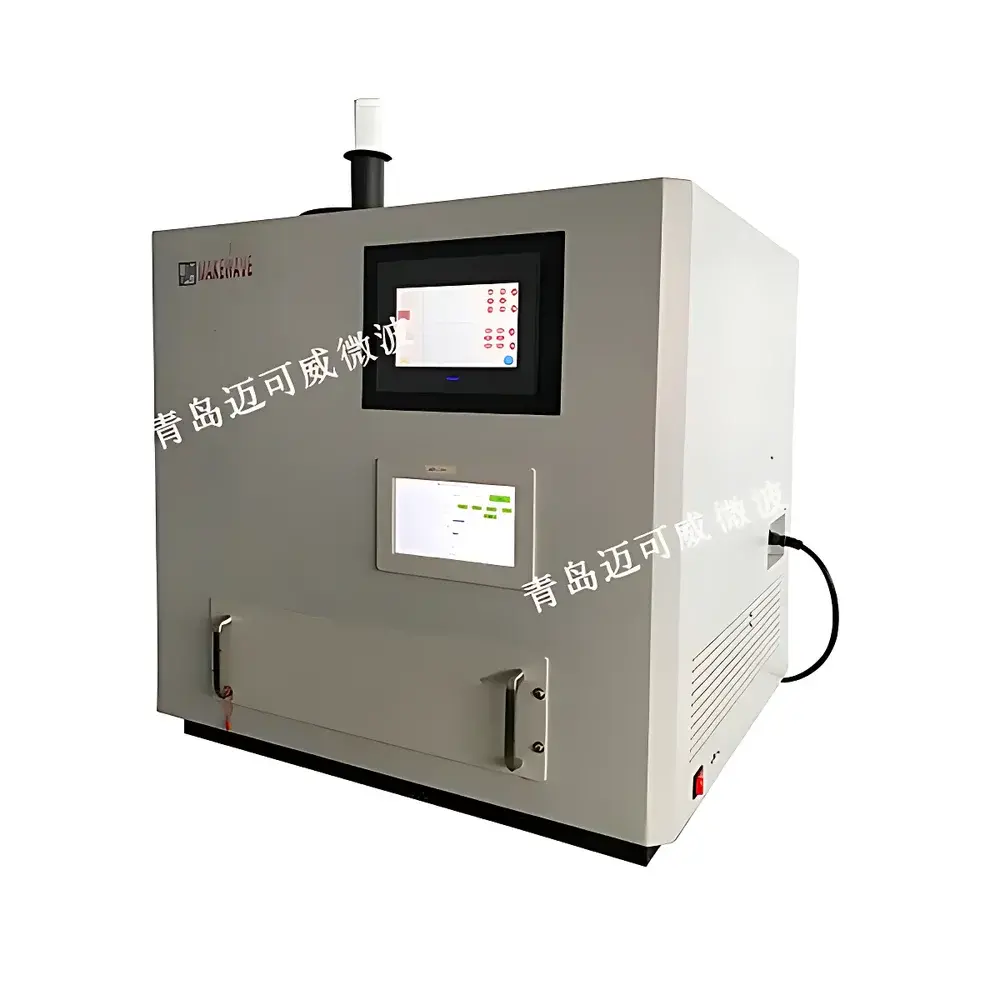
MakeWave MKM-CH1GA Solid-State Single-Mode Microwave Chemical Synthesizer
| Brand | MakeWave |
|---|---|
| Origin | Shandong, China |
| Manufacturer Type | Direct Manufacturer |
| Country of Origin | China |
| Model | MKM-CH1GA |
| Price Range | USD 14,000–28,000 (FOB) |
| Temperature Range | 0–500 °C |
| Temperature Control Accuracy | ±0.1 °C |
| Reaction Units | 1 |
| Maximum Reaction Volume | 1 L |
| Microwave Source | Solid-State, 0–1000 W at 2450 MHz |
| VSWR | ≤5 |
| Cavity Material | Welded Stainless Steel, Positive-Pressure Sealed, Top-Opening Design |
| Cavity Volume | 1 L Annular Single-Mode Chamber with PTFE Coating |
| Reaction Vessels | Helical Tubing (PTFE or Borosilicate Glass) |
| Temperature Sensing | Radial Infrared (0–500 °C), Axial Fiber-Optic (0–300 °C, Optional) |
| Control System | PLC-Based Intelligent Controller with Color Touchscreen |
| Data Logging | Real-Time Temperature/Power Curves, Multi-Protocol Memory, USB Export |
| Atmosphere Control | Inlet/Outlet Gas Ports for Inert, Reducing, or Oxidizing Environments |
| Dimensions (W×D×H) | 615 × 450 × 500 mm |
Overview
The MakeWave MKM-CH1GA Solid-State Single-Mode Microwave Chemical Synthesizer is an engineered platform for precision-controlled, reproducible microwave-assisted synthesis under rigorously defined thermal and electromagnetic conditions. Unlike conventional multimode reactors, the MKM-CH1GA employs a resonant annular single-mode cavity operating at 2450 MHz, enabling spatially uniform electric field distribution and deterministic energy coupling into reaction media. This architecture supports consistent volumetric heating profiles—critical for kinetic studies, catalyst screening, and scale-up pathway development. The system integrates a solid-state microwave generator (0–1000 W), eliminating magnetron drift and enabling microsecond-level power modulation. Designed for operation up to 500 °C with ±0.1 °C thermal stability, it serves as a laboratory-grade instrument for method development in synthetic organic chemistry, inorganic material synthesis, pharmaceutical process chemistry, and environmental catalysis.
Key Features
- Single-Mode Resonant Cavity: 1 L annular stainless steel cavity with PTFE-coated interior, optimized for fundamental TE011-like mode propagation; ensures high electric field homogeneity and minimal standing wave distortion.
- Dual-Mode Temperature Monitoring: Radial non-contact infrared pyrometry (0–500 °C) combined with optional axial fiber-optic probe (0–300 °C) enables cross-validated thermal measurement—essential for exothermic reactions and heterogeneous systems.
- Solid-State Microwave Source: Fully solid-state RF amplifier architecture delivers stable output power with <1% amplitude variation over time, supporting repeatable reaction kinetics and compliant data acquisition per GLP/GMP-aligned workflows.
- Atmosphere-Controllable Environment: Integrated gas inlet/outlet ports support continuous purging, static inert blanketing (N2, Ar), or reactive gas introduction (O2, H2, NH3)—enabling gas–solid, gas–liquid, and vapor-phase synthesis protocols.
- Modular Reaction Vessel Interface: Accommodates helical coiled tubing (PTFE or borosilicate glass) for continuous-flow chemistry, as well as standard batch vessels; top-opening design permits rapid vessel exchange without cavity realignment.
- Regulatory-Ready Control Architecture: PLC-based controller with color touchscreen interface provides audit-trail-capable logging (timestamped temperature, forward/reflected power, VSWR, gas flow status), exportable via USB in CSV format for traceability and FDA 21 CFR Part 11–compatible documentation.
Sample Compatibility & Compliance
The MKM-CH1GA accommodates a broad range of sample types—including viscous organometallic mixtures, aqueous nanoparticle dispersions, solid-supported reagents, and heterogeneous catalytic slurries—within its 1 L single-mode volume. Reaction vessels are chemically inert (PTFE or Class A borosilicate glass), rated for pressures up to 10 bar (optional pressure-rated lid available). The system complies with IEC 61000-6-3 (EMC emission limits) and IEC 61000-6-4 (industrial immunity), and meets CE marking requirements for laboratory equipment. Its sealed, micro-positive-pressure cavity design satisfies ISO 14644-1 Class 8 cleanroom compatibility when operated in controlled environments. For regulated laboratories, the data logging framework supports ALCOA+ principles (Attributable, Legible, Contemporaneous, Original, Accurate, Complete, Consistent, Enduring, Available) and aligns with USP Analytical Instrument Qualification guidelines.
Software & Data Management
The embedded control firmware implements real-time closed-loop temperature regulation using PID algorithms with adaptive gain scheduling. All operational parameters—including setpoint, actual temperature, forward/reflected power, VSWR, gas flow rate (when interfaced with mass flow controllers), and elapsed time—are logged at user-selectable intervals (100 ms to 10 s resolution). Up to 99 independent synthesis protocols can be stored onboard, each with multi-segment ramp-hold-cool profiles. Data export is supported via USB 2.0 to FAT32-formatted drives; exported files include metadata headers (operator ID, timestamp, protocol name, hardware serial number) and are structured for direct import into MATLAB, Python (pandas), or LIMS platforms. No cloud connectivity or proprietary software installation is required—ensuring data sovereignty and IT infrastructure compatibility.
Applications
- Synthetic methodology development for C–C/C–heteroatom bond formation under controlled microwave irradiation
- Rapid screening of homogeneous and heterogeneous catalysts (e.g., Pd/C, Ni nanoparticles, MOFs) in hydrogenation, oxidation, and cross-coupling reactions
- Preparation of metal oxide nanomaterials (TiO2, ZnO, Fe3O4) via solvothermal microwave routes
- Green chemistry process intensification—reducing solvent volumes and reaction times while improving selectivity
- Pharmaceutical intermediate synthesis under nitrogen or argon, with strict moisture/oxygen exclusion
- Environmental remediation studies involving microwave-enhanced Fenton-like degradation of persistent organic pollutants
FAQ
What distinguishes single-mode from multimode microwave synthesis?
Single-mode cavities produce a defined electromagnetic standing wave pattern with high field intensity at specific locations, enabling precise energy localization and predictable heating kinetics—ideal for mechanistic studies and reproducible small-scale synthesis.
Can the MKM-CH1GA be used for continuous-flow chemistry?
Yes—the system supports helical coil reactors (PTFE or glass) mounted internally, with integrated feed and outlet ports compatible with standard HPLC pumps and back-pressure regulators.
Is fiber-optic temperature sensing mandatory for all applications?
No—it is optional and recommended only for opaque or highly absorbing media where infrared measurement may be attenuated; radial IR remains the primary calibrated sensor for transparent and semi-transparent reaction mixtures.
Does the system meet regulatory requirements for GMP environments?
While not certified as GMP-compliant “out-of-the-box,” its audit-trail logging, electronic signature-ready interface (via external authentication), and configurable user access levels enable qualification per Annex 11 and 21 CFR Part 11 when deployed within validated laboratory workflows.
What maintenance is required for the solid-state microwave source?
The solid-state RF amplifier requires no periodic replacement or tuning; routine maintenance is limited to cavity cleaning and O-ring inspection—no magnetron conditioning or waveguide desiccation is necessary.



