
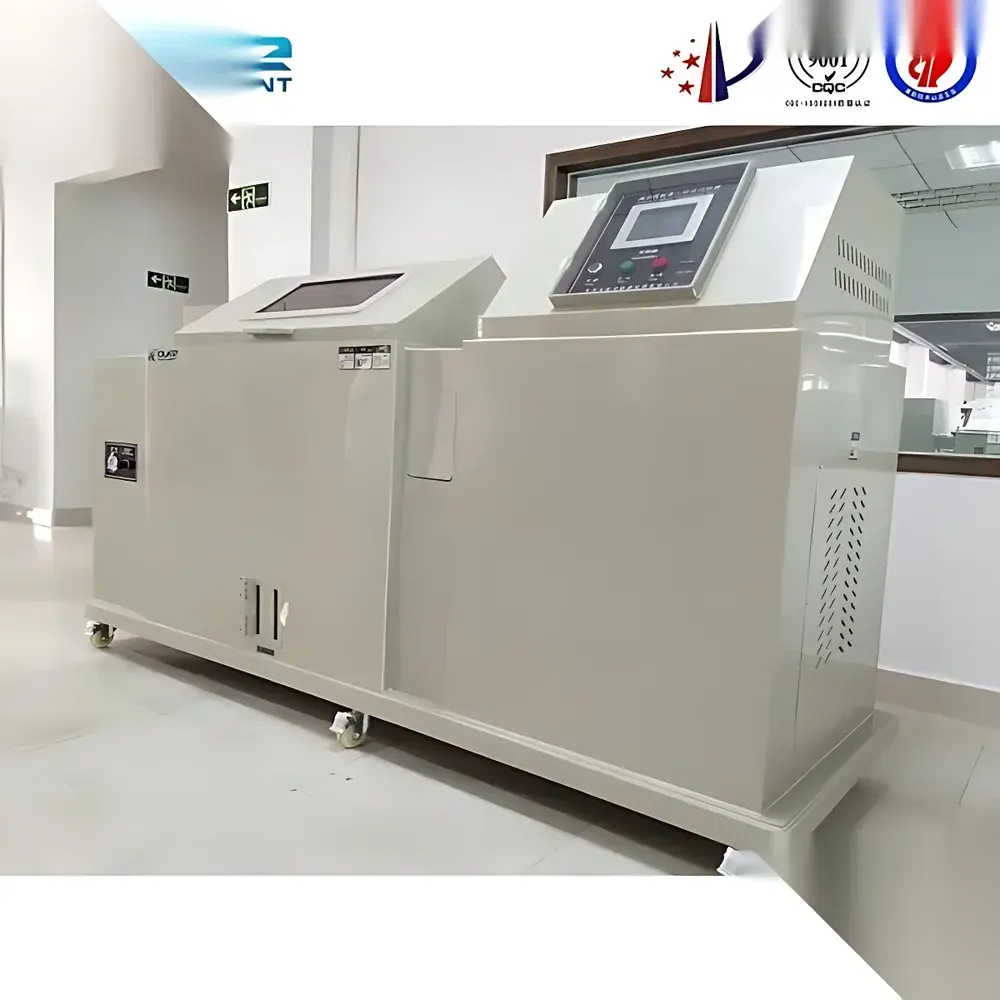
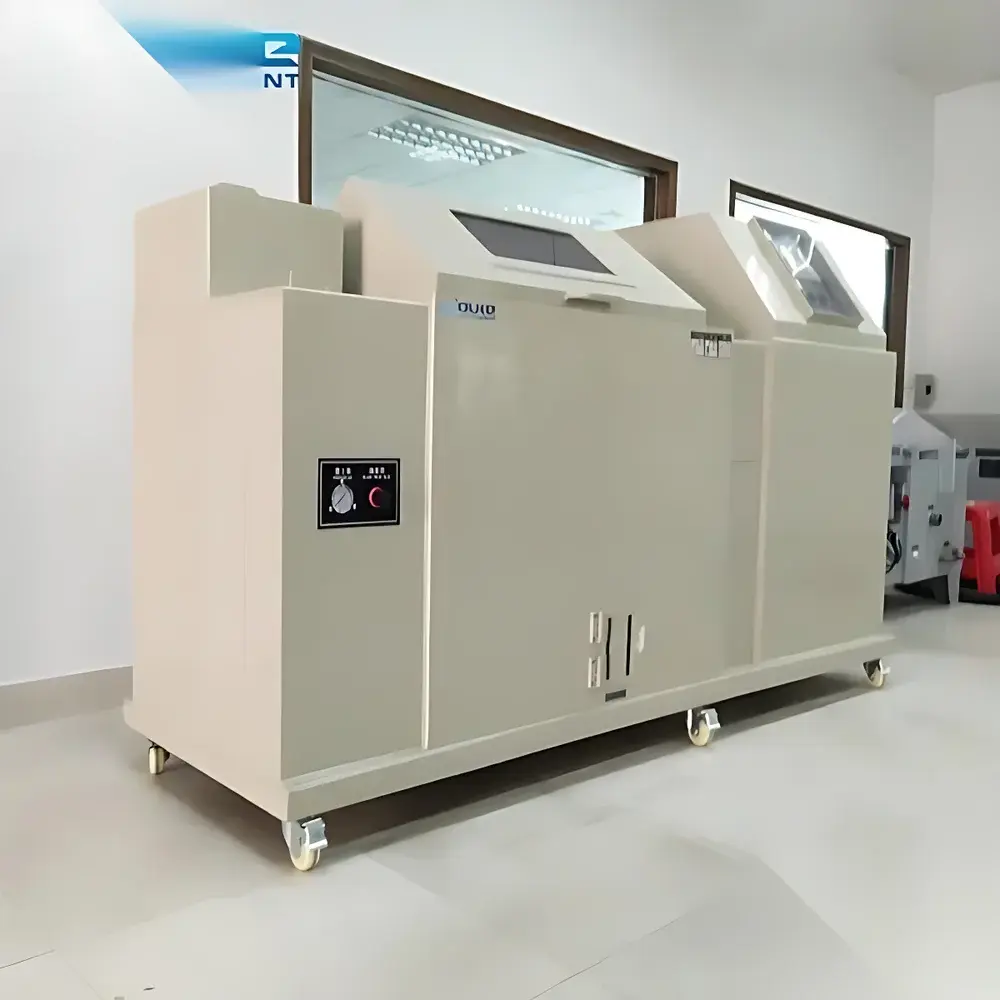
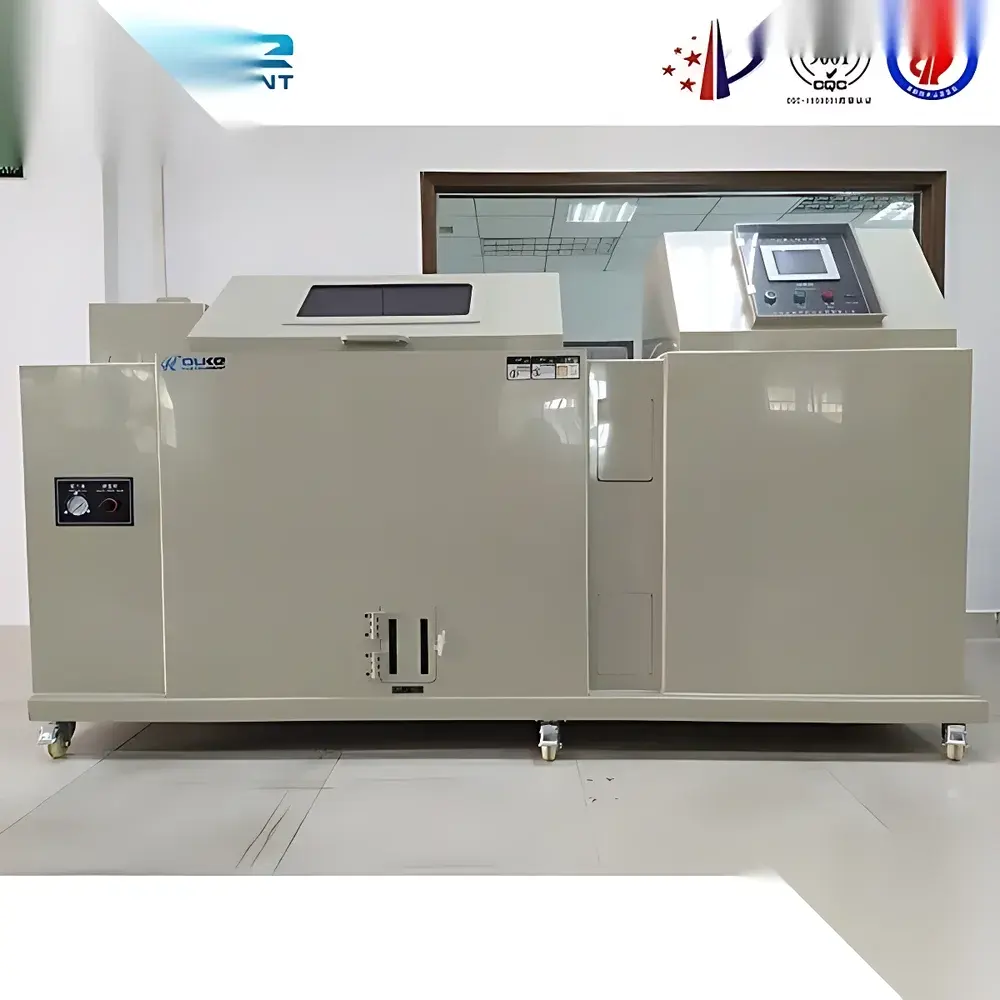
OK-FH-60 Multi-Environmental Corrosion Test Chamber
| Brand | Other brands |
|---|---|
| Origin | Imported |
| Manufacturer Type | Authorized Distributor |
| Chamber Internal Dimensions (W×D×H) | 900 × 600 × 500 mm |
| External Dimensions (W×D×H) | 1420 × 780 × 1280 mm |
| Salt Spray Modes | NSS (ASTM B117), ACSS, CASS (ISO 9227) |
| Test Chamber Temp. Range | 35 ±1 °C (NSS/ACSS), 50 ±1 °C (CASS) |
| Saturated Air Tank Temp. | 47 ±1 °C (NSS/ACSS), 63 ±1 °C (CASS) |
| Air Supply Pressure | 1 kgf/cm² (two-stage regulation) |
| Safety Systems | Low-water cutoff, overtemperature shutdown, low-salt solution alarm, visual/audible warning indicators |
Overview
The OK-FH-60 Multi-Environmental Corrosion Test Chamber is an integrated environmental simulation system engineered for standardized accelerated corrosion testing of coated and treated metallic substrates. It combines precise temperature and humidity control with regulated salt fog generation to replicate aggressive atmospheric exposure conditions—enabling evaluation of protective layer integrity, coating adhesion, and long-term corrosion resistance in accordance with internationally recognized test protocols. The chamber operates on the principle of continuous or cyclic salt spray exposure under controlled thermal and humidification conditions, where corrosion mechanisms—including electrochemical dissolution, chloride-induced pitting, and galvanic degradation—are accelerated through elevated ion concentration, temperature, and relative humidity. Designed for compliance-driven quality assurance laboratories, R&D centers, and third-party testing facilities, the OK-FH-60 supports both static and dynamic environmental profiles required by ASTM B117, ISO 9227 (NSS, ACSS, CASS), JIS Z2371, and GB/T 2423.17.
Key Features
- Triple-mode salt spray capability: Supports Neutral Salt Spray (NSS), Acetic Acid Salt Spray (ACSS), and Copper-Accelerated Acetic Acid Salt Spray (CASS) per ISO 9227 specifications.
- Dual-zone thermal management: Independent precision control of test chamber (±1 °C) and saturated air tank (±1 °C), ensuring consistent fog droplet size distribution and deposition rate.
- Robust stainless steel construction: Inner chamber fabricated from SUS316L stainless steel; exterior housing in powder-coated mild steel for structural durability and chemical resistance.
- Two-stage air pressure regulation system: Enables stable, pulsation-free compressed air supply at 1 kgf/cm² (≈98 kPa), critical for uniform atomization and reproducible salt fog density (1.0–2.0 mL/80 cm²/h).
- Integrated safety architecture: Includes automatic power cutoff upon low water level detection in the saturator, thermal cutout at preset overtemperature thresholds, real-time low-salt-solution alerting, and dual-mode (visual + audible) warning interface.
- Modular nozzle array with adjustable angle: Facilitates uniform fog distribution across the full test volume without dead zones, validated via ASTM B117 collection plate methodology.
Sample Compatibility & Compliance
The OK-FH-60 accommodates a broad range of specimen geometries and surface treatments, including electroplated zinc/nickel/chromium layers, powder-coated aluminum alloys, anodized magnesium components, passivated stainless steels, and organic conversion coatings (e.g., chromate, phosphate). Specimens up to 450 mm in height can be mounted on standardized non-metallic racks or suspended using inert polymer hooks. All operational parameters are traceable to NIST-traceable reference instruments and support audit-ready documentation for GLP and GMP environments. The system meets mechanical and electrical safety requirements per IEC 61000-6-2 (EMC immunity) and IEC 61010-1 (laboratory equipment safety), and its test outputs are accepted for regulatory submissions under FDA 21 CFR Part 11 when paired with compliant data logging software.
Software & Data Management
While the base configuration features manual setpoint control via digital PID controllers, optional RS-485/Modbus RTU or Ethernet/IP interfaces enable integration with centralized laboratory information management systems (LIMS) or SCADA platforms. Real-time monitoring of chamber temperature, saturator temperature, and cycle status is supported via external data loggers compliant with ISO/IEC 17025 calibration requirements. Audit trails—including operator ID, parameter changes, alarm events, and runtime logs—can be exported in CSV or PDF format for internal review or external accreditation audits (e.g., ISO/IEC 17025, A2LA).
Applications
- Validation of automotive fasteners, brake calipers, and chassis components subjected to coastal or de-icing salt exposure.
- Qualification of aerospace aluminum alloys with chromic acid anodizing (CAA) or trivalent chromium passivation (TCP).
- Comparative assessment of alternative corrosion inhibitors in water-based pretreatment formulations.
- Failure analysis of field-failed coated parts by correlating lab-accelerated damage morphology (e.g., blistering, red rust, white corrosion) with service history.
- Supplier qualification testing for Tier-1 OEMs requiring evidence of ≥96 h CASS performance prior to series production release.
FAQ
Does the OK-FH-60 include an integrated air compressor?
No—the unit requires an externally supplied clean, oil-free compressed air source delivering 1 kgf/cm² at ≥100 L/min flow rate, as specified in ASTM B117 Annex A1.
What calibration standards are recommended for routine verification?
Users should perform daily fog collection checks using ASTM B117-certified funnels and graduated cylinders; annual thermocouple calibration against NIST-traceable references is advised.
Can the chamber operate unattended for extended cycles?
Yes—its redundant safety interlocks and self-diagnostic alerts allow for 72+ hour continuous operation when configured with uninterrupted power supply (UPS) and remote monitoring.
Is CASS testing compatible with all sample materials?
CASS is not recommended for cadmium-plated or zinc-nickel alloy substrates due to excessive etching; consult ISO 9227 Clause 6.3 for material-specific applicability guidance.
How is salt solution concentration verified during testing?
Conductivity measurement (23 ± 2 °C) must confirm 49.5–50.5 g/L NaCl for NSS, or 50.0 g/L NaCl + 0.26 g/L CuCl₂·2H₂O for CASS, per ISO 9227 Section 5.2.
Related Products



