
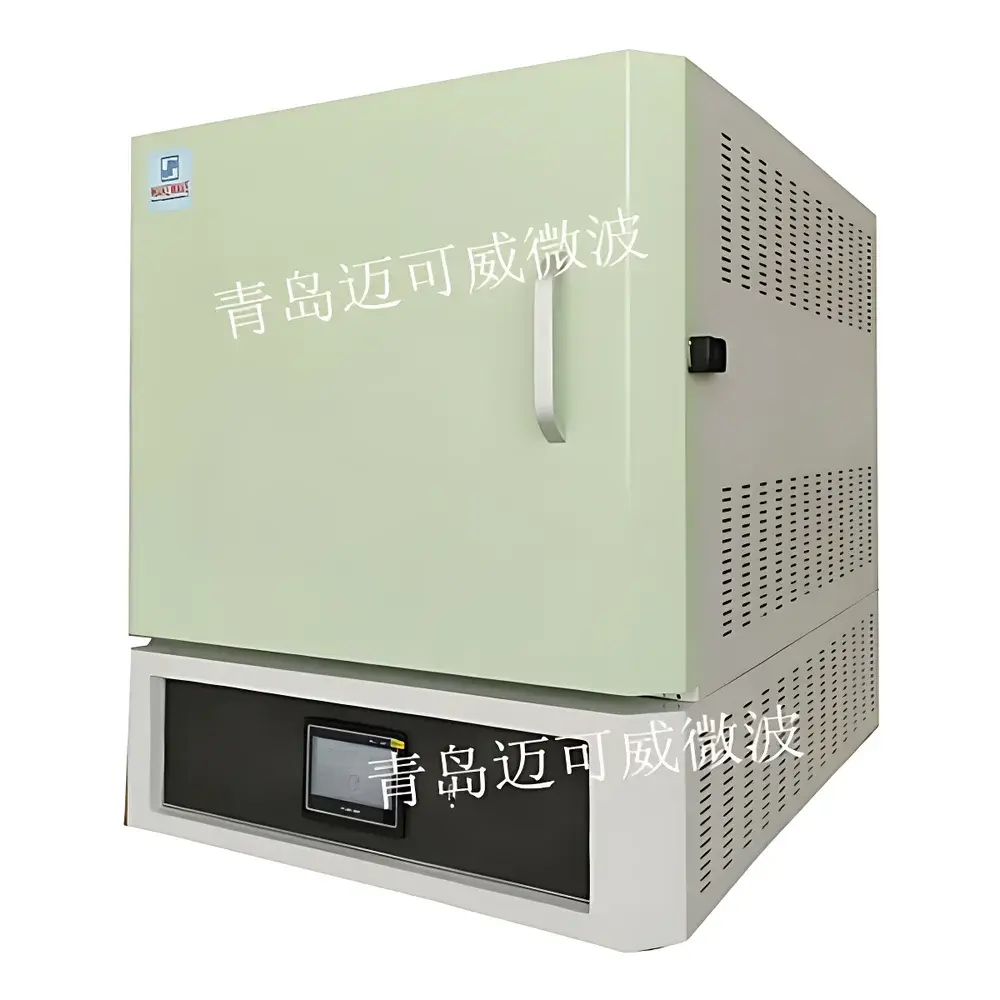
MakeWave MW-3 Large-Volume Biological & Environmental Sample Carbonization and Ashing Furnace
| Brand | MakeWave |
|---|---|
| Origin | Shandong, China |
| Manufacturer Type | Direct Manufacturer |
| Equipment Category | Domestic |
| Model | MW-3 |
| Instrument Type | Box-Type Muffle Furnace |
| Max Temperature | 0–1000 °C |
| Temperature Control Accuracy | ±1 °C |
| Max Power | 0–10 kW |
| Heating Rate to Max Temp | 40 min |
| Heating Method | Electric Resistance Heating |
| Internal Dimensions | 700 × 860 × 820 mm |
| Chamber Volume | 35 L |
| Temperature Sensor | Dual Platinum-Rhodium Thermocouples (Type S) |
| Airflow System | Multi-Port Uniform-Flow Through-Ventilation |
| Exhaust | Integrated Negative-Pressure Extraction with Adjustable Dampers |
| Control System | PLC-Based Closed-Loop PID Control with Color Touchscreen Interface |
| Safety Features | Interlocked Door Switch, Surface Temp <50 °C, Explosion-Resistant Casing, Corrosion-Resistant Interior Lining |
Overview
The MakeWave MW-3 Large-Volume Biological & Environmental Sample Carbonization and Ashing Furnace is an engineered thermal processing platform designed specifically for the controlled, high-throughput thermal decomposition of complex organic matrices in environmental monitoring, nuclear safety, and regulatory compliance laboratories. Unlike conventional muffle furnaces optimized for small-batch inorganic residue analysis, the MW-3 implements a dual-phase thermal treatment principle—sequential low-oxygen carbonization followed by oxidative ashing—enabling complete volatilization of organic matter while preserving inorganic analytes (e.g., radionuclides, heavy metals, rare earth elements) in stable oxide forms. Its 35 L chamber volume supports single-layer loading of up to two 2 L ceramic crucibles or eight 500 mL units, eliminating the need for batch segmentation and minimizing cross-contamination risk during high-volume sample preparation workflows.
Key Features
- Multi-port uniform-flow through-ventilation system ensures laminar, oxygen-gradient-controlled atmosphere distribution—critical for reproducible carbonization kinetics and suppression of charring or splattering.
- Industrial-grade welded steel outer casing with integrated ceramic fiber insulation delivers structural integrity and thermal stability across extended duty cycles (up to 10 kW continuous operation).
- PLC-based closed-loop PID temperature control with dual platinum-rhodium (Type S) thermocouples enables ±1 °C accuracy across the full 0–1000 °C range; optional 1600 °C configuration available for specialized refractory applications.
- Negative-pressure exhaust manifold with adjustable dampers and inline particulate filtration routes volatile combustion byproducts (e.g., NOx, SO2, halogenated organics) safely away from operator zones—compliant with OSHA 1910.1200 and EU Directive 2004/37/EC.
- Touchscreen HMI supports up to 20 pre-programmed multi-segment thermal profiles, real-time temperature/time curve visualization, and CSV data export for audit-ready documentation.
- Surface temperature remains below 50 °C under full-load operation, satisfying IEC 61000-6-3 electromagnetic compatibility and EN 61000-6-4 safety requirements for laboratory environments.
Sample Compatibility & Compliance
The MW-3 accommodates diverse crucible materials—including high-purity alumina, fused quartz, and nickel-chromium alloys—enabling method flexibility per ASTM D5630 (ash content of plastics), ISO 11885 (determination of elements in water by ICP-OES after ashing), and EPA Method 3050B (acid digestion of sediments and soils). It is routinely deployed in GLP-compliant radiation monitoring labs accredited under ISO/IEC 17025:2017 for ashing of foodstuffs (grains, seafood, leafy vegetables), biological tissues, and filter media prior to gamma spectrometry or alpha/beta counting. The furnace’s negative-pressure exhaust design meets national occupational exposure limits (NIOSH RELs) for airborne particulates and aligns with IAEA Safety Standards Series No. GSG-7 for radioactive waste volume reduction.
Software & Data Management
The embedded PLC controller logs timestamped temperature, power output, and airflow status at 1-second intervals. All thermal profiles are password-protected and support electronic signature authentication per FDA 21 CFR Part 11 requirements. Data export includes calibrated thermocouple readings, ramp/soak durations, and alarm event logs (e.g., door interlock breach, overtemperature fault). Audit trails retain user ID, action timestamp, and parameter modification history—fully traceable for regulatory inspections or internal QA reviews.
Applications
- Routine ashing of >100 g biological samples (e.g., rice, seaweed, bovine liver) for elemental analysis by ICP-MS or AAS.
- Pre-concentration of environmental filters (PM2.5, air sampling media) prior to radiochemical separation of 137Cs, 90Sr, or actinides.
- Thermal stabilization of sludge and sediment samples for loss-on-ignition (LOI) determination per APHA Standard Method 2540E.
- Controlled pyrolysis of polymer-based nuclear waste simulants to assess volume reduction ratios and off-gas composition.
- High-temperature conditioning of reference materials (e.g., NIST SRM 1573a Tomato Leaves) for method validation studies.
FAQ
What crucible types are compatible with the MW-3?
Standard configurations support 2 L ceramic crucibles (Al2O3), 500 mL quartz boats, and Ni-Cr alloy trays; custom fixtures for graphite or zirconia vessels can be engineered upon request.
Does the MW-3 meet GLP or GMP documentation requirements?
Yes—the system provides full electronic audit trail, user-access controls, and 21 CFR Part 11–compliant data export for validated laboratory environments.
Can the MW-3 operate under inert or reducing atmospheres?
While primarily configured for air-based oxidation, optional nitrogen purge ports and gas flow controllers (0–5 L/min) enable controlled inert or weakly reducing conditions for sulfide mineral digestion or carbon residue minimization.
Is service and calibration support available outside China?
MakeWave maintains authorized service partners in Germany, South Korea, and the United States; NIST-traceable thermocouple calibration certificates are supplied with each unit.
How is maintenance access designed for long-term reliability?
Front-access modular heating elements, tool-free ceramic fiber liner replacement, and sealed bearing exhaust fans ensure >15,000 hr MTBF under daily operational use.



