
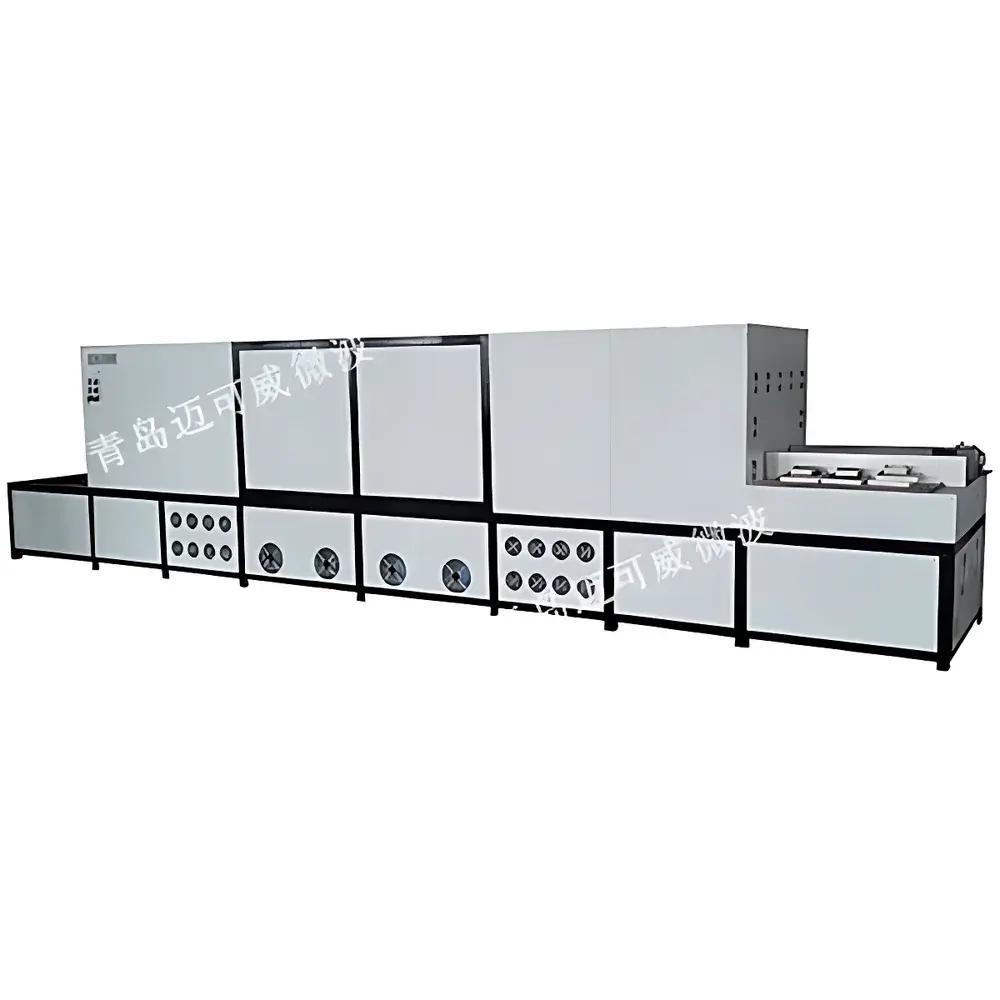
MakeWave MGS-M30 Continuous Microwave High-Temperature Tunnel Kiln
| Brand | MakeWave |
|---|---|
| Origin | Shandong, China |
| Manufacturer Type | Direct Manufacturer |
| Country of Origin | China |
| Model | MGS-M30 |
| Pricing | Upon Request |
Overview
The MakeWave MGS-M30 Continuous Microwave High-Temperature Tunnel Kiln is an industrial-scale thermal processing system engineered for precise, energy-efficient, and atmospherically flexible high-temperature treatment of advanced ceramics, battery cathode materials, catalysts, and functional oxides. Unlike conventional tunnel kilns relying solely on conduction, convection, and radiant heat transfer, the MGS-M30 integrates volumetric microwave heating (2450 MHz) with modular zone-controlled thermal management. It operates on the principle of dielectric loss heating—where electromagnetic energy couples directly with polarizable or conductive components in the material—enabling rapid, uniform, and controllable internal heating without thermal lag. The system adopts a push-boat (push-board) architecture, allowing continuous throughput while maintaining stable temperature profiles across preheating, sintering, and cooling zones. This design bridges the gap between laboratory-scale microwave furnaces and industrial production requirements, supporting scalable process development under ISO/IEC 17025-aligned R&D environments and GLP-compliant manufacturing settings.
Key Features
- Continuous dynamic heating architecture: Replaces static batch-mode microwave muffle furnaces with synchronized material transport through a segmented resonant cavity, enhancing thermal uniformity via statistical exposure to field maxima (“peaks”) and minima (“nulls”).
- Volumetric microwave heating at 30 kW output (2450 MHz), delivered via water-cooled magnetrons and multi-point waveguide feed into a ceramic-lined resonant tunnel—eliminating resistive heating elements and minimizing cross-contamination.
- Atmosphere-flexible sealed cavity: Fully welded 304 stainless steel tunnel housing (720 × 500 mm cross-section) with ceramic structural insulation and dual-stage microwave suppression at inlet/outlet ports (choke flange + lossy absorber segments).
- Zonal thermal control: Three thermally isolated sections—preheat (up to 700 °C), sintering (700–1000 °C; up to 1200 °C intermittent), and forced-air cooling—each with independent microwave power allocation and active airflow recirculation.
- Robust mechanical transport: Hydraulic-driven push-boat mechanism with adjustable stroke frequency and velocity; low-loss ceramic-coated conveyor base; standardized 170 × 170 × 50 mm alumina crucibles (40 units per cycle).
- Integrated safety architecture: Real-time microwave leakage monitoring (<5 mW/cm² per GB 10436), redundant thermal cutoffs per magnetron, surface temperature regulation via forced-air interstitial cooling, and fault-diagnostic PLC alarm logging.
Sample Compatibility & Compliance
The MGS-M30 accommodates powder compacts, green bodies, coated substrates, and granular precursors up to 170 mm wide × 50 mm tall. Its inert, non-reactive cavity enables processing under air, O₂, N₂, Ar, or mildly reducing atmospheres (e.g., 5% H₂/N₂), supporting ASTM C1161 (flexural strength of ceramics), ISO 13384-1 (thermal analysis instrumentation), and USP (residual solvent removal). The absence of combustion byproducts and metallic heater degradation ensures compliance with ISO 14644-1 Class 8 cleanroom-compatible operation for electronic ceramic co-firing and Li-ion cathode synthesis. All electrical and microwave subsystems conform to IEC 61000-6-4 (EMC emission limits) and GB/T 18268.1 (industrial measurement equipment safety).
Software & Data Management
Control is executed via a CE-certified industrial PLC with 10.1″ HMI touchscreen interface. The system supports recipe-based operation with up to 99 programmable thermal-microwave profiles, each defining zone-specific microwave power (0–100% per magnetron), conveyor speed (0.5–15 cm/min), gas flow rates, and dwell times. Temperature data streams from dual-sensor inputs—wide-range infrared pyrometry (500–1400 °C, ±1.0% FS) for real-time surface monitoring of moving samples, and calibrated Type S thermocouples (0–1200 °C, ±0.5 °C) for ambient cavity profiling. All operational parameters, alarms, and sensor logs are timestamped and exportable in CSV format. Optional audit trail module complies with FDA 21 CFR Part 11 requirements for electronic records and signatures in regulated GMP environments.
Applications
- Sintering of oxide ceramics (Al₂O₃, ZrO₂, SiC), including nanostructured and multilayer systems requiring grain growth inhibition.
- Thermal decomposition and calcination of lithium transition metal oxides (NMC, LFP) with minimized Li volatility and improved phase purity.
- Carbothermal reduction of metal oxides (e.g., MoO₃ → Mo, WO₃ → W) under controlled reducing atmospheres.
- Graphitization of carbon precursors and activation of porous carbons for supercapacitor electrodes.
- High-temperature annealing of optical waveguides, piezoelectric thin films, and MEMS packaging substrates where thermal shock resistance is critical.
FAQ
What maximum continuous operating temperature does the sintering zone support?
The sintering zone is rated for continuous operation at 1000 °C, with short-term tolerance up to 1200 °C under nitrogen or argon atmosphere.
Can the system be integrated into an existing factory automation network?
Yes—it supports Modbus TCP and EtherNet/IP protocols for seamless integration with SCADA or MES platforms.
Is remote diagnostics and firmware updates supported?
Standard Ethernet connectivity enables secure remote access via VPN for troubleshooting and version-controlled firmware deployment.
What maintenance intervals are recommended for the magnetron cooling system?
Water-cooling circuit filters require quarterly inspection; deionized coolant replacement is advised every 12 months or per conductivity drift >5 µS/cm.
Does the system meet international electromagnetic compatibility standards?
Yes—certified to IEC 61000-6-3 (immunity) and IEC 61000-6-4 (emissions), with full test reports available upon request.



