
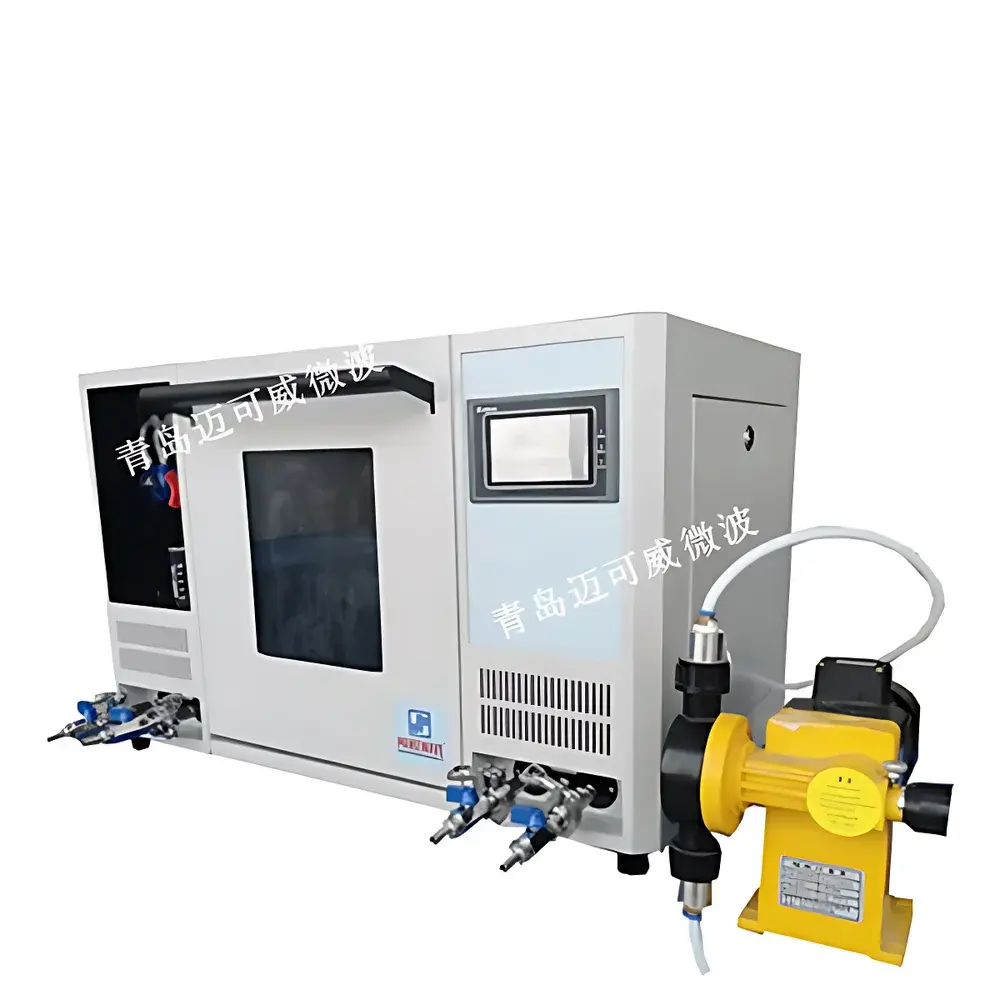
MakeWave MKG-H1C1B Continuous-Flow Microwave Reactor
| Brand | MakeWave |
|---|---|
| Origin | Shandong, China |
| Manufacturer Type | Direct Manufacturer |
| Country of Origin | China |
| Model | MKG-H1C1B |
| Reactor Type | Benchtop Continuous-Flow Microwave Reactor |
| Vessel Capacity | 20 L |
| Construction Material | 316 Stainless Steel |
| Operating Pressure Range | 0–0.5 MPa (optional up to 2 MPa) |
| Vacuum Capability | Up to 2 MPa (gauge, negative pressure) |
| Microwave Power Output | 0–800 W (continuous, non-pulsed, linearly adjustable) |
| Frequency | 2450 ± 50 MHz |
| Reaction Temperature Range | 0–100 °C (optional up to 200 °C) |
| Flow Rate Range | 0–1000 mL/min |
| Tubing Diameter | Φ6 mm (Φ1–Φ10 mm optional) |
| Control System | PLC-based with 7-inch color touchscreen HMI |
| Safety Compliance | Microwave leakage < 5 mW/cm² (per GB 10436 & IEC 61000-3-2), door interlock, pressure/temperature monitoring, forced-air exhaust, overpressure relief |
Overview
The MakeWave MKG-H1C1B Continuous-Flow Microwave Reactor is an engineered benchtop platform for precise, scalable, and reproducible microwave-assisted chemical synthesis under dynamic fluid conditions. Unlike batch-mode microwave reactors, the MKG-H1C1B employs a continuous-flow architecture in which liquid-phase reagents are pumped through a temperature- and pressure-controlled microwave cavity via a chemically resistant coiled reactor path. This design leverages dielectric heating—where polar molecules absorb 2450 MHz microwave energy to generate volumetric, rapid, and uniform thermal excitation—enabling kinetic acceleration of reactions without thermal gradients or hot-spot formation typical of conductive heating. The system is optimized for reaction intensification in organic synthesis, catalytic transformations, nanoparticle synthesis, pharmaceutical intermediate preparation, and extraction processes where residence time control, thermal homogeneity, and scalability are critical. Its 20 L stainless steel cavity accommodates modular tubing configurations while maintaining electromagnetic confinement integrity, making it suitable for method development aligned with Quality-by-Design (QbD) principles and early-stage process validation per ICH guidelines.
Key Features
- Continuous-flow microwave chemistry platform with dual-loop fluid handling: supports both internal recirculation (for residence time extension) and external loop integration (for inline quenching, sampling, or multi-stage cascading)
- Chemically inert reaction pathway: high-purity engineering plastic coil (standard Φ6 mm × 10 m, customizable to Φ1–Φ10 mm; PFA, PTFE, or ETFE options available upon request)
- Precision process control: independent closed-loop regulation of microwave power (0–800 W), temperature (0–100 °C standard, up to 200 °C optional), and system pressure (0–0.5 MPa standard, up to 2 MPa optional)
- Four-port manifold configuration enabling parallel feed, confluence mixing, flow splitting, and serial reactor staging—facilitating combinatorial screening and reaction optimization
- Real-time process visualization: integrated HD color camera with cavity-mounted lens provides direct optical observation of fluid behavior, phase separation, or precipitate formation during operation
- Intelligent PLC-based controller with 7-inch resistive touchscreen interface: supports up to 99 programmable protocols, segmented ramp-hold profiles, automatic temperature compensation algorithms, and live curve plotting (time vs. T, P, W)
- Comprehensive safety architecture: electromechanical door interlock, redundant pressure transducer monitoring, real-time cavity temperature surveillance, microwave choke suppression structure, and active exhaust ventilation maintaining micro-negative cavity pressure
Sample Compatibility & Compliance
The MKG-H1C1B accommodates a broad spectrum of liquid-phase chemistries—including protic and aprotic solvents, aqueous emulsions, acid/base-catalyzed systems, and organometallic precursors—provided compatibility with the selected coil material (e.g., PFA for HF-containing media; ETFE for elevated temperature stability). Its stainless steel cavity with five-layer PTFE coating resists corrosion from HCl, HNO₃, H₂SO₄, and NaOH solutions at elevated temperatures. The system meets ISO 9001:2015 quality management requirements and conforms to national safety standards GB 10436 (microwave leakage limits) and GB/T 19001. While not certified for Class I Div 1 hazardous locations, it is intended for use in non-explosive laboratory environments compliant with NFPA 45 and local chemical hygiene plans. Data logging functionality supports ALCOA+ principles (Attributable, Legible, Contemporaneous, Original, Accurate, Complete, Consistent, Enduring, Available) for GLP/GMP-aligned workflows.
Software & Data Management
The embedded control firmware records timestamped values for temperature, pressure, microwave power, and flow rate at user-defined intervals (1–60 s). All operational data are stored internally and exportable via USB to CSV format for post-processing in MATLAB, Origin, or ChemDraw-compatible platforms. No proprietary software installation is required; raw datasets retain SI-unit metadata and protocol identifiers. Audit trail functionality logs operator ID (via optional RFID badge integration), parameter changes, emergency stops, and system diagnostics—satisfying traceability expectations under FDA 21 CFR Part 11 when paired with institutional electronic signature policies. Remote monitoring is possible via Ethernet-enabled PLC expansion modules (not included standard).
Applications
- Accelerated synthesis of heterocycles, amides, and Suzuki-Miyaura cross-couplings under controlled residence time
- Continuous hydrothermal synthesis of metal oxide nanoparticles (e.g., TiO₂, ZnO) with narrow size distribution
- Extraction of bioactive compounds (polyphenols, alkaloids) from botanical matrices using ethanol/water mixtures
- Kinetic studies of enzyme-catalyzed reactions under transient thermal conditions
- Process analytical technology (PAT) development for QbD-compliant API manufacturing
- Method transfer from batch to continuous operation for DOE-driven optimization
- Training platform for undergraduate and graduate curricula in green chemistry and flow reactor engineering
FAQ
What is the maximum allowable operating pressure for routine use?
The standard configuration supports continuous operation up to 0.5 MPa; higher-pressure variants (up to 2 MPa) require factory calibration and reinforced fittings.
Can the system be integrated with third-party pumps or sensors?
Yes—the four-port manifold includes standardized 1/4″ NPT and Swagelok®-compatible interfaces; analog 4–20 mA and digital RS485 inputs are available for external device synchronization.
Is the microwave cavity accessible for cleaning between experiments?
Yes—the top-access cavity allows manual wipe-down; the PTFE-coated interior and removable coil assembly enable full decontamination without disassembling structural components.
Does the system support automated fraction collection?
Not natively, but the dynamic sampling port (located downstream of the coil exit) is compatible with commercial fraction collectors via TTL-triggered output signals.
What maintenance is required for long-term reliability?
Annual verification of microwave leakage, pressure transducer zero-point drift, and touchscreen calibration is recommended; no scheduled replacement of magnetron or waveguide components is anticipated within 5 years of typical academic usage (≤4 h/day).
Related Products



